
Quick Answer
How do NRIs register a marriage in India?
For a marriage in India the route is set mainly by religion and by where you marry, not simply by your passport; the one route where citizenship is decisive is the consular Foreign Marriage Act, which needs at least one Indian citizen. Both partners Hindu, Sikh, Jain or Buddhist → register the ceremony you already had under the Hindu Marriage Act, 1955 (no waiting period). Inter-faith, a non-Hindu foreign spouse, or any civil marriage → the Special Marriage Act, 1954, with a 30-day notice and three witnesses. Marrying abroad → the Foreign Marriage Act, 1969 at an Indian consulate. Registration is compulsory under state rules for marriages solemnised in India — the Supreme Court pushed states toward this in Seema v. Ashwani Kumar (2006) — and for an NRI it is practically essential, since the certificate is what every consulate and immigration office asks for. Fees are small and state-set (Delhi lists about ₹100 for a Hindu Marriage Act entry), and if you cannot fly in, some High Courts now accept a video-conference appearance with a Power of Attorney. Confirm the exact fee, office and forms on your city or district portal before you plan the trip.
Last updated:
NRI Marriage Registration in India
Compiled from official and primary sources — India Code (the Acts themselves), the Ministry of External Affairs, the HCCH Apostille status table, the Delhi Department of Revenue and PRS Legislative Research — and checked against reported court judgments. It is not legal advice; verify the current rules for your case with the registrar, SDM or consulate.

A couple I know had a 400-guest Hindu wedding in Udaipur — pandit, saptapadi, three days of it. Eight months later, filing her spouse-visa paperwork for London, they hit a wall: the UK office wanted a government marriage certificate, and they did not have one. The wedding had happened. The marriage, on paper, had not. They flew back to register it after the fact.
That gap — between a ceremony that has clearly taken place and a certificate that proves it — is the whole reason this guide exists. For an NRI, registration is not a formality you do “sometime later.” It is the document that follows you across borders: the one a foreign consulate, an immigration officer, a bank, or a name-change office will actually ask to see. And it is not optional in the way people assume — in Seema v. Ashwani Kumar (2006) the Supreme Court directed that registration of marriages, across every religion, be made compulsory, and the states have since framed their own registration rules. (There is still no single central law compelling registration of NRI marriages solemnised outside India — a gap the 2019 Bill below was meant to close.)
NRI marriage registration means entering a marriage — one already solemnised by a religious ceremony, a fresh civil marriage, or a consular marriage abroad — into the government register, so the resulting marriage certificate can be used across borders for spouse and dependent visas, OCI applications, bank accounts and name changes.
The first decision — the one that determines your paperwork, your timeline, and how long you must physically be in India — is which law you register under. For a ceremony in India the filter is the couple's religion and whether the marriage is religious or civil; for a consular marriage abroad, at least one partner must be an Indian citizen. It is not decided by which passport you carry — an OCI or non-Indian Hindu couple should still confirm eligibility with the registrar.
₹100 / ₹150
Delhi fee — Hindu Marriage Act / Special Marriage Act entry
Source: Delhi Dept. of Revenue
₹50
MEA apostille per document (~3–4 working days)
Source: Ministry of External Affairs
30 days
Statutory Special Marriage Act notice — plan it as non-waivable
Source: Special Marriage Act, 1954
1,617
NRI women reported abandoned by spouses in 5 years
Source: MEA government data
Which law should an NRI register under?
India does not have a single marriage law. For NRI weddings it comes down to three, and they work in genuinely different ways. The one distinction to hold onto: under the Hindu Marriage Act, registration only records a marriage the ceremony already created — it is evidence — whereas the Special Marriage Act and the Foreign Marriage Act actually solemnise, or create, the marriage in front of an officer. The table below is the quick answer; the sections after it explain the detail behind each route.
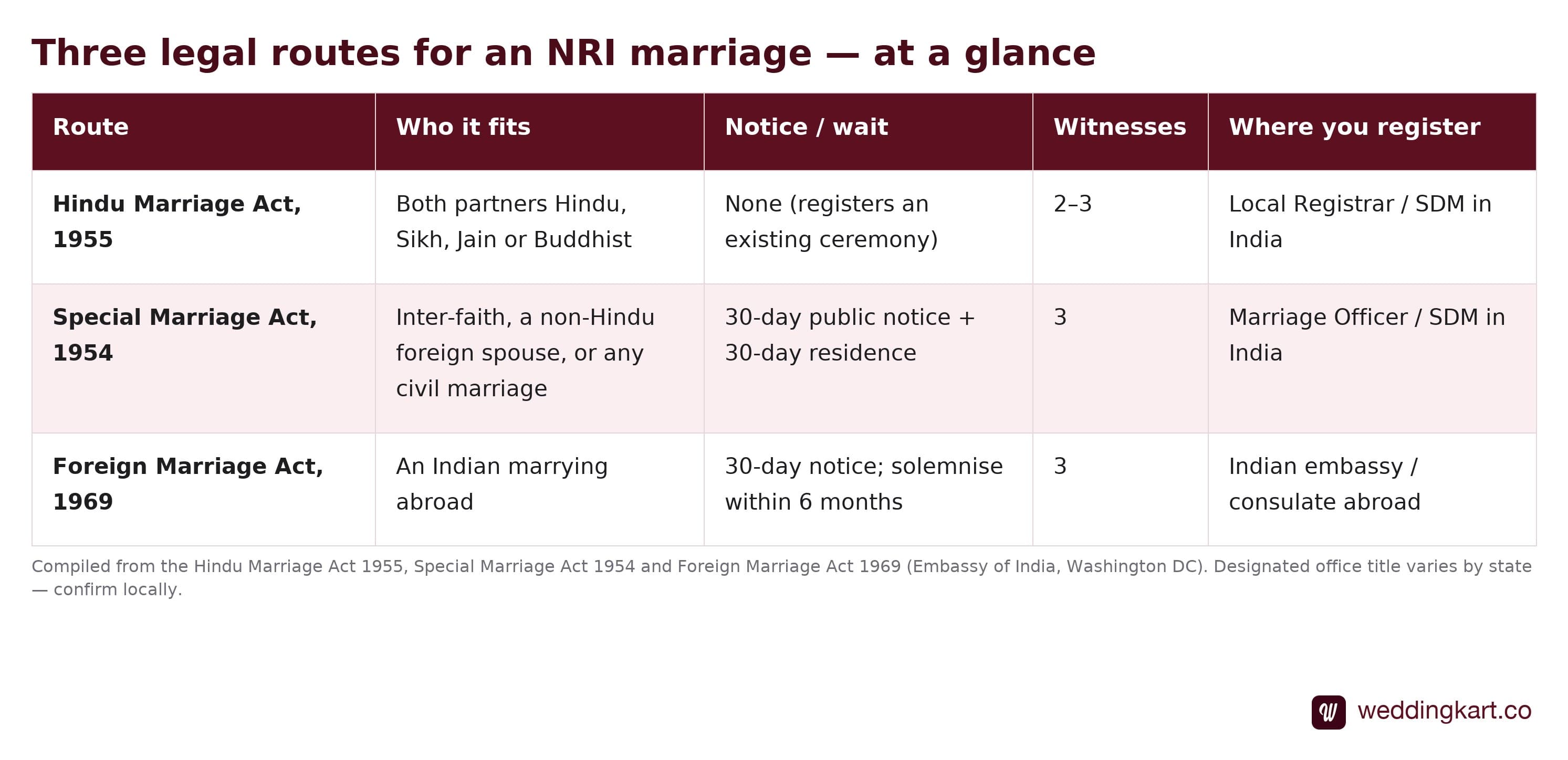
| Route | Who it fits | Notice / wait | Witnesses | Where you register |
|---|---|---|---|---|
| Hindu Marriage Act, 1955 | Both partners Hindu, Sikh, Jain or Buddhist | None (registers an existing ceremony) | 2–3 | Local Registrar / SDM in India |
| Special Marriage Act, 1954 | Inter-faith, a non-Hindu foreign spouse, or any civil marriage | 30-day public notice + 30-day residence | 3 | Marriage Officer / SDM in India |
| Foreign Marriage Act, 1969 | An Indian marrying abroad | 30-day notice; solemnise within 6 months | 3 | Indian embassy / consulate abroad |
Compiled from the Hindu Marriage Act 1955, Special Marriage Act 1954 and Foreign Marriage Act 1969. The designated office title varies by state — confirm locally.
Hindu Marriage Act — you are registering a wedding that happened
This is the point NRIs most often get wrong. Under the Hindu Marriage Act, registration does not create the marriage — the ceremony did. Section 8 of the Act provides for registration as evidence of a marriage already solemnised, and Section 7 is the section that treats the customary rites (notably the saptapadi) as what makes the marriage. Courts have been firm on this: registering a marriage where the essential rites were never performed does not make it valid, and skipping registration does not make a properly solemnised marriage invalid. In plain terms — the ceremony marries you; the certificate proves it.
Because there is no notice or waiting period, this is the faster route and the one that suits a short India trip. In Delhi, an already-solemnised Hindu marriage can often be registered within about two weeks once documents check out (IndiaFilings, Delhi procedure), though appointment queues vary. If both of you are Hindu, this is almost always the Act you want.
Special Marriage Act — a civil marriage with a real waiting clock
If you are an inter-faith couple, or one partner is a foreign national who is not Hindu, the Hindu Marriage Act is not open to you and the Special Marriage Act is the clean, secular route. But it has a timeline NRIs underestimate. You file a Notice of Intended Marriage with the Marriage Officer of a district where at least one partner has lived for 30 days; the notice is displayed publicly for 30 days so any objection can be raised; and only then is the marriage solemnised before the officer and three witnesses. Plan the 30-day notice as non-waivable: it is the statutory default, and while a few High Courts have relaxed the mandatory public-notice step in specific cases, you should not rely on a waiver for travel planning without your own legal advice or a court order.
Here is the field observation worth planning around: stack the residence requirement and the notice window and the Special Marriage Act route realistically needs five to six weeks in India for at least one partner. First-person accounts of the process are candid that it is the statutory clock — not the paperwork volume — that stretches the timeline, along with appointment scheduling friction and getting three witnesses with their own ID and address proof to turn up. You cannot fly in for a week and complete it. If your trip is short and you are eligible for the Hindu Marriage Act, that difference alone often decides the route.
Foreign Marriage Act, 1969 — marrying at an Indian consulate abroad
The route most guides forget. If the wedding is happening entirely abroad, an Indian citizen can marry — and register that marriage — at an Indian embassy or consulate under the Foreign Marriage Act, 1969, so it is recognised back home without a trip to India. The key eligibility rule is that at least one partner must be an Indian citizen, and both must meet the usual capacity conditions (age, sound mind, not within prohibited degrees of relationship). It mirrors the Special Marriage Act in spirit: a 30-day notice that is published so objections can be raised, three witnesses, and the marriage must be solemnised within six months of the notice or the notice lapses. Consular fees are modest — the Indian mission in Washington DC, for instance, lists a sample fee of US$50 plus a US$2 community-welfare contribution — but fees, forms and appointment backlogs vary by mission, so check your specific consulate. Use this route when the couple lives abroad and wants an Indian-recognised marriage without flying home; register in India instead when a full traditional wedding is happening there anyway, or when consular appointment backlogs are worse than the home registrar's.
Can NRIs register a marriage without being physically present?
Sometimes — but this is not a standard, click-to-register online right, and physical appearance remains the default. What has changed is that several High Courts now accept a video appearance where one spouse is genuinely abroad. The Delhi High Court (Justice Rekha Palli) held that the requirement of “personal appearance” for marriage registration is satisfied by appearance via video conferencing; the Kerala and Jharkhand High Courts have taken the same view, resting on the Supreme Court's Praful B. Desai principle that video conferencing amounts to real presence. In practice, an absent partner appears by video conference and gives a Power of Attorney to a trusted person in India to handle the physical filing.
The honest caveat: this is discretionary and office-by-office. In-person appearance is the safe default and every registrar accepts it. Most of these orders concern registration of an already-solemnised marriage; do not assume a video appearance will be accepted for the solemnisation step of a Special Marriage Act civil marriage, where many offices still require both parties physically present unless a court directs otherwise. The video-conference route is worth pursuing when travel is genuinely impractical — but some registrars still insist on physical presence, and you may need a High Court direction if refused. Confirm acceptance with your specific SDM or Marriage Officer before you rely on it, rather than assuming it as a right.
What documents will you need?
Exact lists vary by state and by the office you go to, but nearly every registrar asks for the same core set. Bring originals plus a set of copies for each partner:
- Proof of identity and nationality — passport for the NRI (and for the Indian partner); OCI card if you hold one.
- Proof of date of birth — passport, birth certificate, or a matriculation certificate.
- Proof of address — the NRI's overseas address and, where relevant, a local Indian address; utility bill, bank statement or rental agreement.
- Passport-size photographs of both partners.
- Proof of the ceremony (Hindu Marriage Act route) — a wedding invitation card and photographs are commonly asked for, sometimes a priest's certificate.
- Affidavits declaring marital status, date of birth and nationality, in the format the state prescribes.
- Evidence of a prior marriage ending, if either partner was married before — a divorce decree or the earlier spouse's death certificate.
For a foreign-national partner, expect three extras: a valid visa, a no-objection or single-status certificate from their country's embassy or consulate in India, and often apostilled or attested home-country documents (birth certificate, single-status proof). Any document not in English or Hindi usually needs a certified translation. Consulate rules differ, so ask the embassy early — this is the item that most often delays a foreign-national wedding. Bring several certified copies of everything; you will surrender copies to consulates, banks and name-change offices, and re-ordering from abroad is slow.
How does registration work if one spouse is a foreign citizen?
If one partner is a foreign national who is not Hindu, the Hindu Marriage Act is not open to you, so the marriage in India almost always runs through the Special Marriage Act — the same 30-day notice and 30-day residence clock applies, and it is usually the foreign partner's paperwork, not the timeline, that becomes the bottleneck. Plan for four things that a two-Indian couple never faces:
- A single-status / no-objection certificate confirming the foreign partner is free to marry, from their country's embassy or consulate in India — some missions issue it only after their own checks, which take time.
- A valid visa in the foreign partner's passport (a tourist visa is often accepted, but confirm — some offices ask about visa type).
- Apostille or attestation of home-country documents (birth certificate, single-status proof, any prior-divorce decree) before you travel — done in the home country, not in India.
- Certified translations of anything not in English or Hindi.
The one honest warning: the foreign-partner documents are the single most common reason an NRI wedding registration slips. Start the embassy no-objection certificate and any home-country apostille weeks before you fly, because you cannot fix them from a registrar's queue in India.
The process, step by step
Hindu Marriage Act (register an existing marriage):
- Have the marriage solemnised with the customary rites — the wedding itself.
- Apply to the Registrar of Marriages / Marriage Officer for your area, with the documents above and two or three witnesses (often people who attended the wedding).
- Both partners appear before the registrar — in person, or by video conference where the office allows it — and documents are verified. In many offices, verified applications are registered the same working day, though appointment queues vary.
- The certificate is issued once the marriage is entered in the register.
Special Marriage Act (a fresh civil marriage):
- File the Notice of Intended Marriage with the Marriage Officer where one partner has resided 30+ days.
- The 30-day public-notice period runs; if no valid objection is raised, you proceed.
- Both partners and three witnesses appear before the Marriage Officer; the marriage is solemnised by declaration.
- The certificate is issued and signed by the parties and witnesses.
The witnesses need their own ID and address proof. If one partner genuinely cannot travel, ask early whether the office will accept a video-conference appearance plus a Power of Attorney (see above) — do not assume it, but do not assume it is impossible either.
How much does NRI marriage registration cost?
This is where a lot of online guides quote a confident number they should not. The truth: there is no single national fee, because registration is administered state by state. What we can do is give real, sourced figures for one well-documented jurisdiction — Delhi — and label them as indicative.
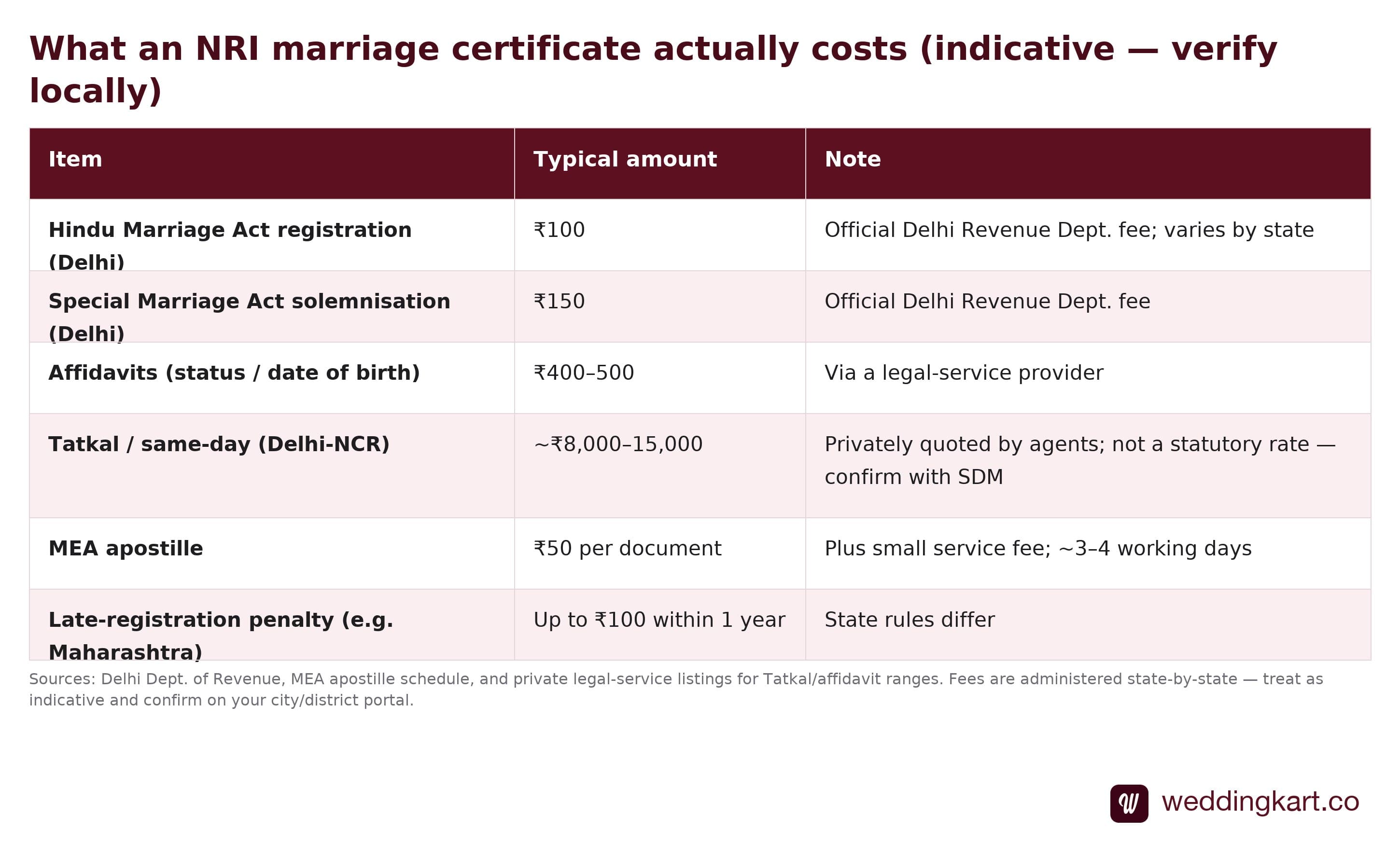
| Item | Indicative amount | Where / source type | Caveat |
|---|---|---|---|
| Hindu Marriage Act registration fee | ~₹100 | Delhi — state guidance (Dept. of Revenue) | State-set; differs by state |
| Special Marriage Act solemnisation fee | ~₹150 | Delhi — official (Dept. of Revenue) | State-set; differs by state |
| Affidavits (marital status, DOB) | ~₹400–500 | Private legal-service provider | Varies by provider |
| MEA apostille | ₹50 / document | MEA — official | Plus service-provider handling charge; ~3–4 working days |
| Tatkal (same-day) registration | ~₹8,000–15,000 | Private agent listings, Delhi-NCR | Not a fixed statutory rate — confirm with the SDM |
| Late-registration penalty | up to ₹100 | Maharashtra — state rule (within 1 year) | State-specific; some states are stricter |
Indicative only. There is no single national fee — registration is administered state by state, so confirm the current amount on your city or district portal before you plan.
Delhi's marriage-registration guidance puts it at roughly ₹100 for a Hindu Marriage Act entry and ₹150 for Special Marriage Act solemnisation (Delhi Dept. of Revenue). Affidavits through a legal-service provider run about ₹400–500. Later, an MEA apostille is ₹50 per document (plus a small service-provider handling charge), typically issued in about 3–4 working days (Ministry of External Affairs). Same-day “Tatkal” registration is privately quoted far higher — agents cite roughly ₹8,000–15,000 in Delhi-NCR (private legal-service listings) — but that is a private agent charge, not a government fee, so do not treat those quotes as an official rate; confirm directly with the SDM. And if you are registering long after the wedding, check the state's late-registration rule (Maharashtra, for example, allows it within a year on a penalty of up to ₹100) rather than assuming you have missed the window.
The only firm rule to plan around is the statutory clock: the Hindu Marriage Act has no waiting period, while the Special Marriage Act's 30-day notice should be planned as non-waivable on top of the 30-day residence requirement. Beyond that, do not trust a specific figure from any article — this one included. Check the current fee and process on your state's registration portal, or ask the local Marriage Registrar / SDM directly, before you book flights.
Do I need an apostille or embassy attestation?
Here is the single most important distinction for NRIs — and the one a lot of pages get wrong by treating “apostille” and “attestation” as the same thing. The rule, in one line:
Apostille (a single MEA stamp) for Hague Apostille Convention countries — the US, UK, Canada, most of Europe, Australia, and — in the Gulf — Saudi Arabia, Bahrain and Oman. Full embassy attestation (a longer, multi-step chain) for the UAE, Kuwait and Qatar, which are not Hague members. Saudi Arabia only joined in December 2022, so older guides still list it on the attestation side — check with the destination authority, as some Gulf offices ask for extra attestation for certain uses.
India joined the Hague Apostille Convention in 2005, and it now has well over a hundred contracting parties, so for most Western destinations a single apostille from the Ministry of External Affairs is all your certificate needs. But a large share of the NRI audience is Gulf-based, and there the picture is split: for the UAE, Kuwait or Qatar — none of them Hague members — an apostille alone will usually be rejected, and those certificates need the embassy-attestation route instead. Saudi Arabia changed sides in December 2022, when the Apostille Convention entered into force for it (HCCH status table), so an MEA apostille is now generally accepted there, as it already is for Bahrain and Oman. Membership and local practice both change, so confirm the current requirement with the destination country's consulate before you file. Even where an apostille replaces legalisation, the receiving authority can still ask for a certified translation, a recent issue date, or other supporting documents. One practical note: an apostille itself does not usually expire, but the receiving authority may want a recently issued certificate — so check the visa or consulate checklist rather than apostilling years early. We cover the mechanics in the companion guide on getting an Indian marriage certificate apostilled.
Why registering promptly actually matters
Beyond the visa admin, there is a protective reason to have a registered, provable marriage — and it is not fear-mongering, it is government data. The Ministry of External Affairs has reported 1,617 complaints from NRI women alleging abandonment by their spouses over a five-year span, and roughly 6,094 NRI-marriage grievances recorded between January 2015 and October 2019, with Punjab alone accounting for around 14% (government data). A registered marriage is not a guarantee against a bad partner, but it is the document that makes a spouse's rights enforceable across borders — for maintenance, for a visa, for a bank account, for proof that the marriage existed at all.
The law may also tighten. The Registration of Marriage of Non-Resident Indian Bill, 2019 — introduced in the Rajya Sabha and referred to a standing committee — proposes making registration of an NRI marriage compulsory within 30 days, with passport impounding for default. It has not been enacted, but it signals the direction of travel: the informal “we'll register it later” habit is a shrinking luxury.
Where you register, and the certificate you walk away with
You register with the marriage-registration authority for the area — but the title of that office varies by state. A rough map of who handles it where:
- Delhi — the SDM (Sub-Divisional Magistrate) office, via the Delhi e-District portal.
- Maharashtra (Mumbai, Pune) — the Registrar of Marriages at the municipal / local body, with much of the flow on the Aaple Sarkar portal.
- Karnataka (Bengaluru) — the Sub-Registrar under the Registration Department (Kaveri Online Services).
- Tamil Nadu (Chennai) — the Sub-Registrar / Registrar of Marriages, with online services on the state registration portal.
- Kerala — the Local Self-Government registrar for the panchayat or municipality.
- Punjab — the SDM / Tehsil-level Marriage Registration Officer, via the state e-services portal.
Treat that as a starting point, not a rule: office titles, portals and the exact online-vs-in-person split change, so search for your specific city or district's marriage-registration page and confirm the current process before you file.
What you get at the end is the marriage certificate — the single document that matters most for an NRI. It is your legal proof of marriage for a spouse or dependent visa, for an OCI application, for a name change, for joint accounts and insurance, and for immigration abroad. Order several certified copies at registration; you will hand them out more than you expect. We cover the next stage — the spouse visa and OCI — in applying for a spouse visa or OCI after an NRI marriage.
One thing off the legal checklist: the guests
The registration is the legal half of an NRI wedding. The other half is the logistics — because your guest list is spread across the Gulf, the US, the UK and half of India, each set arriving on different flights, needing hotels, RSVPs and travel details. That coordination is what Weddingkart handles on WhatsApp: multi-event RSVPs, travel and ID collection, and per-guest hotel details, in Hindi, English and regional languages, with no app for guests to install.
To be clear about where it is not the answer: Weddingkart does nothing for the legal paperwork above, it is not a card designer, and a small single-event wedding does not need it. It earns its place only once the guest count and the number of events make manual coordination painful. If that is your wedding, the destination-wedding communication timeline is the companion piece to this one.
Planning an NRI or destination wedding and want the guest side handled? WhatsApp us at +91 92176 10045.
The bottom line
Start with the two questions that unlock the rest: are both of you Hindu, and where is the wedding happening? Both Hindu, marrying in India → the Hindu Marriage Act lets you register the wedding you already had, fast, on a short trip. Inter-faith or a non-Hindu foreign spouse → the Special Marriage Act, and block out five to six weeks in India for the notice and residence rules. Marrying abroad → the Foreign Marriage Act at an Indian consulate. If neither of you can fly in, ask about a video-conference appearance with a Power of Attorney before assuming a trip is unavoidable. Carry passports, address and age proof, photos, and (for a foreign national) an embassy no-objection certificate. Get the certificate — then apostille it for the West (and for Saudi Arabia, Bahrain and Oman), or embassy-attest it for the non-Hague Gulf states — the UAE, Kuwait and Qatar. And don't trust a specific fee or timeline from any single page; the rules vary by state, so confirm with your local Marriage Registrar or SDM.
This guide is general information, not legal advice. Marriage registration is administered state by state and consulate rules change; fees, timelines and apostille or attestation requirements vary and can be revised. Verify the current process and documents with the registrar, SDM or consulate for your case before you act.
Further watching
- NRI + foreigner court marriage in India — embassy rules, NOC and same-day certificate — Delhi Law Firm (YouTube)
- Process of registration of marriage of an NRI — Law Media — Sai Krishna Azad (YouTube)
- Court marriage process in India — my experience (Special Marriage Act) — Satshya Tharien (YouTube)
Practitioner walkthroughs and a first-person Special Marriage Act account — useful colour, but confirm anything specific against the official portal, as procedures change.
Frequently asked questions
Which law should an NRI use to register a marriage in India?+
It is set mainly by religion and by where you marry, not by your passport. If both partners are Hindu (which the law reads to include Sikh, Jain and Buddhist), you register the ceremony you already had under the Hindu Marriage Act, 1955 — an NRI or OCI Hindu can usually use this route, though NRI/foreign-citizen edge cases are worth checking with the registrar, since domicile and state rules can matter. If the couple is inter-faith, or one partner is a non-Hindu foreign national, or you simply want a civil marriage, you use the Special Marriage Act, 1954, with its 30-day notice. And if the wedding is happening entirely abroad, you can register at an Indian embassy or consulate under the Foreign Marriage Act, 1969. The designated office and forms differ by state and mission, so confirm your exact route with the local Marriage Registrar / SDM or your consulate.
Is marriage registration mandatory in India?+
Effectively, yes. In Seema v. Ashwani Kumar (2006) the Supreme Court directed that registration of marriages of all citizens, of every religion, be made compulsory, and asked the states to frame the procedure. Personal law still treats a properly solemnised Hindu marriage as valid even before registration, but the certificate is what any consulate, immigration office, bank or name-change desk will demand as proof — so for an NRI it is not optional in practice.
Can NRIs register a marriage in India without being physically present?+
Increasingly, yes — though it is discretionary, not guaranteed. The Delhi High Court (Justice Rekha Palli) held that the requirement of "personal appearance" for marriage registration is satisfied by appearance via video conferencing, and the Kerala and Jharkhand High Courts have taken the same view, resting on the Supreme Court’s Praful B. Desai principle that video conferencing amounts to real presence. In practice an absent partner can appear by video conference and give a Power of Attorney to handle the filing. But acceptance varies office to office; some registrars still insist on in-person appearance and you may need a High Court direction if refused, so confirm with your specific registrar before relying on it.
Do NRIs need to spend 30 days in India to register a marriage?+
Only on the Special Marriage Act route. There, the Notice of Intended Marriage requires at least one partner to have resided in that district for 30 days, and a further 30-day public-notice window runs before the marriage can be solemnised — realistically about five to six weeks in the country for one of you. The Hindu Marriage Act route has no notice period; registering a ceremony that has already happened can be far quicker, which is why a short India trip usually points a Hindu couple to that Act. Appointment queues still vary by state.
What documents does a foreign-national spouse need?+
On top of the usual proofs — passport, address proof, photos and a date-of-birth document — a foreign national is normally asked for a valid visa or OCI card and a no-objection or single-status certificate from their country’s embassy or consulate in India, confirming they are free to marry. Home-country documents such as a birth certificate or single-status proof often need to be apostilled or attested first, and anything not in English or Hindi usually needs a certified translation. If either partner was married before, carry the divorce decree or the earlier spouse’s death certificate. Consulate rules differ, so start this early — it is the item that most often delays a foreign wedding.
Do I need an apostille or embassy attestation for the certificate?+
It depends on the destination country. For members of the Hague Apostille Convention — the US, UK, Canada, most of Europe and Australia — a single MEA apostille is enough. The Gulf is more split than most guides admit: the UAE, Kuwait and Qatar are NOT Hague members, so certificates bound for them usually need the longer embassy-attestation chain, not an apostille. But Saudi Arabia, Bahrain and Oman ARE Hague parties — Saudi Arabia joined in December 2022 — so an apostille is generally accepted there, though some Gulf authorities still ask for extra attestation for specific uses. Confirm the current requirement with the destination country’s consulate, since membership and local practice change.
How much does NRI marriage registration cost in India?+
The statutory fee is small and set by each state — Delhi, for example, charges about ₹100 for a Hindu Marriage Act entry and ₹150 for Special Marriage Act solemnisation. Add affidavits (roughly ₹400–500 through a legal-service provider), and an MEA apostille later at ₹50 per document. Same-day "Tatkal" registration is privately quoted far higher (agents cite roughly ₹8,000–15,000 in Delhi-NCR) and is not a fixed statutory rate. There is no single national fee, so treat these as indicative and confirm the current amount on your city or district portal.
What is the Foreign Marriage Act, 1969?+
It is the law that lets an Indian citizen marry — and register that marriage — at an Indian embassy or consulate abroad, so it is recognised back home without a trip to India. Like the Special Marriage Act it carries a 30-day notice and needs three witnesses, and the marriage must be solemnised within six months of the notice or the notice lapses. Consular fees are modest (the Indian mission in Washington DC, for instance, lists a sample fee of US$50 plus a US$2 community-welfare contribution), but they and the paperwork vary by mission, so check your specific consulate.
Is a temple or religious wedding legally valid without registration?+
A Hindu ceremony performed with the essential rites (including the saptapadi, the seven steps) can be a valid marriage under personal law even before you register it. But validity and proof are two different things: a foreign consulate, an immigration officer, a bank or a name-change office will ask for the government-issued certificate, which you only get by registering. So the ceremony may make you married — registration is what makes it provable across borders.
Can I register my marriage years after the wedding?+
Often yes, though the rule is state-specific. Several states allow late registration on payment of a small penalty — Maharashtra, for example, permits it within a year for a penalty of up to ₹100 — while others are stricter. Don’t assume you have missed the window; check your state’s late-registration rule. Note too that the proposed Registration of Marriage of Non-Resident Indian Bill, 2019 would require an NRI marriage to be registered within 30 days, so the informal "we’ll do it later" habit may not survive if that law passes.
Can two NRIs register their marriage in India?+
Yes. If both partners are Hindu (which the law reads to include Sikh, Jain and Buddhist) and the ceremony took place in India, they register it under the Hindu Marriage Act; if the marriage is inter-faith or civil, the Special Marriage Act applies, though its 30-day notice needs one partner resident in that district for 30 days first. Being an NRI or OCI does not bar either route — what decides it is religion and where the ceremony is held, not the passport. If neither of you can be in India for long, ask the registrar about a video-conference appearance with a Power of Attorney, and confirm the exact forms with the local Marriage Registrar or SDM.
Can an OCI cardholder register a marriage under Indian marriage laws?+
Usually yes, but confirm the specific route. An OCI cardholder who is Hindu can register a Hindu ceremony held in India under the Hindu Marriage Act, and an OCI cardholder in an inter-faith or civil marriage uses the Special Marriage Act. The Foreign Marriage Act — marrying at an Indian consulate abroad — is different: it requires at least one partner to be an Indian citizen, which an OCI cardholder is not, so it may not be open to two OCI holders. Because applicability can turn on citizenship and domicile, confirm with the registrar or a lawyer before you file.
Is an Indian marriage certificate valid abroad without an apostille or attestation?+
For official cross-border use — a spouse or dependent visa, immigration, a name change abroad — usually not on its own. A domestic certificate proves the marriage within India, but foreign authorities normally want it legalised first: an MEA apostille for Hague Apostille Convention countries (the US, UK, most of Europe, Australia, and — in the Gulf — Saudi Arabia, Bahrain and Oman), or full embassy attestation for non-Hague states such as the UAE, Kuwait and Qatar. Requirements change, so check the destination consulate’s checklist before relying on the plain certificate.
Can NRI marriage registration be done fully online?+
Not as a straightforward click-to-register process. Several states take part of the application online — you can often fill the form and book an appointment on the state portal — but at least one appearance before the registrar is still the norm, and the certificate is issued after that. What has changed is that some High Courts now allow an absent spouse to appear by video conference, which is not the same as an all-online registration and is granted office by office. Treat physical appearance as the default and confirm any remote option with your specific registrar.
Is court marriage the same as marriage registration?+
Not quite — people use "court marriage" loosely for two different things. A true court marriage is a fresh civil marriage solemnised before the Marriage Officer under the Special Marriage Act, with the 30-day notice. Registering an already-performed Hindu ceremony under the Hindu Marriage Act is a different act — it records a marriage that has already happened, with no notice period. Both end in a government marriage certificate; which one applies depends on whether you are creating a civil marriage or registering a religious one.
What if we married abroad but not at an Indian consulate?+
If you had a local civil or religious marriage abroad rather than one under the Foreign Marriage Act at an Indian mission, you generally rely on the foreign marriage certificate, legalised for use in India (apostille if the country is a Hague member, otherwise attestation), rather than re-registering it in India. Rules vary by state and by what you need it for, so confirm with the registrar or the Indian mission whether the foreign certificate is accepted directly or needs any further step.
Sources
Legal and fee figures below are third-party or state-specific and change — treat every fee, timeline and apostille/attestation rule as indicative and confirm on the official portal (MEA, your state registrar, or the relevant consulate) before acting.
- 1. The Special Marriage Act, 1954 (full text) — India Code, Legislative Department
- 2. Apostille Convention — status table (contracting parties, incl. Saudi Arabia, Bahrain, Oman) — HCCH (Hague Conference on Private International Law)
- 3. Registration of Marriage — process, documents and fees — Government of NCT of Delhi, Dept. of Revenue
- 4. Delhi marriage registration — procedure, charges and timelines (HMA vs SMA) — IndiaFilings
- 5. Marriage under the Foreign Marriage Act, 1969 — consular process, fees, witnesses — Embassy of India, Washington DC
- 6. The Foreign Marriage Act, 1969 (full text) — National Commission for Women
- 7. Apostille and attestation — fees, RPO cities and process — Ministry of External Affairs
- 8. Apostille attestation in India — fees, procedure and documents — PEC Attestation (industry guide)
- 9. Personal appearance for marriage registration includes video conferencing — Delhi High Court — LiveLaw
- 10. Case analysis: Seema v. Ashwani Kumar (2006) — compulsory registration of all marriages — LegalBites
- 11. The Registration of Marriage of Non-Resident Indian Bill, 2019 — tracker and brief — PRS Legislative Research
- 12. Over 1,600 NRI wives abandoned overseas — government data — New India Abroad (citing MEA)
- 13. How to obtain a Tatkal (urgent) marriage certificate in Delhi-NCR — eStartIndia (private legal service)
Related reading
How to Get an Indian Marriage Certificate Apostilled →
The apostille-vs-attestation step that makes your certificate usable abroad.
Spouse Visa & OCI After an NRI Marriage →
What the certificate unlocks — the next paperwork stage.
NRI & Gulf Families: Running an Indian Wedding from Abroad →
Coordinating a wedding across time zones and passports.
Destination Wedding Communication Timeline →
When to send every guest update across the run-up to the wedding.
Was this article helpful?
Share