
Quick Answer
Can a foreign spouse get an Indian visa and OCI after an NRI marriage?
India issues no visa officially called a “spouse visa.” A foreign husband or wife first travels on an Entry (X) visa, and becomes eligible for OCI only once the marriage has been registered and has subsisted continuously for at least two years — with prior security clearance and a mandatory interview. The official OCI fee is US $275 per applicant abroad (the rupee equivalent inside India); a standard case issues in about 30 days, but spouse files commonly take three to six months. Some Indian mission checklists say the spouse card is then renewed every five years. Immigration rules change often — confirm current requirements on ociservices.gov.in and with your Indian consulate before you file.
Last updated:
OCI, Spouse Visa & Name Change After an NRI Marriage
This is an informational guide compiled and checked against the OCI Services portal, Ministry of Home Affairs and Ministry of External Affairs material, and Indian mission guidance on 2 July 2026 — it is not legal advice, and no lawyer has reviewed it. Rules on fees, timelines and eligibility change; for a case-specific answer, use the issuing Indian mission or an immigration lawyer.
Search “India spouse visa” and you will find plenty of pages happy to sell you one. Here is the catch: India does not issue a spouse visa. The document a foreign husband or wife actually travels on is called an Entry Visa — an “X” visa in the consulate's own shorthand — and the card everyone is really chasing, the OCI, sits behind a two-year wall that no amount of paperwork can shortcut.
That gap between what couples search for and what the government actually issues is where the first few weeks after an NRI wedding quietly disappear. So one honest caveat this whole guide is built around: Indian immigration rules move, and 2026 proved it. Around 8 April 2026 the government dropped the six-month in-country residence rule for filing OCI inside India and held the application fee at US $275; immigration advisers and news outlets also report a new US $25 penalty for not updating passport details on the OCI portal within three months of a new passport (Business Standard). Treat everything below as a map of the terrain, not the final word. The final word lives on ociservices.gov.in, on your country's Indian consulate site, and at the BLS or VFS Global centre that takes your file.
US $275
OCI fee per foreign-spouse applicant
Source: OCI Services (MHA) FAQ
2 years
Continuous registered marriage before you can apply
Source: Citizenship Act, sec 7A
30 days → 3–6 months
Standard OCI issue vs spouse security clearance
Source: OCI FAQ / NRI Information
Every 5 years
Spouse-card renewal per mission checklists (e.g. Colombo)
Source: High Commission, Colombo
What visa does a foreign spouse use to enter India before OCI?
Answer first: the Entry (X) visa. For the stretch before OCI eligibility kicks in, this is the instrument. India grants it to a foreign national married to an Indian passport holder or to an OCI/PIO cardholder, along with dependent children (Ministry of External Affairs). It authorises the spouse to reside with their partner in India — it is not a work permit, and taking a job needs separate authorisation. It is the single most common route for a newly married foreign spouse to live in India, and it is the thing people mean when they say “spouse visa,” even though that name appears nowhere on the form.
The paperwork the mission typically wants is short and predictable:
- Proof of the marriage. A marriage certificate in English, attested by the relevant state home department or an Indian mission — or the foreign spouse's name endorsed in the Indian partner's passport. This is exactly why registering the marriage properly is not optional busywork: every visa and OCI step downstream reads off that one certificate.
- The Indian spouse's passport (and, where relevant, their OCI/PIO card).
- The applicant's own passport, valid well beyond the trip, plus the standard photographs and forms.
On validity, be careful with the round numbers floating around online. Entry (X) visas for spouses are generally multiple-entry with one-to-five-year validity, and you will see “up to five years” quoted a lot — but the exact length, and whether it can be extended or converted once you are in India, is the issuing mission's call and is tied to your documents. Treat any number you read, including that one, as indicative and confirm it with your consulate. One duty that is easy to miss: if your stay will run past 180 days, you must register with the FRRO within 14 days of arrival (MHA)— a step, as we will see, that OCI holders skip entirely. The apply-side portal for reference is indianvisaonline.gov.in.
What is OCI, and why is it the real destination?
OCI — Overseas Citizenship of India — is the prize because it ends the visa treadmill. It is not dual citizenship (India does not allow that), but a valid OCI card with a valid foreign passport lets the holder enter India for life, on multiple visits, with no separate visa. It also puts the holder on par with NRIs for a defined set of things — buying and selling most immovable property, inter-country adoption, sitting entrance tests like NEET or JEE against NRI seats, and practising as a doctor, dentist, nurse, pharmacist, advocate, architect or chartered accountant (OCI Services FAQ). The parity is bounded, though, not total. The exceptions worth memorising: OCI holders cannot buy agricultural land, a farm house, or plantation property, cannot take up government service (except where the Centre specifically allows it), and do not get the vote.
For a foreign spouse, though, eligibility has a firm gate. In the government's own words, the spouse of foreign origin of an Indian citizen (or of an OCI cardholder) qualifies where “the marriage has been registered and subsisted for a continuous period of not less than two years immediately preceding the presentation of the application” (OCI Services FAQ). Read that literally. Two years, registered, continuous, counted right up to the day you apply. File a day early and the application is liable to be returned. On top of the clock, three more conditions apply: the case goes through a prior security clearance, there is a mandatory personal interview at the mission or FRRO during document verification (Consulate General of India, San Francisco), and you sign a declaration to surrender the OCI if the marriage ends in divorce or separation.
Some bars sit outside the two-year clock entirely — they disqualify you no matter how long the marriage has lasted. Check these early, because no amount of documentation moves them (OCI Services FAQ):
- Pakistani or Bangladeshi ancestry. Anyone whose parents, grandparents, or great-grandparents is or was a citizen of Pakistan or Bangladesh (or another country the government specifies by notification) is not eligible.
- Foreign military or police service. On the spouse route, having undergone — or currently undergoing — foreign military or police conscription blocks the application. The FAQ carves out only limited exceptions (short compulsory conscription) considered case by case after interview.
- Refugee or stateless status. Refugees and stateless applicants are not eligible to be registered as OCI cardholders, including on the spouse basis.
The documents you will assemble
The exact checklist varies by consulate, but the spine is consistent across missions:
- The applicant's foreign passport, valid several months beyond the application, plus a copy of the bio page.
- Proof of present nationality — the passport, and a naturalisation or citizenship certificate where the applicant naturalised.
- The marriage certificate — attested or apostilled and translated into English if needed.
- Proof of the spouse's Indian status — their current Indian passport, or their OCI card plus the basis documents behind it.
- A police clearance certificate where the mission requires one, and recent passport photographs and signature in the specified format.
- If filing inside India: a long-duration visa (not Tourist, Missionary or Mountaineering) with at least three months' validity, plus the residential permit or registration certificate from the jurisdictional FRRO/FRO.
- Originals for verification at the mandatory interview.
Where the certificate was issued decides who attests it — the foreign country's authorities and the nearest Indian mission if you married abroad, or the state home department if you married in India. Get that attestation chain right the first time; it is the single most common reason a spouse OCI file bounces.
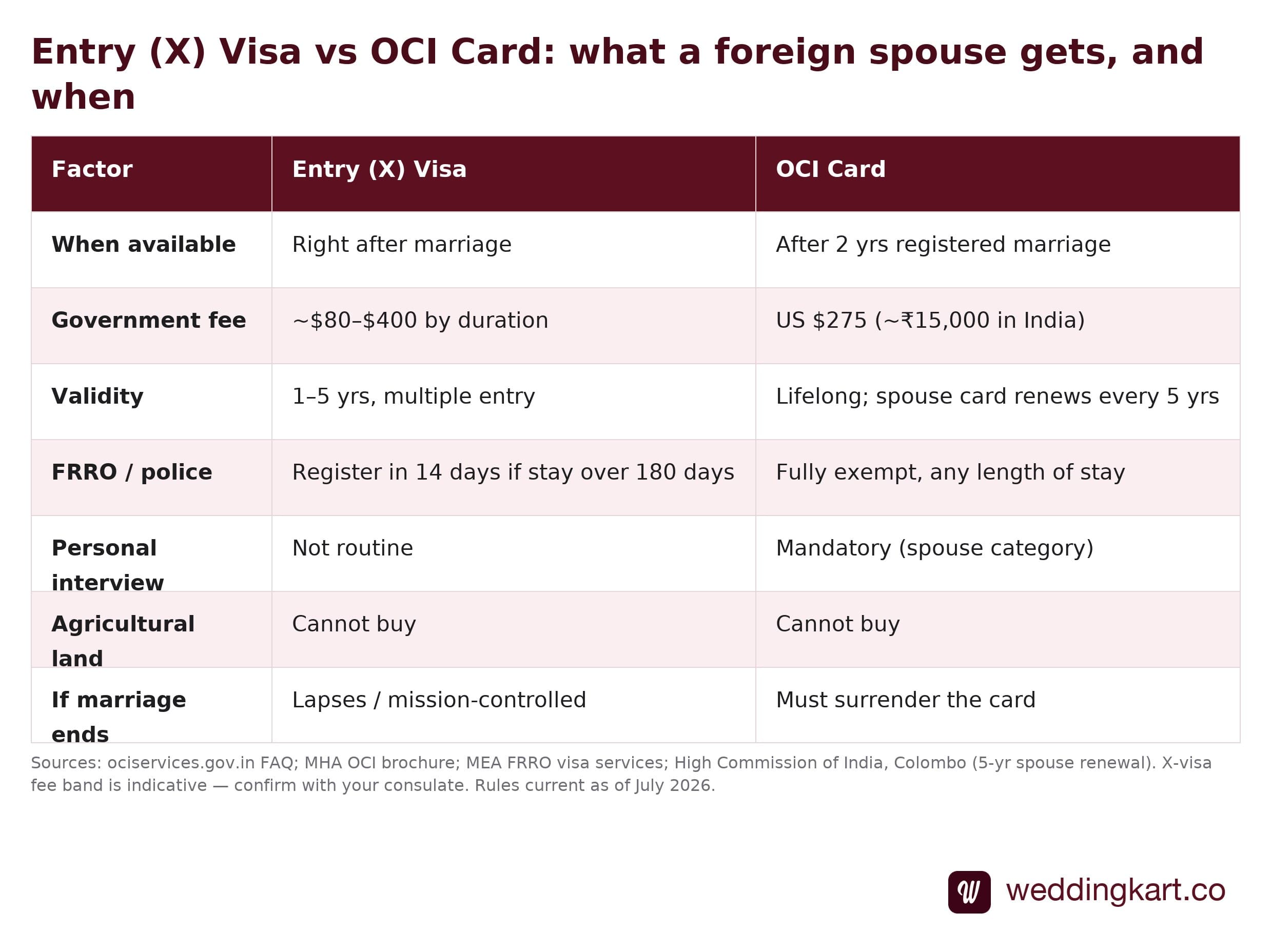
| Factor | Entry (X) Visa | OCI Card |
|---|---|---|
| When available | Right after marriage | After 2 yrs registered marriage |
| Government fee | ~$80–$400 by duration | US $275 (~₹15,000 in India) |
| Validity | 1–5 yrs, multiple entry | Lifelong; spouse card renews every 5 yrs |
| FRRO / police | Register in 14 days if stay over 180 days | Fully exempt, any length of stay |
| Personal interview | Not routine | Mandatory (spouse category) |
| Agricultural land | Cannot buy | Cannot buy |
| If marriage ends | Lapses / mission-controlled | Must surrender the card |
Sources: ociservices.gov.in FAQ; MHA OCI brochure; MEA FRRO visa services; High Commission of India, Colombo. X-visa fee band is indicative — confirm with your consulate. Rules current as of July 2026.
Where does a foreign spouse apply for OCI — the mission or the FRRO?
Answer: it depends where you are ordinarily resident. If you live outside India, you apply at the Indian Mission or Post that has jurisdiction over the country you ordinarily reside in. If you are already in India on a long-duration visa — an Entry (X), employment, business, student or research visa — you file from inside the country, routed through the Foreigners Regional Registration Office (FRRO) of the area where you are staying (OCI Services FAQ). One firm limit: you cannot file the OCI application from within India while on a Tourist, Missionary or Mountaineering visa — the in-India route needs a long-duration visa with at least three months' validity and your FRRO registration papers. This jurisdiction question is exactly the kind of detail couples get wrong, so match your residence to the right desk before you start the form.
Here is the whole spouse-OCI rulebook compressed to one reference, each row tied to where it comes from:
| Rule | What it means in practice | Source |
|---|---|---|
| No “spouse visa” | A foreign spouse enters on an Entry (X) visa; India issues no product with that name | MEA / FRRO |
| Two-year rule | Marriage registered and continuously subsisting for ≥2 years before you apply | OCI FAQ (sec 7A) |
| Security clearance | Every spouse file routes through prior MHA clearance | OCI FAQ |
| Personal interview | Mandatory in-person interview at document verification | CGI San Francisco |
| Fee | US $275 per applicant abroad; rupee equivalent inside India | OCI FAQ |
| Filing inside India | Needs a long-duration visa (not Tourist / Missionary / Mountaineering) plus FRRO registration | OCI FAQ |
| FRRO exemption | No registration for any length of stay; residents only email FRRO on address/occupation change | OCI FAQ / MHA brochure |
| Absolute bars | Pakistani or Bangladeshi ancestry; refugee/stateless; foreign military or police service | OCI FAQ |
Sources: OCI Services FAQ (ociservices.gov.in); MHA OCI brochure; MEA FRRO visa services; Consulate General of India, San Francisco. Rules current as of July 2026 — confirm before you file.
How much does OCI cost for a foreign spouse?
Answer: US $275 per applicant at an Indian mission (or the local-currency equivalent). Filed inside India it is paid as the rupee equivalent, widely reported around ₹15,000 (OCI Services FAQ). The 2026 rule refresh held that $275 figure steady (Business Standard). For context, the Entry (X) visa you travel on first is cheaper up front — roughly $80 to $400 depending on duration — but it expires, needs renewing, and can trigger FRRO registration; OCI does none of that. Fees change and vary by mission, so confirm the current amount on ociservices.gov.in and your consulate before you pay.
How long does a spouse-category OCI take?
Answer: budget months, not weeks. A standard OCI is usually issued in about 30 days from acknowledgement, but spouse-category files route through Ministry of Home Affairs security clearance and that mandatory interview, and commonly take three to six months or longer (NRI Information). This is the single biggest expectation-setter couples miss: the two-year clock is not the finish line, it is the starting gun for a clearance process that runs on its own calendar. Plan travel and any deadlines around the longer window, and track your file's status on the portal rather than assuming the 30-day figure applies to you.
Does a foreign spouse have to renew their OCI card?
Answer: yes — and this is where the word “lifelong” misleads for spouses. Official High Commission guidance is blunt about it: “Spouse category OCI valid only 5 years only. It has to be renewed after every 5 years with supporting documents along with declaration/Certificate of marriage subsisting as on the date of submission” (High Commission of India, Colombo). Be precise about the nuance here, because it is where the government's own wording pulls in two directions: the central OCI FAQ describes the card's core benefit as a lifelong visa, while mission checklists like Colombo's state plainly that the spouse-category card is valid five years and renewed every five. Treat the five-year renewal as mission-sensitive and confirm it with the post that issued (or will issue) your card. Either way, diarise the renewal and keep proof that the marriage is still subsisting — joint documents, photos, cohabitation evidence — because the renewal asks for it, just as the security clearance and interview did.
Separate from that renewal is the passport-re-issue rule, which trips up even descent-based OCI holders. The OCI booklet must be re-issued each time the passport changes up to age 20, then once more on the first new passport after 20, and once after 50; between 21 and 50 you simply carry the old passport the OCI was issued against alongside the new one (CGI San Francisco). And under the 2026 rules, you are expected to update passport details on the portal within three months of a new passport — advisers report a $25 penalty for missing it, which is worth confirming on the portal.
Does an OCI holder need to register with the police or FRRO?
Answer: no — an OCI holder is exempt from FRRO or police registration, for any length of stay (MHA OCI brochure). One caveat that gets lost: an OCI holder who is normally resident in India must still email the jurisdictional FRRO/FRO whenever their permanent residential address or their occupation changes (OCI Services FAQ)— it is an intimation, not the periodic registration a visa holder files. Even with that, the contrast is stark. On the Entry (X) visa, a stay beyond 180 days means registering with the FRRO within 14 days of arrival and keeping that registration current; on OCI, you walk in and out of the country for the rest of your life with nothing to file beyond that address/occupation intimation. If you plan to live in India long-term, that difference alone is worth the wait.
What changed in India's 2026 OCI rules?
The refresh that took effect around 8 April 2026 is worth knowing precisely, because it changes the “where do I apply” calculus:
- Six-month in-country stay rule removed. Previously you generally needed a continuous six-month residence in India to file OCI from within the country; that requirement was dropped, making it far easier for couples already settled in India to apply locally (VisaVerge). Read this narrowly: it is about filing from inside India through the FRRO. A separate “ordinarily resident” six-month test can still apply if you apply through a third-country mission that is not your country of citizenship.
- $275 fee held steady. The application fee was fixed rather than raised.
- A reported $25 passport-update penalty. Immigration advisers and news outlets report a USD 25 penalty for failing to update your passport details on the OCI portal within three months of getting a new passport (Fragomen). This one is media- and adviser-sourced rather than quoted from a single official notification here, so confirm the current penalty and deadline on the OCI portal before you rely on it.
These are exactly the kind of specifics that go stale — and the dates and amounts above lean on reputable immigration-law and news coverage rather than a Gazette notification we have linked. Treat them as of mid-2026 and re-check ociservices.gov.in before you act on them.
Name change: two people, two completely different processes
This is the part that trips couples up, because “changing your name after the wedding” sounds like one task and is really two — governed by two different legal systems. Which one applies depends entirely on whose passport you are changing.
If the Indian citizen is changing their name (say, adopting a spouse's surname), that runs through India's standard three-step route: a notarised affidavit on stamp paper stating the old name, new name and reason; a newspaper announcement, conventionally in one English and one regional-language paper; and a Gazette of India notification via the Department of Publication at egazette.gov.in, which banks, the passport office and Aadhaar treat as proof. The government publication fee is modest and fixed by the Department of Publication; the bulk of what people quote — commonly a total of ₹7,000 to ₹15,000, with the Gazette entry itself taking about one to two months (name-change service guides) — is agent and notary charges, not the state fee. Both vary, so treat the range as indicative and check the department's current schedule directly.
If the foreign spouse is changing their name, none of the above applies to them. India's gazette process is for Indian documents. A foreign national changes their legal name under their own country's law — a deed poll in the UK, a court order in much of the US, a marriage-certificate route elsewhere — and then updates their home passport. Only after the passport carries the new name do you touch the Indian side: the OCI card and any visa must be re-issued so they match the passport exactly.
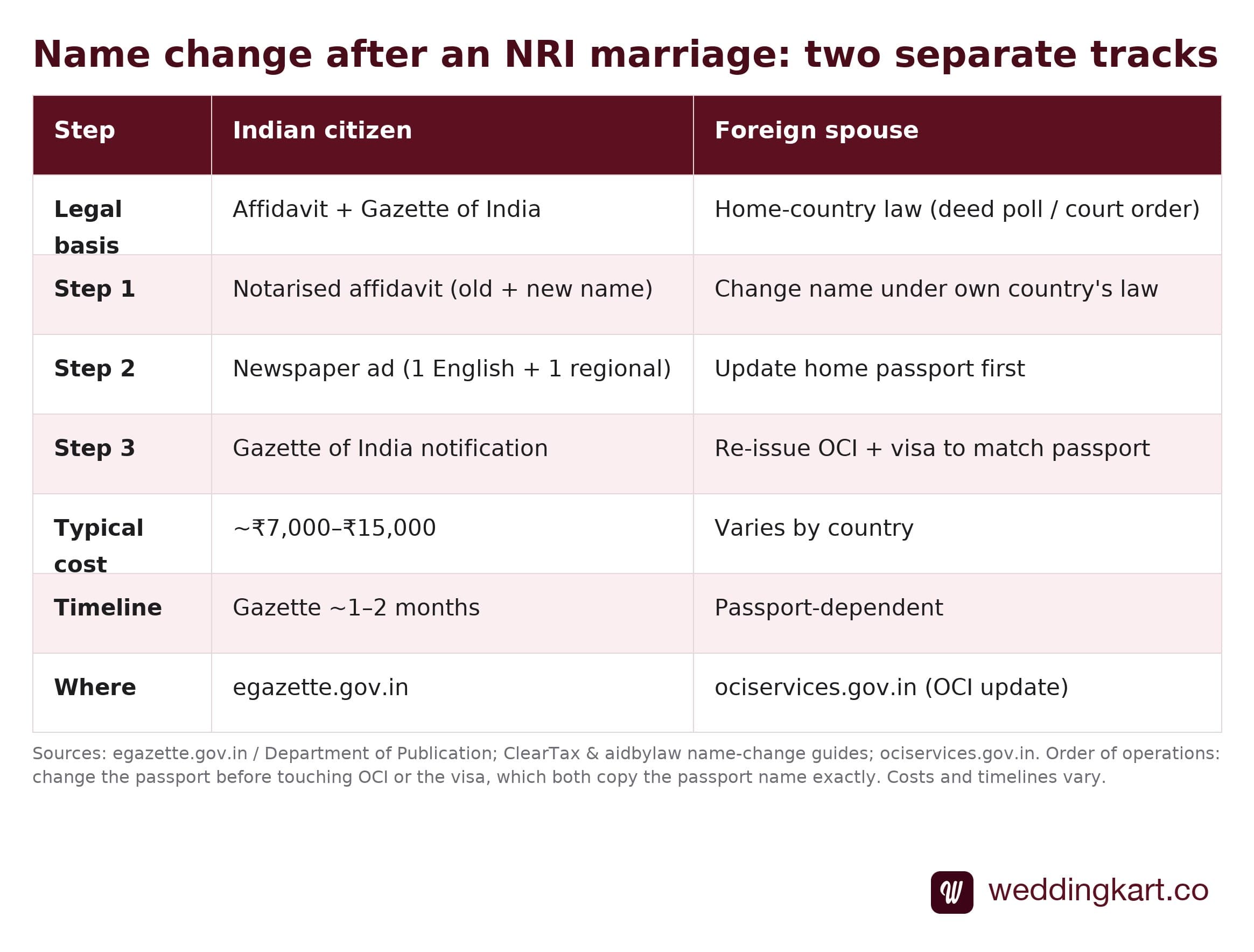
| Step | Indian citizen changing name | Foreign spouse changing name |
|---|---|---|
| Legal route | Affidavit → newspaper ad → Gazette of India | Home country’s law (deed poll, court order, marriage certificate) |
| Official proof | Gazette of India notification | Amended home-country passport |
| Do this first | File the affidavit and newspaper announcement | Update the foreign passport |
| Then update | Passport, Aadhaar, bank and other records | Re-issue the OCI card and any visa to match the passport |
| Typical cost / time | ~₹7,000–₹15,000 (mostly agent/notary); Gazette ~1–2 months | Varies by country; keep passport-first to avoid mismatches |
Two separate legal systems. Costs and timelines are indicative and vary — confirm the Department of Publication schedule and your own country’s process.
The order of operations is the whole trick here, and it is the one thing I would put on a sticky note: change the passport first, everything else second. OCI and Indian visas copy the name straight off the passport, so if you update them before the passport, you create a mismatch that airlines and immigration desks flag. Better still, if the name change is already decided, finish it before you file OCI — then the card is issued once, in the final name, and never needs a re-issue at all. And there is no obligation to change your name; keeping the maiden name is perfectly valid and saves you two rounds of passport-plus-OCI churn.
What happens to the OCI card if the marriage ends?
This cuts two ways, and most guides only tell you the harsh half. On divorce or separation, you are required to surrender the spouse-category OCI — you signed that declaration when you applied. Death is treated more leniently: the official OCI FAQ says that where the Indian spouse has died, a foreign spouse's case can be considered on a case-to-case basis, provided they have not remarried another foreigner and there are qualifying grounds — Indian-citizen children, property acquired in India, and the like (OCI Services FAQ). Because this is one of the murkier corners of the rules and the phrasing matters, confirm your exact position with the issuing mission before you travel or reapply rather than relying on any single summary.
How to apply for spouse-category OCI, step by step
Once the two-year clock is up, the mechanical process runs like this:
- Start the application on the OCI portal (ociservices.gov.in) and complete both parts of the form.
- Upload documents, photo and signature to the portal's photo and signature specification — a common rejection point, so match the spec exactly.
- Route it to the right office — your jurisdictional Indian mission if you live abroad, or the FRRO if you are resident in India on a long-duration visa.
- Pay the fee — US $275 per applicant, or the rupee equivalent inside India.
- Attend document verification and the mandatory spouse interview with your originals.
- Give biometrics — fingerprints and a facial capture where technically feasible; applicants over 70 or under 12 are exempt (OCI Services FAQ).
- Wait out the security clearance — the spouse-specific step that stretches the timeline from the standard ~30 days into months.
- Track the acknowledgement and file status on the portal, then collect the OCI booklet once it is issued.
A sane order of operations
- Register the marriage and get a clean, translatable, attestable certificate — the source document for every step after this.
- Get the attestation chain right. Apostille or Indian-mission attestation for a marriage abroad; state-home-department attestation for a marriage in India. A broken chain is the top reason spouse files bounce.
- Sort the immediate visa. The foreign spouse applies for the Entry (X) visa so they can live in India while the two-year OCI clock runs; register with the FRRO within 14 days if the stay will exceed 180 days.
- Do the name changes early, passport-first. Whoever is changing their name should finish it before OCI, so the OCI is issued in the final name and never needs a re-issue.
- Apply for OCI once two years are up. Registered, continuous, counted to the application date — with security clearance, the mandatory interview, and the surrender declaration in the file. Then diarise the five-year renewal.
Where a tool like Weddingkart actually helps
Weddingkart cannot file your OCI, and no wedding platform should pretend it can — that is consular territory, and the sections above are the honest map of it. What a guest-ops tool owns is the other logistics problem an NRI wedding creates: the relatives flying in. When a chunk of your guest list is arriving from the Gulf, the US, or the UK, the coordination — flight details, arrival windows, IDs, who needs a pickup — runs over WhatsApp, the channel those guests already use. Weddingkart's AI travel assistant reads the flight tickets guests send, pulls the details out automatically, and tracks a separate RSVP per event — with no app for anyone to download. If your guest list looks like a departures board, the NRI and Gulf guest playbook is the companion piece. The paperwork above gets the couple settled; this gets the wedding actually run.
The short version
After an NRI marriage there is no “spouse visa” to buy — the foreign spouse travels on an Entry (X) visa, and OCI opens up only after two continuous years of registered marriage, with a $275 fee, security clearance, a mandatory interview, and a wait that usually runs three to six months. And “lifelong” comes with an asterisk: several Indian mission checklists say the spouse card is renewed every five years with a fresh marriage declaration, so confirm that with your issuing post. Name changes split cleanly down national lines — the Indian citizen uses the affidavit-newspaper-Gazette route, the foreign spouse uses their own country's process and changes the passport first. Get the order right and the OCI is issued once, in the right name, and never needs re-doing. And because these rules genuinely do shift — 2026 already moved several — treat this as your starting map and confirm the current specifics on the official channels before you file.
Planning the guest side of an NRI or destination wedding? WhatsApp us at +91 92176 10045 — we'll walk you through collecting travel and RSVPs from guests flying in.
Further watching — non-official explainers
- New OCI Card Rules 2026: 6-Month Stay Rule Removed! Fees & Passport Update — NBT Tech-Ed (YouTube)
- How to Get OCI Card for Foreign Spouse — a real couple’s complete walkthrough — Canada Tried and Tested (YouTube)
- Qualifying for Spouse-based OCI — the two-year rule and security clearance — Whytecroft Ford (YouTube)
Third-party videos for orientation only — they are not legal advice, and rules may have changed since they were published. Verify anything actionable on ociservices.gov.in.
Frequently asked questions
Can a foreign spouse get an OCI card right after marrying an Indian citizen?+
No. The spouse-category OCI has a hard gate: the marriage must be registered and have subsisted continuously for at least two years immediately before you apply, plus a prior security clearance and a declaration to surrender the card if the marriage ends. Before that two-year window opens, the foreign spouse travels on an Entry (X) visa. Because criteria are tightened from time to time, confirm the current rule on ociservices.gov.in before you file.
Does the two-year OCI clock start from the wedding or from the marriage registration?+
The rule counts a continuous period of at least two years during which the marriage is both registered and subsisting, right up to the day you apply. In practice that means the two years run on the registered marriage, so registering the marriage late pushes back the earliest date you can file. Register early and get a clean, attestable certificate, and the registration is not the bottleneck. Confirm the exact counting with your mission on ociservices.gov.in.
Can a foreign spouse apply for OCI from inside India, or only at a consulate abroad?+
Both are possible, depending on where you are ordinarily resident. If you live abroad, you apply at the Indian Mission with jurisdiction over your country of residence. If you are already in India on a long-duration visa — an Entry (X), employment, business, student or research visa — you can file from within India through the jurisdictional FRRO. You cannot apply from inside India while on a Tourist, Missionary or Mountaineering visa; the in-India route needs a long-duration visa with at least three months' validity plus your FRRO registration papers.
Can the spouse of an OCI cardholder — not an Indian citizen — also get OCI?+
Yes. The spouse of foreign origin of an OCI cardholder qualifies on the same terms as the spouse of an Indian citizen: the marriage must be registered and have subsisted continuously for at least two years before you apply, and the same security clearance, interview and surrender declaration apply. Verify the current wording on ociservices.gov.in before you file.
What visa does a foreign husband or wife use to enter India before OCI?+
The Entry (X) visa. India grants it to a foreign national married to an Indian passport holder or to an OCI/PIO cardholder. It is generally multiple-entry with one-to-five-year validity, but the exact length and any extension or conversion are the issuing mission's call. Typical documents are the marriage certificate in English — attested by the relevant state home department or an Indian mission — plus the Indian spouse's passport and the applicant's own passport. Confirm current requirements with your Indian consulate or its BLS/VFS visa centre.
How much does the OCI card cost for a foreign spouse?+
The OCI application fee is US $275 per applicant (or the local-currency equivalent) when filed at an Indian mission; filed inside India it is paid as the rupee equivalent, widely reported around ₹15,000. The Entry (X) visa itself is cheaper up front — roughly $80 to $400 depending on duration — but it expires, while OCI does not. Fees change, so confirm the current amount on ociservices.gov.in and your consulate before you pay.
How long does a spouse-category OCI application take?+
Budget months, not weeks. A standard OCI is usually issued in about 30 days from acknowledgement, but spouse-category files route through Ministry of Home Affairs security clearance and a mandatory in-person interview, and commonly take three to six months or longer. Timelines vary by mission and case, so treat these as planning estimates and track your file's status on the OCI portal.
Does a foreign spouse have to renew their OCI card?+
Here the government's own wording pulls two ways. The central OCI FAQ describes the card's benefit as a lifelong visa, but Indian mission checklists — the High Commission in Colombo, for example — state that the spouse-category OCI is valid only five years and has to be renewed every five years with supporting documents and a fresh declaration or certificate that the marriage still subsists. Treat the five-year renewal as mission-sensitive and confirm it with your issuing post before you rely on "lifelong." Separately, the OCI booklet must be re-issued when the passport changes up to age 20, once on the first passport after 20, and once after 50.
Does an OCI holder need to register with the police or FRRO?+
No — an OCI holder is exempt from FRRO or police registration for any length of stay. The one residual duty: an OCI holder normally resident in India must email the jurisdictional FRRO if their permanent address or occupation changes — a one-off intimation, not the periodic registration a visa holder files. By contrast, an Entry (X) visa holder whose stay will run past 180 days must register with the FRRO within 14 days of arrival. Rules can change, so confirm on the FRRO portal (indianfrro.gov.in) if you are unsure.
Can a foreign spouse work in India on an Entry (X) visa or on OCI?+
On the Entry (X) visa, no — it is a residence visa, not a work permit, and spouse passports are typically endorsed that employment is not permitted; taking a job needs separate authorisation, so ask the FRRO before you accept any employment. Once you hold OCI, you are on par with NRIs for private-sector employment and business and can practise listed professions such as doctor, advocate, architect or chartered accountant — but you cannot take up government service except where the Central Government specifically allows it. Confirm current work rules with your mission or FRRO before relying on them.
Can I travel in and out of India while my OCI application is pending?+
There is no OCI-based travel right until the card is actually issued. While the file is pending you travel on whatever valid visa you already hold — usually the Entry (X) visa — subject to its validity and any FRRO registration. Because spouse cases commonly take three to six months, do not let the X visa lapse on the assumption OCI will arrive first; keep it current and track your file on the OCI portal.
What changed in India’s 2026 OCI rules?+
The headline change, now reflected on the OCI portal, is that the six-month continuous in-country residence requirement for filing OCI within India was removed, making it easier for couples already settled in India to apply; the application fee was held at US $275. Immigration advisers and news outlets also report a new US $25 penalty for not updating your passport details on the OCI portal within three months of getting a new passport — treat that one as adviser/media-sourced and confirm it on the portal. Because rules keep moving, verify the current position on ociservices.gov.in.
How does the name change work after an NRI marriage?+
There are two separate tracks. An Indian citizen changes their name through a notarised affidavit, a newspaper announcement, and a Gazette of India notification — commonly ₹7,000 to ₹15,000 all in, with the Gazette entry taking about one to two months. A foreign spouse changes their name under their own country's law (a deed poll, court order, or marriage-certificate route), updates their home passport first, and only then re-issues the OCI card and any visa, because both copy the name exactly as it appears on the passport.
What happens to the OCI card if the marriage ends?+
On divorce or separation you are required to surrender the spouse-category OCI — you signed that declaration when you applied. Death is treated differently and more leniently: the OCI FAQ says a foreign spouse's case can be considered on a case-to-case basis where the Indian spouse has died, provided the foreign spouse has not remarried another foreigner and there are qualifying grounds (such as Indian-citizen children or acquired property). This is one of the murkier corners of the rules, so confirm your exact position with the issuing mission on ociservices.gov.in before you travel or reapply.
Does an OCI holder need a separate visa to enter India?+
No. A valid OCI card together with a valid foreign passport lets the holder enter India for life, on multiple visits, with no separate visa. OCI also gives parity with NRIs in a defined set of areas — most immovable property, inter-country adoption, NRI-seat entrance tests, and listed professions — but the notable exceptions are buying agricultural land, a farm house or plantation property, taking up government service, and voting. If an OCI holder later changes their name, the card must be re-issued so it matches the current passport.
Sources
Legal, fee and timeline figures below are third-party or official-portal references checked in mid-2026, and they change — the OCI fee, spouse-renewal rule, security-clearance timelines and 2026 penalties can all be revised. Confirm the current position on ociservices.gov.in and with your Indian consulate before you file. Nothing here is legal advice.
- 1. OCI — Frequently Asked Questions (eligibility, fee, two-year rule) — OCI Services, National Informatics Centre / Ministry of Home Affairs
- 2. OCI Cardholder Brochure (benefits, FRRO exemption) — Ministry of Home Affairs, Government of India
- 3. Foreign Spouse Category — Fresh OCI (5-year renewal, interview, checklist) — High Commission of India, Colombo (CPV)
- 4. FAQ’s on OCI (mandatory spouse interview, re-issue rules) — Consulate General of India, San Francisco
- 5. Visa services provided by FRROs (Entry/X visa, registration) — Ministry of External Affairs, Government of India
- 6. New OCI rules: application fee fixed at $275, 6-month stay rule dropped — Business Standard
- 7. India OCI Rules 2026: New Fees and Passport Update Deadlines — VisaVerge
- 8. India: New OCI Rules Bring Broader Eligibility but Stricter Compliance — Fragomen, Del Rey, Bernsen & Loewy LLP
- 9. How to apply for OCI, step-by-step (spouse security-clearance timeline) — NRI Information
- 10. OCI Card for a Foreign Spouse: eligibility, the two-year rule, divorce/death — Whytecroft Ford (UK immigration advisers)
- 11. Gazette Name Change in India: process, fees, and timeline — aidbylaw
- 12. Indian Visa Online (Entry/X visa application portal) — Bureau of Immigration, Government of India
Related reading
Registering an NRI Marriage in India →
The certificate that every visa and OCI step after the wedding reads off.
Apostille & Attesting an Indian Marriage Certificate →
How to get the certificate accepted abroad — and by the OCI desk.
Planning an Indian Wedding From Abroad →
The NRI playbook for running a wedding across time zones and borders.
The NRI & Gulf Guest Playbook →
Coordinating relatives flying in from the Gulf, the US, and the UK.
Was this article helpful?
Share