
Quick Answer
How do you get an Indian marriage certificate apostilled?
Register the marriage first, then run a two-step chain. Step one: get the certificate authenticated at the state level — through your state's Regional Authentication Centre, usually the Home Department, or the SDM in Delhi. Step two: a designated agency submits it to the Ministry of External Affairs (MEA), which affixes the apostille — a Hague Convention stamp accepted with no embassy step in the roughly 130 member countries where the treaty is in force between India and the destination. The MEA's own fee is just Rs 50 per document; agencies add Rs 84 plus Rs 3 per page. Since July 2012 the MEA takes no documents directly from individuals. It does not work for the UAE, Kuwait, Qatar (not Hague members) or Germany (which objected to India's accession) — those need embassy legalisation instead.
Last updated:
How to Get an Indian Marriage Certificate Apostilled
A couple gets married in Pune, moves to Toronto six months later, and the Canadian visa office asks for their marriage certificate. They send the crisp certificate the registrar gave them. It comes back rejected — not because the marriage isn't real, but because for a visa, immigration, or civil-registration file abroad, a bare Indian certificate usually isn't enough on its own. What they needed was an apostille: a small stamp the Ministry of External Affairs adds that makes the document travel.
The apostille itself is the easy part. What trips NRIs up is everything around it — apostilling the wrong certificate, skipping the state step the MEA insists on, paying a middleman ten times the real fee, or assuming the stamp works everywhere (it doesn't; more on the Gulf below). Here is the actual chain, the real numbers, and the potholes marked.
What an apostille actually is
An apostille on an Indian marriage certificate is a stamp or sticker the Ministry of External Affairs adds to certify that the signature and seal of the issuing registrar are genuine. It is recognised only in Hague Apostille Convention countries; non-Hague destinations require the older embassy legalisation / attestation chain instead.
An apostille is a standardised authentication defined by the 1961 Hague Apostille Convention, which entered into force for India on 14 July 2005. It doesn't verify that you're happily married; it verifies that the signature, seal, and stamp on the certificate belong to a genuine public official. Once that's certified, other member countries — where the Convention is in force between India and that country — accept the document without dragging you through their embassy. The Ministry of External Affairs (MEA) is the single authority allowed to issue apostilles in India — no state office, notary, or agent can produce the stamp itself.
The practical payoff: an apostilled certificate is recognised in one step, instead of a separate legalisation for each destination — across the Convention's membership, which the HCCH status table lists as 130 contracting parties (last updated 30 June 2026). One caveat that trips people up: the Convention only applies where it is in force between India and the receiving country. A handful of members objected to India's 2005 accession — most notably Germany — so an apostille is not accepted there, and those documents still need embassy legalisation. Always check the destination on the HCCH status table before you rely on an apostille.
Apostille vs attestation vs legalisation
- Apostille — the one-step Hague route: a single MEA stamp accepted by member countries where the Convention is in force between India and the destination.
- Attestation / legalisation — the longer chain for non-Hague countries (and members like Germany that objected to India's accession): state attestation, then the MEA, then the destination's embassy or consulate (and MOFA for the UAE).
- Same starting document — the apostille simply replaces the embassy step where it applies.
Rs 50
MEA statutory apostille fee, per document
Source: MEA apostille page
130
Hague Convention contracting parties
Source: HCCH, 30 Jun 2026
14 Jul 2005
Convention entered into force for India
Source: HCCH
16 cities
Where the MEA apostille step is decentralised
Source: MEA apostille page
Which countries accept an Indian apostille?
For most popular NRI destinations, a single MEA apostille is enough — no embassy step. The important exceptions are the non-Hague Gulf states and Germany. Here is the quick check for the countries Indian couples ask about most (always reconfirm your exact destination on the HCCH status table, since membership changes):
| Destination | Apostille enough? | Notes |
|---|---|---|
| USA | Yes | Long-standing Hague member |
| UK | Yes | Long-standing Hague member |
| Canada | Yes | Hague member (in force 11 Jan 2024) |
| Australia | Yes | Long-standing Hague member |
| Germany | No | Objected to India’s accession — needs embassy legalisation |
| UAE, Kuwait, Qatar | No | Not Hague members — need embassy legalisation |
Status per the HCCH status table (130 contracting parties, 30 June 2026). Germany objected to India’s 2005 accession, so the Convention is not in force between them.
Why do NRIs need an apostille?
You need an apostille the moment an Indian marriage has to be proven to a foreign system. The common triggers:
- Sponsoring a spouse or dependent visa — the immigration office wants a government-registered, apostilled marriage certificate as proof of relationship.
- OCI for a foreign husband or wife — applying for an OCI card after an NRI marriage asks for the same authenticated certificate.
- Name change, family reunification, residence permits — updating a passport, joining a spouse abroad, or filing for residency all lean on it.
One prerequisite people miss: you can only apostille a government-registered certificate. A temple, church, or Arya Samaj ceremony certificate isn't enough on its own — get the marriage entered with the registrar first. If you haven't done that yet, start with registering an NRI marriage in India, then come back to apostille the certificate it produces.
How do you get an Indian marriage certificate apostilled?
For a marriage certificate, the MEA apostille is a two-stage chain — never a single counter visit. The certificate has to be authenticated by your state first; only then does the MEA add the stamp.
- Register the marriage. Hold a government certificate issued by a competent registrar — under the Hindu Marriage Act, the Special Marriage Act, the Indian Christian Marriage Act, the Parsi Marriage and Divorce Act, or your state's registration rules. This is the document everything else authenticates.
- State-level authentication first. The MEA apostilles a personal document only after your state has authenticated it. The MEA publishes a state-by-state list of Regional Authentication Centres (RACs) (the official RAC appendix). Depending on the state, this is the Home Department, the General Administration Department, or — in Delhi — the SDM (Sub-Divisional Magistrate). Confirm your state's RAC before you start rather than assuming.
- MEA apostille — via a designated agency. Since July 2012 the MEA has not accepted documents directly from individuals at its counter. You submit the certificate to one of its designated outsourced agencies — currently BLS International, Superb Enterprises, IVS Global Services, and Alhind Tours & Travels (check the MEA's current list, as it changes) — along with a photocopy of the document and a passport copy. They handle the MEA submission and return the apostilled certificate.
One thing to keep expectations straight: the MEA legalises the document based on the signature and seal of the designated state authority — it does not verify the contents of the certificate or take responsibility for them. The apostille proves the paperwork is genuine, not that the facts on it are correct.
Two things can shorten this. Apostille services have been decentralised since January 2019 to 16 cities — Ahmedabad, Bengaluru, Bhopal, Chennai, Chandigarh, Cochin, New Delhi, Guwahati, Hyderabad, Kolkata, Lucknow, Mumbai, Panaji, Jaipur, Patna and Thiruvananthapuram — so you may not need to route everything through Delhi. And the MEA's e-Sanad portal offers an online, contactless path for documents already sitting in a digital repository that is integrated with it — the issuing authority verifies them digitally, skipping the physical state-counter visit. In practice, though, most registrar-issued marriage certificates are not e-Sanad-eligible: the issuing registrar or state has to be integrated with the portal, and a DigiLocker copy of an older paper certificate alone does not qualify. Check e-Sanad first, but plan for the physical route as the default for a marriage certificate.
The three routes for the state step, compared
The slow, variable link in the chain is the state authentication. There are three practical ways through it — the “home state” RAC route, the notary-plus-SDM (Delhi) route, and e-Sanad online (which rarely applies to a marriage certificate; more on that below). Some agencies offer the notary → Sub-Divisional Magistrate (Delhi) → MEA route because it is markedly faster (~3–5 working days vs ~3–4 weeks) when state attestation is slow or unavailable. But the MEA's own guidance points to state/UT authentication through the Regional Authentication Centres, and a few destination countries scrutinise SDM attestation more than state-government attestation. So for a high-stakes immigration filing, prefer your issuing-state RAC unless the receiving authority confirms it accepts an SDM-attested certificate.
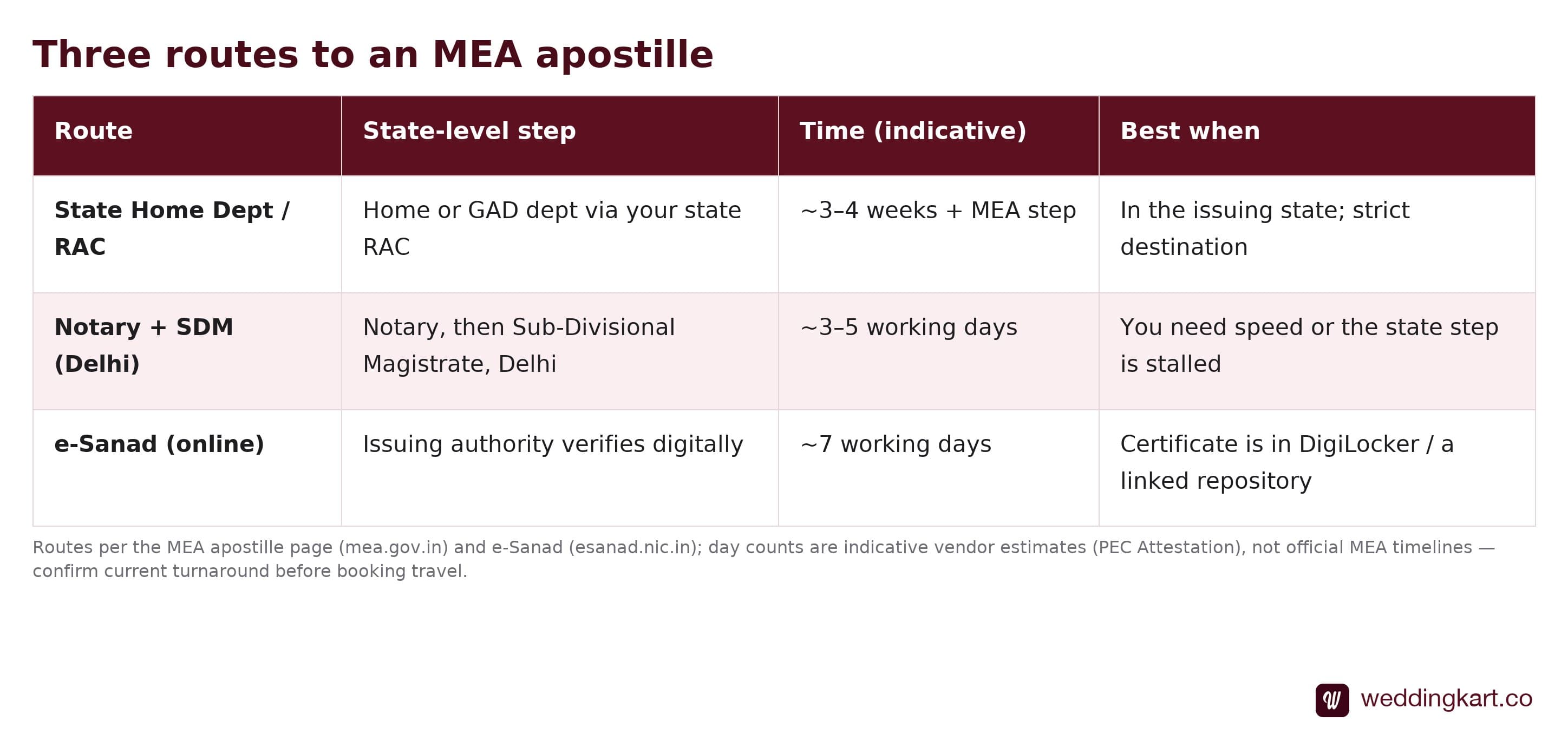
| Route | State-level step | Time (private-agent estimate, not official) | Best when |
|---|---|---|---|
| State Home Dept / RAC | Home or GAD dept via your state RAC | ~3–4 weeks + MEA step | You’re in the issuing state; strict destination |
| Notary + SDM (Delhi) | Notary, then Sub-Divisional Magistrate, Delhi | ~3–5 working days | Speed matters and the receiving office accepts SDM |
| e-Sanad (online) | Issuing authority verifies digitally | Varies (if eligible at all) | Rare — only if your registrar/state is integrated |
Routes per the MEA apostille page and e-Sanad; day counts are indicative vendor estimates (PEC Attestation), not official MEA timelines — confirm current turnaround before booking travel.
How much does it cost to apostille a marriage certificate in India?
I'm going to be straight about numbers here, because the internet is full of confident, outdated ones. The three-part official breakdown is small and knowable:
- Rs 50 — the MEA's statutory apostille fee, per document (ordinary non-apostille attestation is actually free) (MEA).
- Rs 84 — the service/processing charge a designated agency is permitted to add per document, plus Rs 3 per page for scanning.
- A separate state fee — the state authentication step may carry its own small charge, which varies by state.
So the MEA + outsourced-agency minimum for a two-page certificate is roughly Rs 140 (Rs 50 + Rs 84 + Rs 6 scanning) — before any state authentication fee, courier, translation or agent markup, so treat it as a floor, not an all-in price. Where the bill balloons is the convenience layer: private full-service agents who collect, run the queue, and courier the document back typically charge Rs 1,500–7,000 for a marriage certificate (indicative agency rates). That's fine if you're abroad or on a deadline — but you're paying for someone to stand in the queue, not for a legal shortcut. These figures move, so confirm the current schedule on the official MEA apostille page before you budget.
| Cost component | Indicative amount | Who charges it |
|---|---|---|
| MEA apostille fee | Rs 50 per document | Ministry of External Affairs (statutory) |
| Agency service charge | Rs 84 per document | Designated outsourced agency |
| Scanning | Rs 3 per page | Designated outsourced agency |
| State authentication | Small, varies by state | State Home / GAD / SDM |
| Translation (if regional language) | Varies | Certified translator |
| Full-service private agent (optional) | Rs 1,500–7,000 all-in | Private agent — convenience, not a legal step |
MEA and agency fees per the MEA apostille page; state, translation and private-agent figures are indicative and vary. Confirm current fees on the official MEA page before you pay.
How long does a marriage certificate apostille take?
Timelines swing more than fees. Counting the state step, the routes stack up like this (all indicative, all dependent on state and city):
- State Home Department / RAC route: ~25–30 working days (about 3–4 weeks) end to end, because district-level verification is the slow part.
- Notary + SDM (Delhi) route: ~3–5 working days (agency-reported) — faster when the state route is stalled, but confirm the receiving authority accepts SDM attestation first.
- e-Sanad (online): online and contactless when it applies, but the turnaround after issuer verification varies — and most marriage certificates are not eligible in the first place (see below).
- The MEA apostille step itself: only ~3–4 working days once state clearance is done.
The rule is simple: don't book a flight or a visa appointment off a blog's number, mine included. Confirm the current turnaround with a designated agency or the MEA before you plan around it — the state step is where delays hide.
Why marriage certificate apostilles get rejected
Most rejections are avoidable and happen before the MEA ever sees the document. The usual causes:
- It is not a registrar certificate — a temple, church, or Arya Samaj ceremony certificate that was never registered with the government.
- A photocopy or a laminated original — the MEA does not legalise photocopies, and agencies commonly refuse laminated certificates because the seal and signature cannot be inspected.
- Name mismatch with the passport — the spelling on the certificate does not match the passport used as ID, which stalls verification.
- Wrong route for the destination — apostilling for a non-Hague country (the UAE, Kuwait, Qatar) that needs embassy legalisation instead.
- State / RAC mismatch — sending the certificate to the wrong state authority, or skipping the state authentication step the MEA requires.
- An uncertified or missing translation — for a regional-language certificate where the destination wanted a certified translation.
- Ignoring the recency window — an apostille done years early that the receiving office rejects for being too old.
What documents do you need for the MEA stage?
A short, practical checklist before you submit anything:
| Document | Required or optional | Notes / common rejection |
|---|---|---|
| Original marriage certificate | Required | Must be the un-laminated original — photocopies are not legalised; agencies often refuse laminated ones |
| Photocopy of the certificate | Required | For the agency’s file |
| Passport copy of the applicant | Required (per MEA) | Name must match the certificate; agencies often want both spouses’ passports |
| Authorisation letter | If an agent or relative submits for you | Many agencies ask for this when the applicant is overseas |
| Certified translation | If the certificate is in a regional language | Check whether the destination wants the translation itself apostilled or just attached |
| Destination-specific extras | Depends on the receiving country | Some visa checklists ask for additional attestations or recency |
Passport-copy requirement per the MEA apostille page; other rows reflect common designated-agency practice and vary — confirm your agency’s exact list before you submit.
Does an apostille work for the UAE and the Gulf?
This is the one that catches Gulf-bound NRIs, so verify it before you pay for anything. An apostille only works for Hague Convention members. Heading to the UAE, Kuwait, or Qatar? An apostille is useless there — those three sit outside the Convention and want full embassy/consular legalisation, plus MOFA attestation in the UAE, instead of a stamp. That route has more steps than an apostille, so it is generally slower and costlier — confirm the current embassy and MOFA fees and turnaround on the official portals rather than trusting a quoted figure.
Saudi Arabia (apostille in force from 7 December 2022), Oman (since 2012), and Bahrain (since 2013) are members, so the MEA apostille route applies for them. Membership changes — reconfirm your receiving country's status before spending on either path.
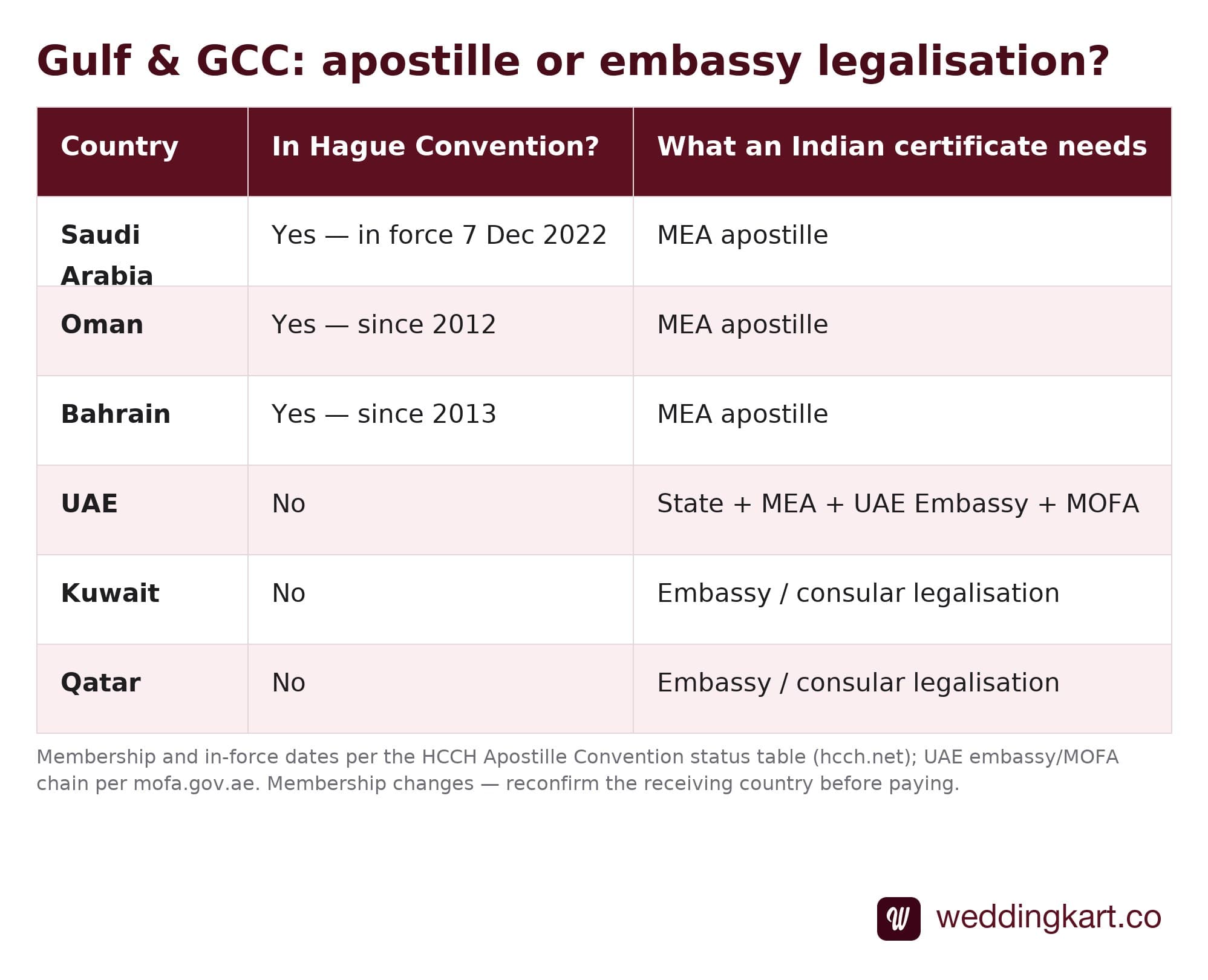
| Destination | Hague member? | What you need |
|---|---|---|
| Saudi Arabia | Yes (in force 7 Dec 2022) | MEA apostille |
| Oman | Yes (since 2012) | MEA apostille |
| Bahrain | Yes (since 2013) | MEA apostille |
| UAE | No | Embassy legalisation + MOFA attestation |
| Kuwait | No | Embassy / consular legalisation |
| Qatar | No | Embassy / consular legalisation |
Membership status per the HCCH status table; UAE legalisation per UAE MOFA. Convention membership changes — reconfirm your receiving country's status before you pay.
Does an apostille expire?
The apostille itself has no expiry date — it's a permanent certification of the signature and seal. But in practice some receiving offices — immigration, visa, OCI, or civil-registration — require the apostilled marriage certificate to be less than 6 months old (sometimes 12) (how validity windows work). So don't apostille the certificate years ahead of a visa or OCI application “to get it out of the way” — do it in the window right before you file, or you may be sent back to do it again.
What does a finished apostille look like?
It helps to know what you're paying for. A genuine apostille is a printed sticker or stamp affixed to the original certificate, carrying the 11 standardised Hague fields (country, who signed, the capacity in which they signed, the seal, place and date of the apostille, the issuing authority, a serial/reference number, and the signature/seal of the MEA officer) plus a reference number — increasingly with a QR code the receiving authority can verify. Keep it intact: don't detach it, laminate over it, or staple through it, because foreign offices verify the reference and a tampered apostille can be rejected.
Where Weddingkart fits (and where it doesn't)
To be straight with you: the apostille is post-wedding legal paperwork, and it is not something we touch. What Weddingkart builds for is the part before the certificate — the wedding itself, and the tangle of getting guests from three continents to the right venue on the right day. We run guest communication over WhatsApp, the channel NRI families actually check, with +91 and +971 numbers, Hindi and regional languages, and multi-event RSVPs. It won't apostille anything; it just keeps the run-up to the day out of your DMs.
The short version
Register the marriage, get the certificate authenticated at the state level (your state RAC — Home Department, or SDM in Delhi), then submit it through a designated agency for the MEA to apostille — a two-step chain, not one counter. The official cost is small (Rs 50 + Rs 84 + Rs 3/page); the timeline runs from ~3–5 working days via SDM to ~3–4 weeks via the state route. The stamp is accepted across the Hague Convention's ~130 members where it is in force between India and the destination, but not in the UAE, Kuwait, or Qatar (non-Hague) or Germany (which objected to India's accession), where you need embassy legalisation instead. And whatever fee or timeline you see quoted — here or anywhere — confirm it against the MEA before you plan around it. This post is general guidance, not legal advice; rules vary by state and by destination country.
Planning the wedding behind all this paperwork? WhatsApp us at +91 92176 10045 — we'll walk you through guest logistics for an NRI event.
Further watching (unofficial walkthroughs)
- How to get an MEA apostille in India — notary, SDM & state attestation from Delhi — ITALY AND IDLI (YouTube)
- What is apostille? HRD, notary, SDM, MEA — the complete process — Chandra Shekher Visa and Study Consultant (YouTube)
- How to get a marriage certificate apostille in India — complete process — Secure Apostille Services (YouTube)
Creator walkthroughs for context; some are visa-consultant channels, so treat any pricing or timeline they quote as indicative and cross-check the official MEA page.
Frequently asked questions
What is an apostille on a marriage certificate?+
An apostille is a standardised authentication — a printed sticker or stamp — added under the 1961 Hague Apostille Convention. It certifies that the signature and seal on your Indian marriage certificate are genuine, so the certificate is accepted without a further embassy legalisation step in member countries where the Convention is in force between India and the destination. In India, only the Ministry of External Affairs (MEA) can issue it, and the Convention has 130 contracting parties (HCCH, 30 June 2026) — though a few, such as Germany, objected to India’s accession and do not accept it.
How much does it cost to apostille a marriage certificate in India?+
The MEA charges Rs 50 per document for the apostille itself, and its designated outsourced agencies are permitted to add Rs 84 per document plus Rs 3 per page for scanning — so the MEA-plus-agency minimum is roughly Rs 140 for a two-page certificate, before any state fee, courier or translation. The state authentication step may carry a small separate fee. Private end-to-end agents who run the whole queue for you typically charge Rs 1,500–7,000. Fees change, so confirm the current schedule on the MEA apostille page before budgeting.
How long does a marriage certificate apostille take in India?+
It depends on the route. The traditional State Home Department chain runs about 3–4 weeks end to end; the notary-plus-SDM (Delhi) route is roughly 3–5 working days; e-Sanad (when a marriage certificate qualifies at all) is online but its turnaround varies after issuer verification. The MEA apostille step itself is only about 3–4 working days once state clearance is done. These are indicative private-agent timelines, not official MEA figures — the MEA does not publish a guaranteed marriage-certificate turnaround, so confirm before booking travel.
Do I need State Home Department or SDM attestation before the MEA apostille?+
Yes — for a personal document like a marriage certificate, the MEA apostilles only after the certificate is authenticated at the state level first. Which office does this varies: the MEA publishes a state-by-state list of Regional Authentication Centres (RACs), which may be the Home Department, the General Administration Department, or the SDM in Delhi. Confirm your state RAC before you start.
Does an apostille expire?+
The apostille itself has no expiry date. But some receiving offices — immigration, visa, OCI, or civil-registration — require the apostilled marriage certificate to be less than 6 months old (sometimes 12), so do not apostille years ahead of an application — time it to the window before you file, and check the specific office’s recency rule.
Can I apostille a photocopy of my marriage certificate?+
No — the MEA does not legalise photocopies; the document that gets the stamp must be the original certificate. Avoid laminated certificates too: agencies commonly refuse them because the original seal and signature cannot be inspected cleanly. Carry a photocopy of the certificate and a passport copy of the applicant for the file (the MEA lists a passport copy; many agencies also ask for both spouses’ passports — if the applicant has none, ask the agency what ID it accepts).
Is an SDM apostille valid for all countries?+
Often, but not guaranteed. Some agencies offer a notary-plus-SDM (Delhi) route that is faster when state attestation is slow or unavailable. The catch: the MEA’s own guidance points to state/UT authentication and Regional Authentication Centres, and a few destination countries scrutinise SDM attestation more than state-government attestation. For high-stakes immigration filings, prefer the issuing-state RAC unless the receiving office confirms it accepts an SDM-attested certificate.
Does an apostille work for the UAE or other Gulf countries?+
Not for the UAE, Kuwait, or Qatar — they are not in the Hague Convention, so documents for them need embassy/consular legalisation, and for the UAE also MOFA attestation, instead of an apostille. Saudi Arabia (in force from December 2022), Oman, and Bahrain are members, so an MEA apostille works there. Always verify the receiving country’s current status before you pay.
Germany is a Hague member — why won’t it accept my Indian apostille?+
Because Hague membership alone is not enough; the Convention has to be in force between India and the receiving country. Germany objected to India’s 2005 accession, so the Apostille Convention does not apply between the two — despite both being members. An Indian marriage certificate for use in Germany therefore still needs the older legalisation route (state/MEA authentication, then the German mission), not an apostille. A few other countries objected to India’s accession too, so always check your destination on the HCCH status table first.
Do I get the certificate translated before or after the apostille?+
It depends on the destination, so confirm on its official page. Commonly, a regional-language certificate is translated by a certified translator and then the whole set is authenticated, but some countries want the translation itself apostilled, and others accept a translation simply attached to the apostilled original. Since the requirement varies by receiving country, check the destination government or consulate checklist before you pay for translation or the apostille.
Can I apostille a temple, church or Arya Samaj marriage certificate?+
Not directly. Only a government-registered certificate — the one a competent registrar issues under the Hindu Marriage Act, Special Marriage Act, Indian Christian Marriage Act, Parsi Marriage and Divorce Act, or your state’s registration rules — can be apostilled. A temple, church, or Arya Samaj ceremony certificate has to be entered with the registrar first; the registrar’s certificate is what everything else authenticates.
What is the difference between apostille, attestation and legalisation?+
An apostille is the one-step Hague authentication: a single MEA stamp accepted by member countries where the Convention is in force between India and that country. Attestation and legalisation refer to the longer chain used for non-Hague countries (and members like Germany that objected to India’s accession) — state attestation, then the MEA, then the destination country’s embassy or consulate (and MOFA for the UAE). Same starting document; the apostille just replaces the embassy step where it applies.
Is an apostille enough for Canada, the UK, the USA or Australia?+
Yes — all four are Hague Apostille Convention members (Canada joined most recently, in force 11 January 2024), so a single MEA apostille on a government-registered marriage certificate is accepted with no embassy legalisation step. The receiving visa, immigration or civil office may still impose its own recency window (often under 6 months), and some ask for a certified English translation if the certificate is in a regional language. Confirm the specific requirement on the destination government or consulate page before you file.
Can an NRI get this done through an agent or a relative in India?+
Yes. You do not have to be physically present in India for the apostille. Since the MEA works only through designated outsourced agencies, most NRIs either appoint one of those agencies directly or send the original certificate plus a passport copy to a trusted relative who runs it through an agency on their behalf. Some agencies ask for a signed authorisation letter. What you cannot skip is the original certificate itself — it has to physically reach the agency to receive the stamp.
Can I apostille a certificate issued in one state from a different city?+
The state-level authentication generally has to go through the authority of the state that issued the certificate — its Regional Authentication Centre, Home Department or General Administration Department — so a Maharashtra certificate is authenticated by Maharashtra’s designated authority, not another state’s. The MEA apostille step itself is decentralised to 16 cities, so once state clearance is done you can often submit the MEA stage at the nearest of those cities. Confirm your state’s RAC and the nearest submission centre on the MEA site.
Can I get the apostille online through e-Sanad?+
Rarely for a marriage certificate, though it is worth checking. e-Sanad is the MEA’s contactless online route: the issuing authority verifies the document digitally, skipping the physical state counter. It only works if your marriage record already sits in a digital repository that is integrated with e-Sanad — and most registrar-issued marriage certificates are not, so the physical route is still the norm. A DigiLocker copy alone does not make an older paper certificate eligible; the issuing registrar or state has to be integrated. Turnaround after issuer verification varies and the MEA does not publish a guaranteed marriage-certificate SLA, so check eligibility on the e-Sanad portal first and plan for the physical route as the default.
Sources
Official process, fees and membership were checked mid-2026 on the sources below. Legal figures, fees, and timelines are set by third parties (the MEA, state governments, foreign authorities) and change — always confirm the current fee, turnaround and receiving-country status on the official portal before you pay or plan. This is general guidance, not legal advice.
- 1. Attestation / Apostille — process, designated agencies, fees, 16 decentralised cities — Ministry of External Affairs (Government of India)
- 2. Apostille Convention (5 October 1961) — Status Table of contracting parties — HCCH (Hague Conference on Private International Law)
- 3. Saudi Arabia accedes to the Apostille Convention (in force 7 Dec 2022) — HCCH
- 4. e-Sanad — online attestation and apostille of documents — Ministry of External Affairs (Government of India)
- 5. Regional Authentication Centres (RACs) for States / Union Territories — Ministry of External Affairs (Government of India)
- 6. Attestation guide — embassy & MOFA legalisation for the UAE — Ministry of Foreign Affairs, United Arab Emirates
- 7. Complete guide to marriage certificate apostille in India (indicative timelines & document list) — PEC Attestation & Apostille Services
- 8. Do apostilles expire? (validity windows required by foreign authorities) — Kraemer & Kraemer
Related reading
How to Register an NRI Marriage in India →
The certificate you apostille comes from here — the registration step that has to happen first.
OCI & Spouse Visa After an NRI Marriage →
Where the apostilled certificate goes next — sponsoring a spouse and applying for OCI.
NRI & Gulf Families Planning Indian Weddings →
Running an Indian wedding from abroad — guests, time zones, and the WhatsApp-first playbook.
Wedding Guest List App →
Track RSVPs, travel, and IDs for a guest list spread across the world.
Was this article helpful?
Share