
Quick Answer
How do NRIs plan an Indian wedding in India from abroad?
Start 10–12 months out and split every task into what needs you in India (venue recce, tastings, fittings) and what runs from a laptop (planner, invites, the guest list). Budget in rupees — the average Indian destination wedding runs about ₹51.1 lakh — and move money through a specialist service (~0.5–1.5%) rather than a bank wire (3–7% all-in). The one job you cannot delegate is the worldwide guest list: send invites, collect a separate RSVP per event, and gather flight and ID details on WhatsApp, because guests in New Jersey, Dubai and Delhi all open WhatsApp but never the same email. Sort the legal route early — Hindu Marriage Act after the ceremony, or Special Marriage Act with its 30-day notice — and if one partner is a foreign national, spouse OCI only comes after the marriage has been registered for two continuous years.
Last updated:
How NRIs Plan an Indian Wedding From Abroad: The Remote Checklist
Mayank Jaiswal writes from Weddingkart's guest-management work with Indian weddings, where the product runs WhatsApp-based RSVP and guest-travel workflows — including scattered, cross-border NRI guest lists. Cost, legal and OCI figures below are cited to the sources listed at the end; confirm anything legal on the official portal before you rely on it.
The vendors are the easy part. There are planners in every Indian metro who will book the palace, the caterer and the band while you sleep in Toronto — one industry estimate puts the destination-wedding segment alone at roughly ₹2.5 lakh crore, growing about 35% a year, so that end of it is deep and competitive. What actually breaks a wedding run from abroad is the gap between you and the ground: you are ten hours and eight thousand miles away, and the one job you can't hand to a planner is getting a hundred relatives scattered across three continents to reply, book flights and send their passport numbers in time.
And this is not a niche problem. One in four Indian weddings is now a destination wedding, and 89–90% of those are still hosted inside India — NRIs overwhelmingly fly the wedding home to Rajasthan, Goa or Kerala rather than marry abroad. So the real skill isn't choosing a country; it's running an Indian wedding remotely. This guide is organised around that: plan by what needs your body in India versus what you can do from a laptop, run vendors on a rhythm that respects the time difference, and treat the worldwide guest list as the part you personally own. Money and the legal registration sit underneath all of it.
₹51.1 lakh
Average destination-wedding budget
Source: WedMeGood 2024–25
1 in 4
Indian weddings are now destination
Source: WedMeGood 2024–25
89–90%
Destination weddings hosted inside India
Source: First Resort 2026
40–50%
Of the budget is venue + stay
Source: First Resort 2026
How much does an NRI wedding in India actually cost?
The average Indian destination wedding runs about ₹51.1 lakh — roughly 40% more than the ₹36.5 lakh average wedding — and most of that premium is venue and stay. At a destination property, venue and accommodation typically eat 40–50% of the budget (against ~30–35% for a wedding at home), and per-plate catering runs ₹1,200–3,000. One quietly useful planning fact: a destination wedding hosts about 280 guests on average, versus ~420 for a local one — the format naturally trims the list, which matters when every extra head is a flight and a hotel room.
Here is the rough shape by city, for a two-day event with 150–200 guests. Ranges are wide because season, guest count and how much you DIY move them a lot — read them as a starting anchor, then get a real quote:
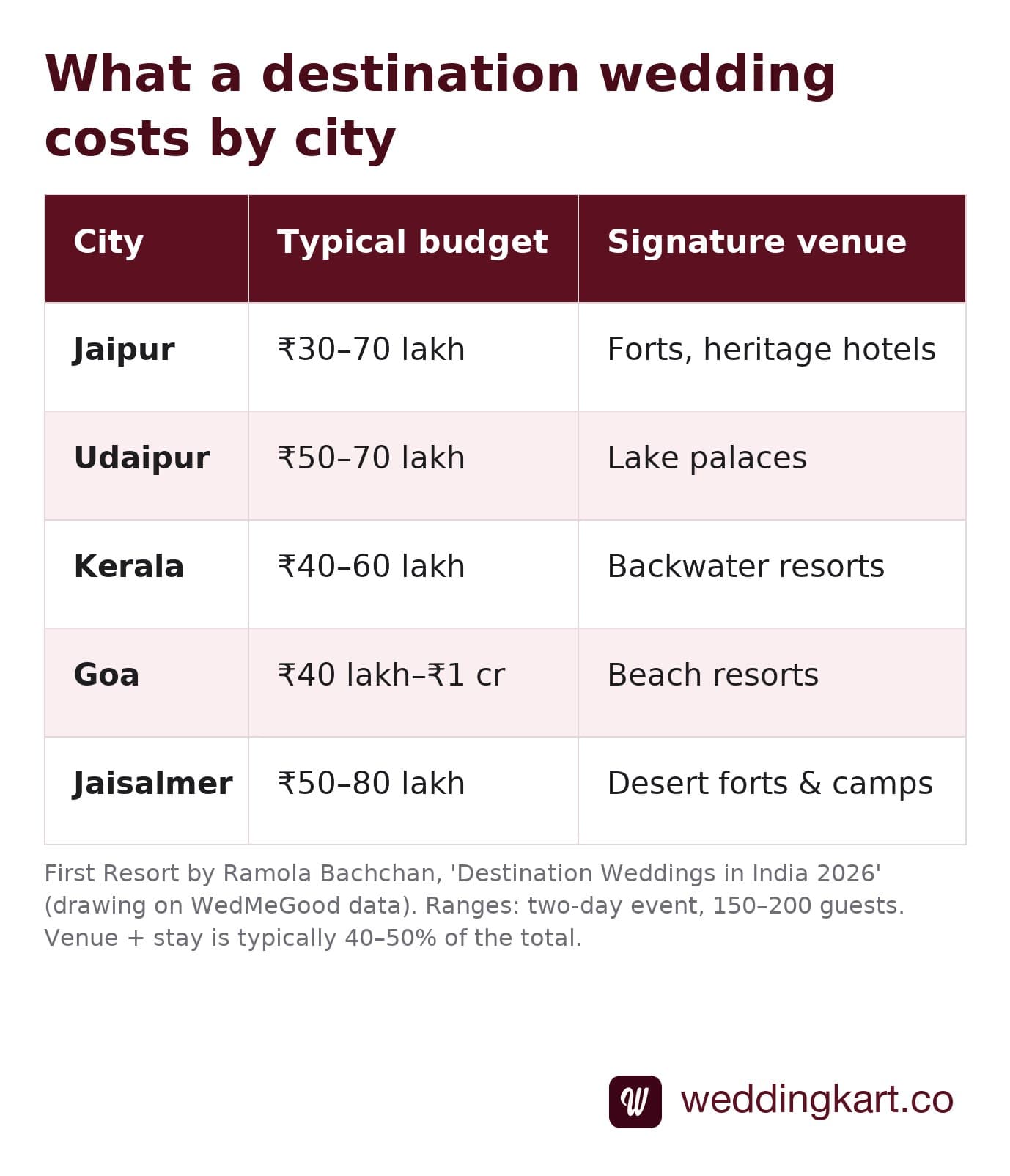
| City | Typical budget | Signature venue |
|---|---|---|
| Jaipur | ₹30–70 lakh | Forts, heritage hotels |
| Udaipur | ₹50–70 lakh | Lake palaces |
| Kerala | ₹40–60 lakh | Backwater resorts |
| Goa | ₹40 lakh–₹1 cr | Beach resorts |
| Jaisalmer | ₹50–80 lakh | Desert forts & camps |
City ranges compiled from WedMeGood 2024–25 and First Resort 2026; they move with season and guest count, so quote the venue directly.
For the full line-item breakdown — venue, catering, décor, photography, and the hidden costs specific to a hosted-from-abroad wedding — our guide to destination wedding costs in India has the real numbers. One money-saving lever the planners repeat: book vendors local to the venue so you aren't paying their travel and lodging on top of your own.
Which wedding tasks need an India trip, and which don't?
Before you touch a timeline, sort every task into two buckets. It changes how you spend your one scarce resource — trips to India.
- Venue recce and layout walk-through
- Menu and cake tastings
- Final outfit fittings and trials
- Meeting the priest / registrar
- The wedding week itself
- Hiring the planner and photographer
- Invites, RSVPs and the guest list
- Décor and theme sign-off (over video)
- Budget, payments and forex
- Guest travel and hotel coordination
Now batch the left column into trips. Planners split on the number, and it's worth being honest that there isn't one right answer. Many NRI-focused planners say one structured trip (5–10 days around the 4–6 month mark) plus arriving 7–10 days before the wedding is enough — if you trust your planner to run tastings and fittings and sign off over video. Others prefer two trips: an early recce to lock the venue and outfits, then the final fortnight. The trade is simple — the cost of an extra long-haul ticket and leave against the risk of a remote-approved decision you'd have caught in person. Complex multi-venue weddings lean toward two; a trusted planner and a single property lean toward one.
What does an NRI Indian wedding checklist look like, month by month?
An NRI Indian wedding checklist is a month-by-month plan for running an Indian wedding from overseas, splitting the tasks that need an India trip from the ones you can handle remotely — vendors, guest RSVPs, travel, payments, marriage registration and the post-wedding documents. Work backwards from the date. Peak Indian wedding season runs roughly November through February, and the best venues, planners and photographers for those dates are gone a year out — so the further from peak season you marry, the more this timeline can compress.
NRI Indian wedding checklist: the 12-month timeline
| Timeline | Key tasks | Where you need to be | Why it matters |
|---|---|---|---|
| 12 months | Lock the date and muhurat, pick the city, publish a save-the-date, open a rupee budget | Remote | Guests book long-haul flights around this date; moving it later costs them money |
| 10 months | Interview planners over video; book the photographer (they sell out first) | Remote | Top planners and photographers for peak-season dates go a year out |
| 8 months | First India trip — sign the venue, meet the planner shortlist, taste menus | In India | The venue is hard to judge on video; sign it in person |
| 6 months | Build the guest list as data; send invites; open a separate RSVP per event; book the pandit/priest | Remote | Per-event counts drive every catering and rooming number later |
| 4 months | Block hotel room-blocks; start collecting flight and ID details; sign off décor over video | Remote | Room-blocks and award seats vanish first for busy dates |
| 3 months | Order outfits with a shipping/customs buffer; confirm mehendi artist, band and baraat logistics | Remote | Outfit shipping and alterations across borders eat weeks |
| 2 months | Chase RSVPs; build the rooming list and airport-pickup grid; brief foreign guests on visas and ceremonies | Remote | Foreign guests need visa lead time; late RSVPs break the rooming plan |
| 1 month | Lock final per-event headcounts; confirm vendor meals; pay milestone tranches | Remote | Caterers cost on final numbers; milestone payments track delivery |
| 2 weeks | Arrive in India; final fittings; registrar paperwork prep; hand the rooming and pickup plan to your on-ground team | Arrive in India | Fittings and registrar paperwork need you physically present |
| Wedding week | Vendor walk-throughs, welcome guests, run one channel for every update, room number and pickup time | In India | One source of truth stops a hundred repeat questions |
| Post-wedding | Register the marriage and collect the certificate; apostille it if needed; diarise the two-year OCI clock for a foreign spouse | India or home | You need the certificate for spouse visas, name changes and OCI |
The timeline tells you when; the workstream list tells you who owns what. Every Indian wedding runs the same core workstreams — here they are, tagged by whether you drive each one from abroad, need an India trip, or hand it to family on the ground:
NRI Indian wedding checklist: by workstream
| Workstream | Typical owner | Remote, India trip, or delegate? |
|---|---|---|
| Venue & room-blocks | You + planner | India trip to sign; room-blocks booked remotely |
| Catering & menu | Planner | Taste on your India trip; confirm counts remotely |
| Décor & mandap | Planner | Moodboard remote; final walk-through by planner or family |
| Photography & video | You | Book and brief the shot list fully remotely |
| Outfits & jewellery | You + family | Order remote; final fittings on your India trip |
| Hair & makeup | You | Book remote; trial during your India trip |
| Mehendi, sangeet & music/DJ | Planner + family | Book remotely; family confirms details on the ground |
| Invitations & guest list | You | Fully remote — the job only you can do |
| Priest/pandit & rituals | Family | Family delegate books; brief the ritual list remotely |
| Guest travel & transport | You | Collect details remotely; pickups delegated on-ground |
| Gifts, favours & welcome kits | Family | Delegate assembly and delivery on the ground |
| Marriage registration & OCI | You | India registrar or home country; OCI follows later |
The same timeline again, with the reasoning behind the order that matters most:
- 10–12 months — lock the date and city. This is the single decision your entire guest list depends on. Publish a save-the-date the moment it's fixed so relatives can hunt for long-haul fares and use up airline miles before prices climb.
- 8–10 months — planner, venue, photographer. Interview planners over video, then use your first India trip to sign the venue and meet the shortlist in person. Book the photographer early; the good ones are the first to sell out.
- 6 months — invites and the guest list. Build the guest list as structured data, not a WhatsApp forward. Send digital invites and open RSVPs for each event so you can size the mehendi, sangeet and reception separately.
- 3–4 months — travel and stay. Block hotel rooms, start collecting flight and ID details, and map who needs airport pickups. This is where an out-of-country guest list gets genuinely hard — see the guest section below.
- 4–6 weeks — the final India stretch. Final fittings, registrar paperwork, vendor walkthroughs, and the pickup-and-rooming plan handed to your on-ground team.
- Wedding week — one source of truth. Every guest update, room number and pickup time goes out on the channel guests already have open, so nobody is refreshing an email they never signed up for.
For the messaging cadence across those months — what to send when, and how not to spam guests — our destination wedding communication timeline lays it out message by message.
How do you coordinate vendors across time zones?
Pick one standing call window in India's evening and defend it, instead of rescheduling weekly. India is UTC+5:30 and — usefully — doesn't observe daylight saving, so its clock never moves. Yours does. US Eastern sits 9.5–10.5 hours behind IST and Pacific 12.5–13.5 hours behind, which leaves only a narrow 2–3 hour overlap: a weekend morning in America is a weekend evening in India. India's evening is also the only slot that catches the UK and the Gulf awake at the same time.
Here is roughly what 9 p.m. in Delhi looks like elsewhere (shift by an hour when your country changes its clocks):
| When it's 9 p.m. in India | Local time |
|---|---|
| Dubai / Abu Dhabi | ~7:30 p.m. |
| London | ~4:30 p.m. |
| New York / Toronto | ~11:30 a.m. |
| San Francisco | ~8:30 a.m. |
| Sydney | ~1:30 a.m. (next day) |
Three habits make the distance manageable:
- Everything in writing. Get quotes, inclusions and payment milestones on WhatsApp or email, not on a call you'll half-remember at midnight. When a dispute comes up three months later, the thread is your contract. Ask specifically for a written breakdown of what is and isn't included — the gap between the two is where destination budgets blow up.
- One decision-maker on the ground. A planner, a sibling or a parent who can walk into the venue, sign for a delivery and send you a photo. Trying to approve a fabric swatch over a laggy video call at 2 a.m. is how mistakes happen.
- Structure payments as milestones. Never wire the full amount up front. A common planner model is tranches — for example 25% on signing, 25% at venue lock, 25% at the four-month mark, and 25% before wedding week — so your money tracks delivery, not promises.
For the step-by-step version of this — shortlisting, video walkthroughs, contract red flags and how to pay deposits safely — see the full playbook for hiring and coordinating vendors remotely.
Vetting a planner or vendor from 8,000 miles away
Only about 16.7% of couples hire a planner — but for a remote NRI wedding, the planner is your on-ground proxy, not a luxury. Vet on evidence, not a laggy video call: ask for written inclusions, the deposit and cancellation/refund terms in writing, two or three recent couple references you can actually message, and a clear answer on who covers vendor no-shows. Red flags: cash-only, no written contract, vague “we'll sort it” on refunds, and a portfolio with no weddings at your venue tier.
What's the cheapest way to send wedding money to India?
For the bulk of vendor payments, a specialist remittance service (Wise, Remitly and the like) typically works out around 0.5–1.5% all-in as a rough guide, while a bank SWIFT wire can quietly cost 3–7% once you count the exchange-rate margin, correspondent-bank cuts and GST — roughly ₹1,500–₹2,500 on a typical transfer. The “no fee” bank credit isn't free; the cost is hidden in the rate. On a wedding-sized budget that spread is real money. Provider pricing shifts, so compare the live all-in cost — the exchange rate plus the fee — before each big transfer rather than assuming one service is always cheapest.
Two definitions worth pinning down, because most guides assume them: an NRE (Non-Resident External) account holds money you earn abroad — the balance is freely repatriable and the interest is tax-free in India; an NRO (Non-Resident Ordinary) account holds India-source income like rent, where repatriation is capped and conditioned (subject to RBI limits and tax paperwork) and the interest is taxed here. Both sit under FEMA/RBI rules and your bank's documentation, so confirm specifics with your bank. For funding a wedding from overseas earnings, the NRE account is usually the cleaner hub. Fund it with a specialist transfer, then pay Indian vendors from it — traceable, repatriable, and easy to reconcile. The Ministry of External Affairs sets out the remittance rules for NRIs. When you do want a bank wire — very high per-transfer limits, or a Foreign Inward Remittance Certificate for compliance — use it deliberately; many couples run both, the NRE account as the hub and specialist rails to fund it.
How should NRIs budget across rupees and foreign currency?
The mistake NRIs make is thinking in their home currency. Every vendor invoices in rupees, so make the INR figure your source of truth and convert to dollars or pounds only to understand what you're actually spending. If you budget in USD and let the rupee number float, you lose the ability to compare quotes and catch overruns.
Then respect two buffers, because they cover different risks. Keep a 5–10% forex buffer for exchange-rate drift, and a separate 15–20% contingency reserve for surprise line items — the two are not the same thing, and conflating them is how couples get caught short. On the currency itself: the rupee has kept drifting weaker, and as of mid-2026 was trading in the low-to-mid ₹90s to the US dollar, which actually works in your favour if you earn in USD, GBP or AED. Don't hard-code a number, though — check the live bank or reference rate on transfer day, because it moves both ways month to month, and on a booking made a year out a few percent of swing is real money. Locking a rate early makes sense if you've budgeted tight; paying at spot as milestones fall due keeps flexibility if your income currency is strengthening. The buffer covers you either way.
For the exact rupee splits — venue, catering, décor, outfits and everything in between — see a full category-by-category NRI wedding budget breakdown.
Why is the guest list the one job you can't outsource?
This is where planning from abroad is genuinely different from planning at home — and where most of the stress lives. Your guest list isn't in one city; it's an aunt in Leicester, a college friend in Sydney, cousins across New Jersey and Texas, and family in three Indian states. Getting all of them to reply, book flights and hand over travel details is not something a Mumbai planner can do for you. It runs on your relationships and your family group chats.
The tool that fits this is WhatsApp, for one blunt reason: it is the one app every guest already has open, in every country, and nobody installs an app for someone else's wedding. Email gets ignored; a website login gets abandoned. That's the whole reason Weddingkart is WhatsApp-native rather than an app your guests have to download. From one guest sheet it will:
- send the invite and take a separate RSVP for each event — so 40 people at the sangeet and 250 at the wedding are counted correctly, not lumped together;
- collect flight details and passport or ID numbers straight in the chat — its AI reads an uploaded ticket and pulls out the flight number and arrival time, so nobody types it wrong;
- work on Indian and UAE numbers (+91 and +971) in Hindi and regional languages, so your Gulf relatives and your Delhi ones both reply in the language they text in;
- gather guest photos after the events, without a shared drive nobody uploads to.
Whether you use a dedicated tool or not, that is the workflow to aim for. For the full picture of running a scattered guest list end to end, see destination wedding guest management, and for how the per-guest merge works — sending each guest their own hotel, room and pickup — see personalised guest details.
If you want more depth on structuring the list itself, a dedicated guide to building an NRI wedding guest list covers segmentation and tiers, and a deep dive on WhatsApp wedding invitations for NRI families covers getting the invitation itself right.
When not to bother: if your wedding is small and single-event, everyone already has your number, and there's no travel or room logistics to run, a family WhatsApp group and a simple spreadsheet are genuinely enough — don't pay for guest coordination you won't use. A tool earns its keep only once the list is large, multi-event, and spread across countries and time zones.
Should NRIs register their marriage in India or abroad?
It depends on residency and citizenship, not on which is “better.” You'll need a marriage certificate for spouse visas, name changes and joint accounts abroad, and the paperwork takes time you won't have during the wedding week — so decide the route early. There are three:
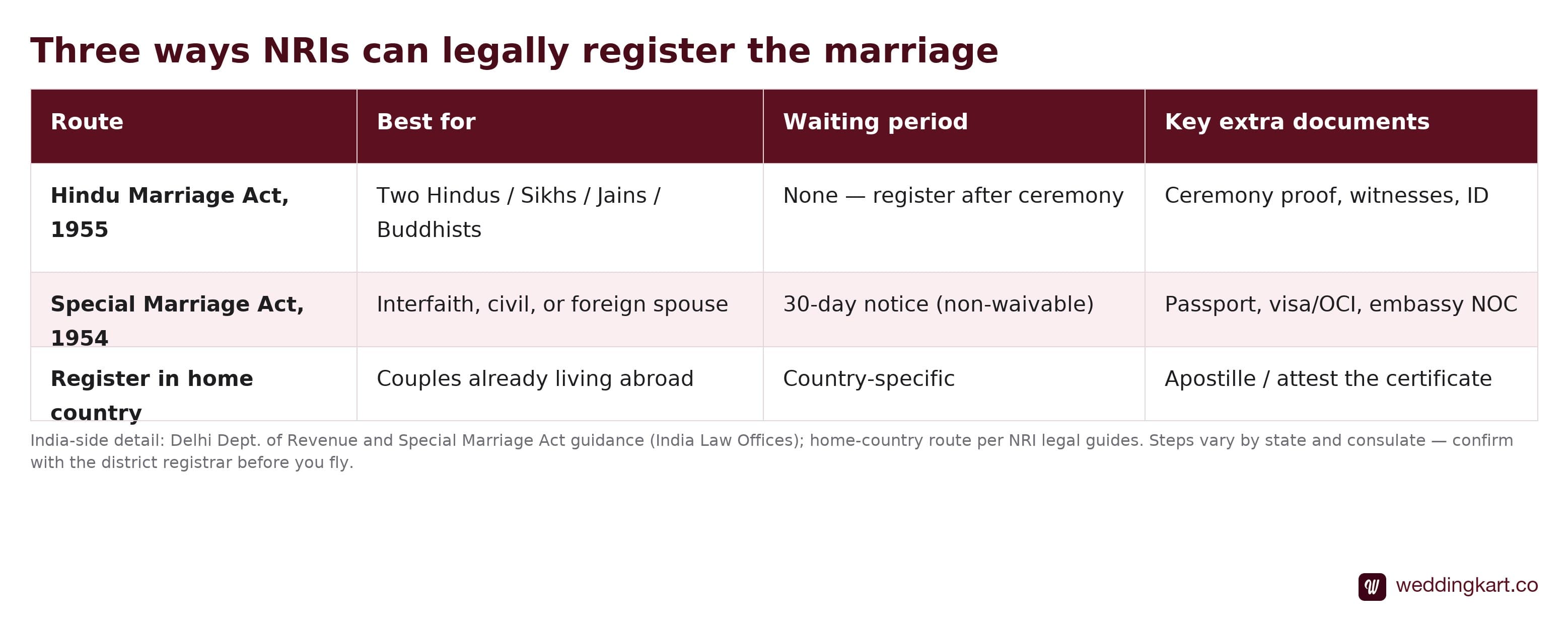
| Route | Best for | Waiting period | Key extra documents | Watch-out |
|---|---|---|---|---|
| Hindu Marriage Act, 1955 | Two Hindus (also Buddhists, Jains, Sikhs) | None — register after the ceremony | Proof of ceremony, age and address proof | Still a process, not instant; witnesses and an appointment are needed |
| Special Marriage Act, 1954 | Interfaith, civil, or foreign-national marriages | 30-day public notice, generally not waivable | Foreign spouse: passport, valid visa/OCI, embassy no-objection or single-status certificate | The 30-day notice needs one of you resident in that district; build it into the trip |
| Register abroad, then apostille | You already live abroad or can't spare 30+ days in India | Your home country's own process | Apostille (Hague) or attestation so India accepts the certificate | Some documents may need Indian-mission attestation, not just apostille — check per country |
- Hindu Marriage Act, 1955 — for two Hindus (also Buddhists, Jains, Sikhs). You register after the religious ceremony; there's no waiting period, because the ceremony is the marriage and registration is the official proof.
- Special Marriage Act, 1954 — for interfaith, civil, or foreign-national marriages. It carries a 30-day public notice at the registrar of a district where one of you has lived for the preceding 30 days, and per the Act's procedure the marriage is solemnised on or after the 31st day. That 30-day notice period is statutory and registrars generally require it, so build it into your timeline rather than assuming it can be shortened. A foreign-national spouse usually also needs a passport, a valid visa or OCI, and a no-objection / single-status certificate from their embassy. Confirm the exact procedure with the district registrar — steps and online options differ by state.
- Register in your home country, then apostille the certificate. If you already live abroad or can't spare 30+ days in India, marry where you are — then get the certificate apostilled (a standardised Hague-Convention certification that makes a document valid across borders) or attested so it's accepted in India for a spouse visa or OCI.
You may have heard about a mandatory NRI-registration rule — the Registration of Marriage of Non-Resident Indian Bill, 2019, which proposed that NRIs register within 30 days on pain of passport action. It was introduced in the Rajya Sabha and referred to the Standing Committee on External Affairs; as of 2026 it is not yet law, so don't plan around it. One honest caveat on all of the above: the fine detail — which documents, whether your state offers online registration, how appointments are booked — varies by state and consulate and changes. Treat this as the shape of the process, then confirm the exact steps with the district registrar or a family lawyer before you fly. Our deeper walkthrough of NRI marriage registration in India goes route by route.
How does a foreign spouse get an OCI card after marriage?
Not straight away. A foreign-national spouse becomes eligible for spouse-category OCI only after the marriage has been registered and has subsisted for two continuous years, per the Consulate General of India. Until that two-year mark, the spouse enters and stays in India on an X (Entry) visa, whose duration and documents are set by the issuing Indian mission — commonly a multi-year term, so they're not stranded in the meantime. OCI is officially a lifelong, multiple-entry visa, but a spouse-based OCI is conditional: it can be affected if the marriage ends in divorce, and the physical card is re-issued at intervals set by the government — check the current rule on the OCI portal.
The practical sequence, then, is: register the marriage, get the certificate (apostilled or attested as needed), put the foreign spouse on an X visa now, and diarise the OCI application for the two-year anniversary of registration. Fees, document lists and processing times change, so confirm current requirements on ociservices.gov.in or with your local consulate — never plan around a specific date without checking the official portal. We cover the full path in OCI and the spouse visa after an NRI marriage.
How much lead time do foreign guests need?
Most non-Indian guests need an Indian visa or e-Visa, so give them a long runway and a briefing pack. OCI cardholders don't need a visa at all. For everyone else, India's e-Visa is applied for online at the official e-Visa portal, but eligibility and processing time vary by nationality and can change — so tell foreign guests to apply well ahead and check the official portal for current timelines rather than trusting a friend's experience from two years ago. Point them to the government site directly: only the official portal should be used, and it warns against third parties charging “emergency” or express e-Visa fees.
| Guest type | Document for India | Where to apply |
|---|---|---|
| OCI cardholder | None — travels on the OCI card plus passport | Already held |
| Indian citizen living abroad | None — enters on an Indian passport | Not applicable |
| Foreign passport-holder | Indian e-Visa (or a regular visa), subject to nationality | Official e-Visa portal |
| Foreign-national spouse (pre-OCI) | X (Entry) visa; duration set by the mission | Indian mission / portal |
Beyond the visa, a short briefing pack saves you a hundred WhatsApp questions: what each ceremony means (haldi, mehendi, pheras), the dress code for each, a blocked hotel room-block with early check-in for jet-lagged arrivals, and a clear arrivals plan. Non-Indian guests aren't being difficult — they simply don't know that the mehendi is a different dress code from the reception unless you tell them.
That lead time question runs both directions — for the couple's side of the timing, see how far in advance to send save-the-dates for a destination wedding and how to manage RSVP deadlines across US/UK/UAE/India time zones.
The short version
Planning an Indian wedding from abroad isn't about doing more — it's about deciding what only you can do. Hand the vendors to a planner, batch your India trips around the tasks that need your physical presence, and run the standing vendor call in India's evening so nobody's awake at 3 a.m. Budget in rupees, move money on cheap rails through an NRE account, keep both a forex buffer and a contingency, and start the marriage registration — and, if one of you is a foreign national, the OCI clock — early. Then own the one thing distance makes hard: the worldwide guest list, run on WhatsApp because that's the one channel every guest opens. Get those right and eight thousand miles stops mattering.
Where Weddingkart fits
If you decide to run the guest list on WhatsApp with a tool rather than by hand, Weddingkart does the invites, per-event RSVPs and flight/ID collection described above. You can try it on your own list with 30 free credits before paying anything; paid plans start at ₹5,999 + GST per wedding (2,000 messages, send-only); per-event RSVPs and flight/ID collection are on Standard at ₹14,999 + GST. Everything legal, financial and logistical above stands on its own whether or not you use it.


Running a guest list across three continents? WhatsApp us at +91 92176 10045 — we'll walk you through the setup for your wedding.
Further watching
- The only Indian wedding planning checklist and timeline you need — Poonam Gururajan — The Maharani Diaries (YouTube)
- Wedding budget shoots to ₹37,00,000 average — what are couples spending on? — Mint (YouTube)
- Destination wedding in Udaipur — budget, 4-star and 5-star venues — Smita — Wedding Planner (YouTube)
Frequently asked questions
What should be on an NRI Indian wedding checklist?+
Work backwards from the date. 12 months out: lock the date, muhurat and city and publish a save-the-date. 10 months: hire the planner and photographer over video. 8 months: take your first India trip to sign the venue and taste menus. 6 months: build the guest list, send invites and open a separate RSVP per event. 4 months: block hotel rooms and start collecting flight and ID details. 3 months: order outfits with a shipping buffer and confirm the mehendi artist, band and baraat. 2 months: chase RSVPs and build the rooming and airport-pickup grid. 1 month: lock per-event headcounts and pay milestone tranches. Final fortnight: fly in for fittings, registrar paperwork and vendor walk-throughs. After the wedding: register the marriage and, for a foreign spouse, start the two-year OCI clock. Tag every task by whether it needs you physically in India or can be done from a laptop.
Can NRIs plan an Indian wedding without visiting India?+
Almost — but not quite. Everything up to the wedding week can be run remotely: hiring the planner and photographer, invites and RSVPs, décor sign-off over video, budgeting and payments, and the entire guest list. What genuinely benefits from you being on the ground is the venue recce, menu tastings and final outfit fittings, plus the wedding week itself. A few couples with a fully trusted planner compress this to a single trip — arriving 7–10 days before the wedding and approving everything else over video — but most also make one earlier trip. Zero trips is only realistic if someone you trust completely is your eyes on the ground.
How much does an NRI destination wedding in India cost?+
The average Indian destination wedding runs about ₹51.1 lakh — roughly 40% more than the ₹36.5 lakh average wedding — with venue and stay eating 40–50% of the budget. By city, a two-day event for 150–200 guests typically runs ₹30–70 lakh in Jaipur, ₹50–70 lakh in Udaipur, ₹40–60 lakh in Kerala, and anywhere from ₹40 lakh to over ₹1 crore in Goa. Per-plate catering at destination venues is usually ₹1,200–3,000. These are third-party ranges that move with season and guest count — treat them as a planning anchor, not a quote.
How early should NRIs start planning an Indian wedding?+
Ten to twelve months out for a full-scale wedding, and earlier if it lands in peak season (roughly November to February). Lock the date and city first, before anything else — your guests are booking international flights, and long-haul fares and award seats to India disappear months in advance. Everything else can slot in behind a fixed date, but a date you move after people have booked is the one mistake that costs guests real money.
Should NRIs register their marriage in India or abroad?+
It depends on residency and citizenship, not on which is “better.” Register in India when both partners are Indian citizens or OCIs and can be on the ground long enough — two Hindus can use the Hindu Marriage Act after the ceremony (no waiting period), while an interfaith or civil marriage, or one with a foreign national, goes through the Special Marriage Act with its statutory 30-day notice. Register in your home country when you already live there or cannot spare 30+ days in India — then get the certificate apostilled or attested for use in India. Exact documents vary by state and consulate; confirm with the district registrar before you fly.
Can my foreign spouse get an OCI card after we marry?+
Not immediately. A foreign-national spouse becomes eligible for spouse-category OCI only after the marriage has been registered and has subsisted for two continuous years. Until then they enter and stay in India on an X (Entry) visa, whose duration is set by the issuing Indian mission (commonly a multi-year term), so they are not stranded in the meantime. OCI itself is described by the government as a lifelong, multiple-entry visa — but a spouse-based OCI is conditional and can be affected if the marriage ends in divorce. Rules, fees and card-renewal intervals change, so confirm eligibility and the current fee on ociservices.gov.in or with your local Indian consulate before you plan around any date.
What is the cheapest way to send wedding money to Indian vendors?+
For the bulk of vendor payments, a specialist remittance service (Wise, Remitly and similar) usually costs about 0.5–1.5% all-in, while a bank SWIFT wire can quietly cost 3–7% once you add the exchange-rate margin, correspondent-bank cuts and GST — roughly ₹1,500–₹2,500 on a typical transfer. Route payments through an NRE or NRO account for a clean, traceable trail. Use a bank wire when you specifically need very high limits or a Foreign Inward Remittance Certificate for compliance. Many couples do both.
How do NRIs avoid vendor fraud when paying from abroad?+
Pay in milestones tied to delivery, never the full amount up front — a common split is 25% on signing, 25% at venue lock, 25% at the four-month mark and 25% before wedding week. Get every quote, inclusion and payment term in writing on WhatsApp or email so the thread is your contract. Route money through an NRE or NRO account for a traceable trail, ask for two or three recent couple references you can actually message, and treat cash-only demands, no written contract and vague refund terms as red flags. One trusted person on the ground who can physically verify the venue and deliveries is your best fraud check.
How do you collect RSVPs and travel details from guests spread across countries?+
Use WhatsApp rather than email or a website login — a guest in New Jersey, one in Dubai and one in Delhi all open WhatsApp daily, and guests rarely install an app for someone else’s wedding. The workflow to aim for: send the invite, take a separate RSVP for each event (mehendi, sangeet, wedding, reception), and collect flight and ID details in the same thread, ideally in the language each relative actually texts in. A WhatsApp guest-management tool such as Weddingkart is one way to automate this — including reading an uploaded ticket to pull out the flight and arrival time — but a disciplined family group chat and a shared spreadsheet can handle the basics.
How many trips to India do NRIs need to plan the wedding?+
It is a judgment call, not a fixed rule. Many NRI-focused planners say one structured 5–10 day trip around the 4–6 month mark, plus arriving 7–10 days before the wedding, is enough if you trust your planner to run tastings and fittings and sign off over video. Others prefer two trips — an early recce and the final fortnight — for hands-on couples or complex multi-venue setups. The real trade is the cost of an extra long-haul ticket against the risk of a remote-approved mistake.
Do foreign (non-Indian) guests need a visa for an Indian wedding?+
Most do. Foreign passport-holders generally need an Indian visa or e-Visa; OCI cardholders do not. India’s e-Visa is applied for online, but processing time and eligibility vary by nationality and can change, so tell non-Indian guests to apply well ahead and check the official portal for current timelines. Send them a short briefing pack too — what each ceremony means, the dress code, and a blocked room with early check-in for jet-lagged arrivals.
What is the difference between an NRE and an NRO account?+
An NRE (Non-Resident External) account holds money you earn abroad; the balance is freely repatriable and the interest is tax-free in India. An NRO (Non-Resident Ordinary) account holds India-source income (rent, dividends), with limits on repatriation and interest taxed in India. For funding a wedding from overseas earnings, the NRE account is usually the cleaner hub — fund it with a specialist transfer, then pay Indian vendors from it.
What can a wedding planner not do for you from abroad?+
A planner books and manages vendors, and a good one is worth every rupee when you’re 8,000 miles away — only about 16.7% of couples hire one, but for a large, multi-day wedding it buys you one accountable point of contact instead of fifteen vendor threads. What they can’t do is chase your forty cousins in the US and UK for their RSVPs, flight times and passport numbers — that outreach runs on your relationships, in your family group chats, in the languages your relatives use. The guest list is the one part of a remote wedding you have to own yourself.
Sources
Figures were checked mid-2026 on the sources below. Market, cost and exchange-rate numbers are third-party estimates that move with season and rates; legal, registration and OCI details are the shape of the process only — fees, documents and timelines vary by state and consulate and change, so confirm on the official portal (MEA, ociservices.gov.in, your state registrar) before you rely on them.
- 1. Annual Wedding Industry Report 2024–2025 — average budgets, destination share, planner adoption — WedMeGood
- 2. Destination Weddings in India 2026 — market size, costs, top locations, guest counts — First Resort by Ramola Bachchan
- 3. Examining the Economic Impact of India’s Wedding Industry — India Brand Equity Foundation (IBEF)
- 4. FAQs on OCI — foreign-spouse eligibility and validity — Consulate General of India, San Francisco
- 5. OCI — Frequently Asked Questions — OCI Services, Government of India
- 6. Solemnization and Registration of Marriage under the Special Marriage Act — India Law Offices
- 7. Marriage Registration — procedure and documents — Government of NCT of Delhi, Department of Revenue
- 8. The Registration of Marriage of Non-Resident Indian Bill, 2019 — status (referred to committee, not enacted) — PRS Legislative Research
- 9. Indian e-Visa — official application portal (eligibility and processing vary by nationality) — Bureau of Immigration, Government of India
- 10. Remittance Facilities for Non-Resident Indians / Persons of Indian Origin — Ministry of External Affairs, Government of India
- 11. Bank Charges For Receiving International Transfers In India (2026) — Remitbee
- 12. US Dollar to Indian Rupee History: 2026 — Exchange Rates UK
- 13. India Wedding Services Market Size, Industry Report 2030 — Grand View Research
Related reading
What a Destination Wedding Costs in India →
Real line items — venue, catering, décor, photography — and the costs specific to hosting from abroad.
NRI Marriage Registration in India →
Hindu Marriage Act, Special Marriage Act, or register abroad and apostille — route by route.
OCI & Spouse Visa After an NRI Marriage →
The X-visa-now, OCI-after-two-years path for a foreign-national spouse.
Destination Wedding Guest Management →
Run a scattered, worldwide guest list end to end — on the channel guests actually open.
Destination Wedding Communication Timeline →
What to send every guest, and when, across the months before the wedding.
Was this article helpful?
Share