
Last updated:
All PostsWedding Card Matter in Hindi: Templates, Formats & How to Write Your Own
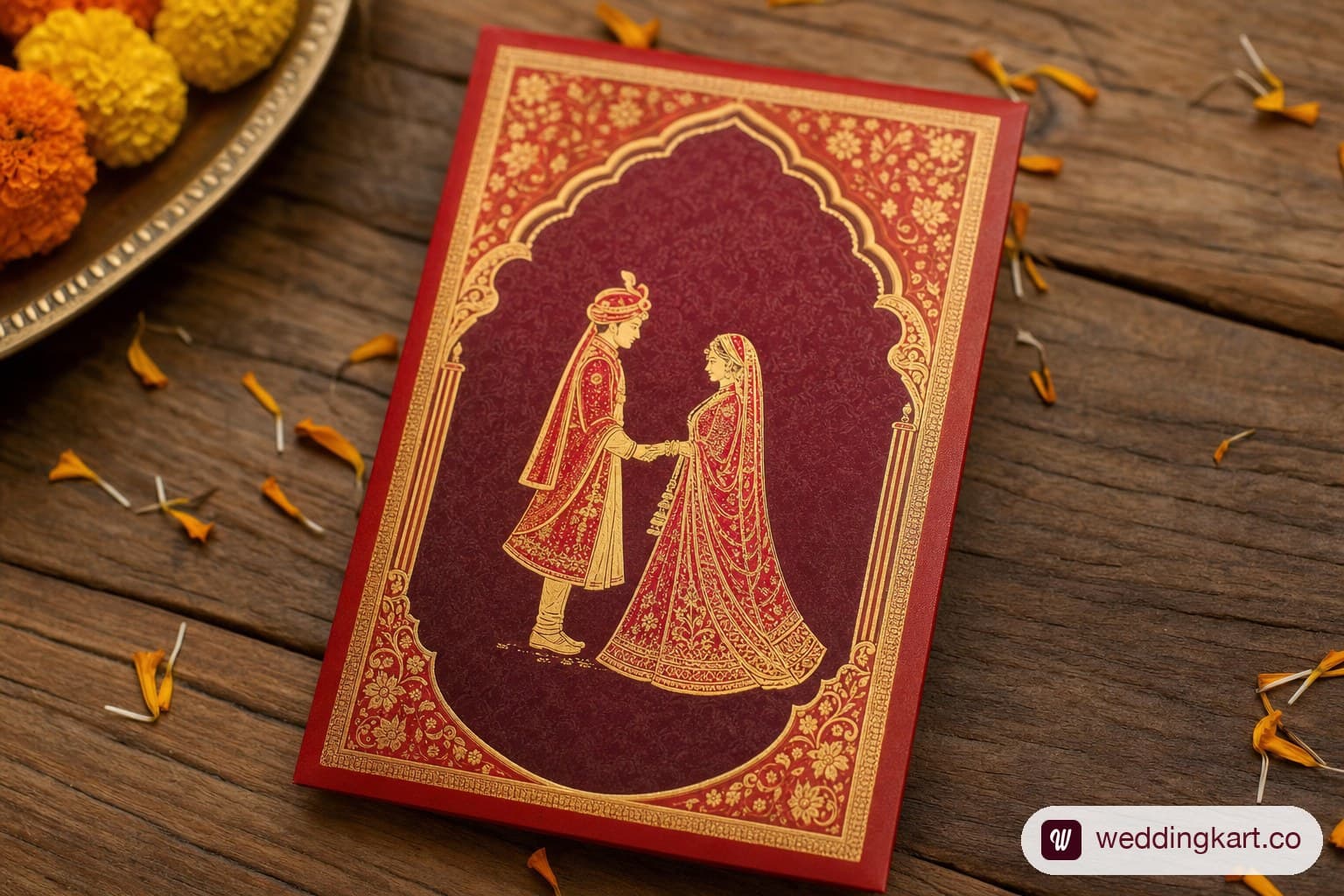
“Wedding card matter” refers to the actual written content of a wedding invitation — the wording itself, as distinct from the design, font, or layout. In Hindi-speaking families across North India, this wording follows a fairly structured, expected format, and deviating from it (missing a section, getting the honorific wrong, omitting the reception line) is the kind of thing older relatives notice immediately even if younger family members wouldn't.
Traditional Hindi wedding card structure — section by section
The opening shloka
Most traditional Hindi wedding cards open with a short Sanskrit shloka, typically invoking Lord Ganesha as remover of obstacles before any auspicious undertaking. The most commonly used opening across North Indian cards is the single line “श्री गणेशाय नमः” (“Shri Ganeshaya Namah”) set above the family name in a larger or stylised font. Families wanting a fuller verse often use the Ganesh vandana “वक्रतुण्ड महाकाय सूर्यकोटि समप्रभ। निर्विघ्नं कुरु मे देव सर्वकार्येषु सर्वदा॥”, or the shorter, widely printed “शुभस्य शीघ्रम्” (“let the auspicious happen swiftly”) as a closing tagline near the bottom of the card instead.
Family name and introduction
Below the shloka, the card introduces the hosting family — typically the father's name, sometimes the grandfather's name or family gotra/clan reference, since this signals lineage and family connection to guests who may not know the couple directly. A standard opening line follows the pattern: “श्री [पिता का नाम] एवं श्रीमती [माता का नाम] अपनी पुत्री / पुत्र के शुभ विवाह में आपकी उपस्थिति चाहते हैं” (“Shri [father's name] and Smt. [mother's name] request your presence at the auspicious wedding of their daughter/son”).
Couple's names
Names are typically written in a larger, stylised font, often preceded by “कुमारी” (Kumari, for the bride) and “चि.” (Chiranjeevi, abbreviated, for the groom) as formal honorifics — for example, “कुमारी प्रीति वेड्स चि. रोहित” or, in fully Hindi phrasing, “कुमारी प्रीति सुपुत्री … का शुभ विवाह चि. रोहित सुपुत्र … के साथ”.
Event details (Vivah, Tilak, Reception)
Each function is named explicitly using its Hindi term — विवाह (Vivah/wedding ceremony), तिलक (Tilak), स्वागत समारोह or रिसेप्शन (Reception) — with date, day, and time listed under each.
Venue and date in Hindi
Dates are commonly written in both the Gregorian format and, for more traditional cards, alongside the Hindu tithi/muhurat reference. Venue name and address follow, usually in a smaller font below the event details. If you haven't finalized your muhurat yet, our guide to Shubh Vivah Muhurat 2027 covers how these dates are calculated and listed month by month.
Nimantrak (inviting family members' names)
Below the main invitation text, a nimantrak (निमंत्रक) section lists the extended family members formally extending the invitation — typically both sides of the family, arranged by generation. This section can be long for large joint families and is one of the more customizable parts of the card.
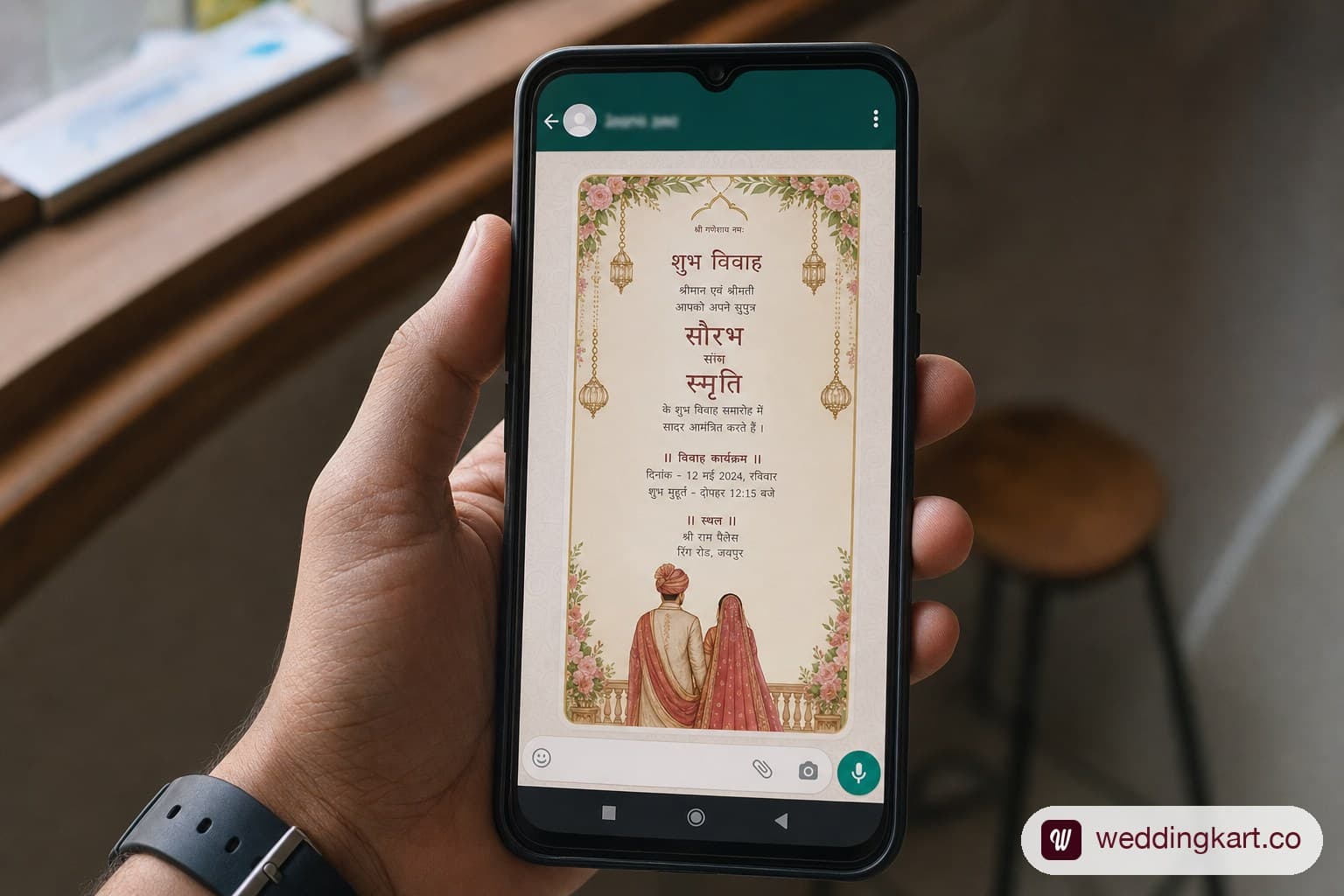
Wedding card matter samples in Hindi
Traditional Hindu wedding card matter (formal)
श्री गणेशाय नमः
वक्रतुण्ड महाकाय सूर्यकोटि समप्रभ।
निर्विघ्नं कुरु मे देव सर्वकार्येषु सर्वदा॥श्री रमेश कुमार शर्मा एवं श्रीमती सुनीता शर्मा अपनी पुत्री
कुमारी प्रीति
का शुभ विवाहश्री सुरेश कुमार गुप्ता एवं श्रीमती अनीता गुप्ता के सुपुत्र चि. रोहित के साथ करना चाहते हैं
एवं आप सादर परिवार सहित पधार कर हमें अनुगृहीत करेंविवाह मुहूर्त: शनिवार, 12 दिसम्बर 2026, रात्रि 7:00 बजे
स्थान: द ग्रैंड पैलेस, जयपुरनिमंत्रक: शर्मा एवं गुप्ता परिवार
Modern & simple Hindi wedding card matter
शुभस्य शीघ्रम्
प्रीति एवं रोहित
हमारे विवाह के इस पावन अवसर पर आपकी उपस्थिति चाहते हैं12 दिसम्बर 2026, शनिवार, सायं 7 बजे
द ग्रैंड पैलेस, जयपुरआपका आशीर्वाद ही हमारे लिए सबसे बड़ा उपहार होगा
Hindi wedding card matter for reception only
स्वागत समारोह
हमारे विवाह की खुशी में आपको सपरिवार आमंत्रित करते हैं
कृपया इस मंगल-मय अवसर पर उपस्थित होकर हमें आशीर्वाद देंदिनांक: 14 दिसम्बर 2026, सोमवार
समय: सायं 7:30 बजे से
स्थान: होटल ताज, जयपुरआपकी उपस्थिति ही हमारे लिए सबसे बड़ी खुशी होगी
Hindi + English bilingual card matter
श्री गणेशाय नमः
Preeti weds Rohit
प्रीति वेड्स रोहितWith the blessings of our families, we invite you to celebrate our wedding.
हमारे परिवारों के आशीर्वाद से हम आपको अपने विवाह के इस पावन अवसर पर सादर आमंत्रित करते हैंSaturday, 12th December 2026 | शनिवार, 12 दिसम्बर 2026
7:00 PM onwards | सायं 7:00 बजे से
The Grand Palace, Jaipur | द ग्रैंड पैलेस, जयपुर
WhatsApp wedding invite text in Hindi
🙏 शुभ विवाह निमंत्रण 🙏
प्रीति ❤️ रोहित
हमारी शादी में आपका होना हमारे लिए बेहद खास है!📅 12 दिसम्बर 2026, शनिवार
🕖 रात्रि 7 बजे
📍 द ग्रैंड पैलेस, जयपुरकृपया अपनी उपस्थिति दर्ज कराकर इस अवसर को यादगार बनाएं! 💐
Common mistakes in Hindi wedding card writing
The most frequent error is incorrect spelling of the couple's names in Hindi transliteration — a name that sounds simple in English can have multiple valid Hindi spellings, and getting this wrong on a printed card is expensive and slow to fix. A second common mistake is an incorrect or inconsistent tithi/muhurat format when the family wants to include the auspicious timing alongside the standard date. A third mistake is forgetting to include the reception invitation on the main card, forcing a separate communication later that some guests miss entirely. A fourth, particularly at larger joint-family weddings, is overloading the nimantrak section with so many names that it becomes visually cluttered rather than a meaningful acknowledgment of family involvement.
How to use free Hindi wedding card maker tools online
Several free design tools — Canva, Greetings Island, and Adobe Express among them — support Hindi text input and offer wedding card templates. The one recurring technical issue worth knowing about in advance is font compatibility: Hindi text typed in a tool using the Mangal font won't always render correctly if the recipient's device or the printer's software expects Kruti Dev encoding, or vice versa. If a printer is producing the final cards, confirm which font system they use before finalizing text, since re-typesetting Hindi text after a font mismatch is a common and avoidable delay.
Printing vs. digital Hindi wedding invitations — pros and cons
Printed cards for a 500-guest wedding typically cost ₹15,000 to ₹60,000 once design, printing, and courier delivery are factored in, and they retain a physical keepsake value that many families still consider important, particularly for the immediate family and elder relatives. Digital invitations cost close to nothing to distribute and reach guests instantly regardless of location, which matters considerably for outstation and NRI guests, but they lack that same physical presence. Most families today use a hybrid approach — a smaller batch of printed cards for close family and elders, alongside a digital version sent widely over WhatsApp.
Once your Hindi wedding card matter is finalized, sending it out to a large guest list without manually copy-pasting into hundreds of individual chats is the next practical hurdle. WeddingKart can send your finalized Hindi card matter as a personalized WhatsApp message to every guest, with their name inserted automatically at the top, even across a guest list running to 600 people.
Was this article helpful?
Share