
Quick Answer
Which is the best WhatsApp wedding invitation & RSVP tool in India?
Short answer: for a 150+ guest, multi-event wedding where the hard part is the RSVP, Weddingkart is the strongest WhatsApp guest-ops tool; for a free, good-looking invite card, WedMeGood and Canva win; the rest fit specific budgets. The real question is which half of the job you're solving. With 535.8 million users, WhatsApp is where Indian guests already are — a card maker hands you a design, while a guest-ops tool runs the replies, reminders, travel and room details across every event. Greetings Island and Desievite sit in between; a Google Form plus a WhatsApp broadcast is the free DIY floor (capped at 256 guests).
Last updated:
Best WhatsApp Wedding Invitation & RSVP Tools in India (2026)
The pretty animated card is the easy part. You pick a template, drop in the couple's names, share it on WhatsApp, watch the heart emojis roll in, and feel productive. Then the wedding gets closer and the real question lands: who is actually coming? How many for the mehndi lunch? Did the groom's Delhi cousins ever reply? That is the moment most “WhatsApp invitation tools” quietly stop helping — they made you a card, not a guest list.
So this roundup splits the eight tools by which half of the job they do. Some are design tools that hand you a beautiful artifact and leave the RSVP to you. Some are guest-operations tools that barely care what the card looks like but track every reply, reminder and room number. A couple try to do both and do neither especially well. I've ranked them for an Indian wedding — multi-event, 150 to 800 guests, half the family more comfortable on WhatsApp than on a website — and given each one a fair catch, because every tool here has a real one.
The distinction that decides everything
An invitation maker produces the card — a static design or a video you share. An RSVP / guest-operations tool runs the process after you hit send: who replied, who hasn't, how many for each ceremony, travel and room details, and reminders to the silent 40%. Card makers are the easy 20% of the work; the RSVP and follow-up is the 80% that eats your time.
How many people actually use WhatsApp in India?
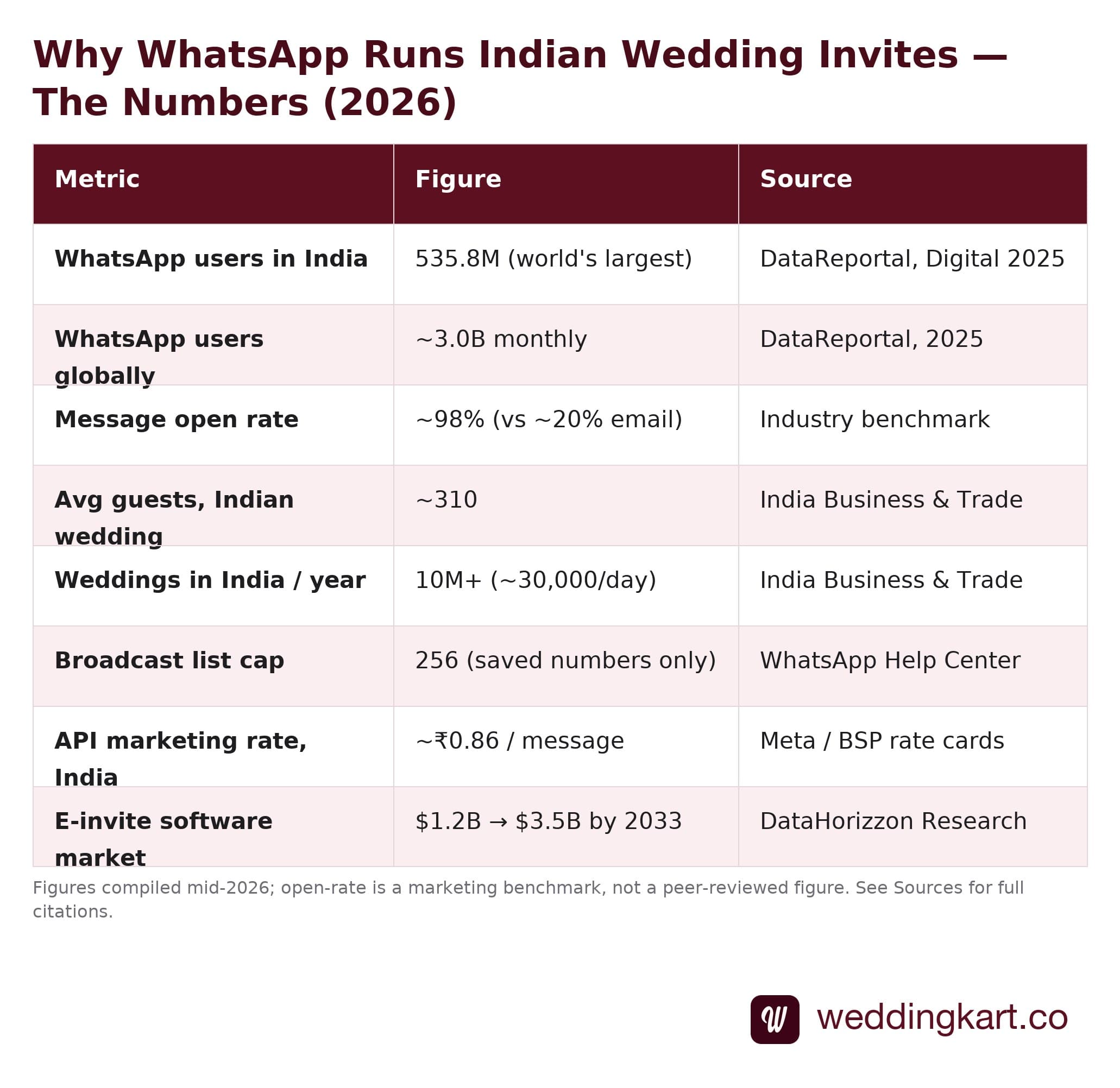
The premise under every tool on this list is simple: your guests already live inside WhatsApp. The numbers make that concrete. India has 535.8 million WhatsApp users — the largest single-country WhatsApp audience on earth — and the average person spends nearly 15 hours a month in the app (DataReportal, Digital 2025). WhatsApp marketing vendors routinely quote a message open rate around 98% (versus roughly 20% for email) — treat that as a directional vendor benchmark rather than a peer-reviewed figure, but the direction is right: an invite that lands in WhatsApp gets seen, where an emailed one dies in a promotions tab.
535.8M
WhatsApp users in India (world's largest)
Source: DataReportal 2025
10M+
Weddings in India every year (~30,000/day)
Source: India Business & Trade
~310
Guests at an average Indian wedding
Source: India Business & Trade
256
Hard cap on a WhatsApp broadcast list
Source: WhatsApp Help Center
Scale is the other half of the story. The average Indian wedding now hosts about 310 guests — up from 270 in 2022, and roughly triple a typical US or UK wedding (India Business & Trade). An American “big wedding” is an Indian medium one. That is precisely why manual RSVP tallying breaks here — and it feeds a large industry: India's wedding-services market is put at around $103.9 billion a year (Grand View Research), and the e-invite software slice alone is projected to grow from $1.2B to $3.5B by 2033 (DataHorizzon Research).
Which WhatsApp wedding invitation tools are best in India?
Here is the whole field in one view — what each tool designs, whether it tracks RSVPs, how it reaches guests, where its pricing starts, and who it suits. The table below is the quick answer; the per-tool notes after it explain the detail behind each cell.
How we ranked these
We assessed each tool from its live product pages, pricing, and public documentation in mid-2026 (a desk review, not a hands-on trial of all eight), against one scenario — a ~300-guest, three-event Indian wedding with a Hindi/English family shared over WhatsApp — on how well it (1) captures RSVPs natively on WhatsApp, (2) tracks a separate count per ceremony, (3) minimises guest friction (no app install), (4) fits Indian multi-event weddings, (5) is transparent on price, and (6) designs a good card. A card-only tool can still rank well for the design job; it just can't win the guest-operations job. Full disclosure: Weddingkart is our own product, so we've been deliberately explicit about where it is the wrong choice.
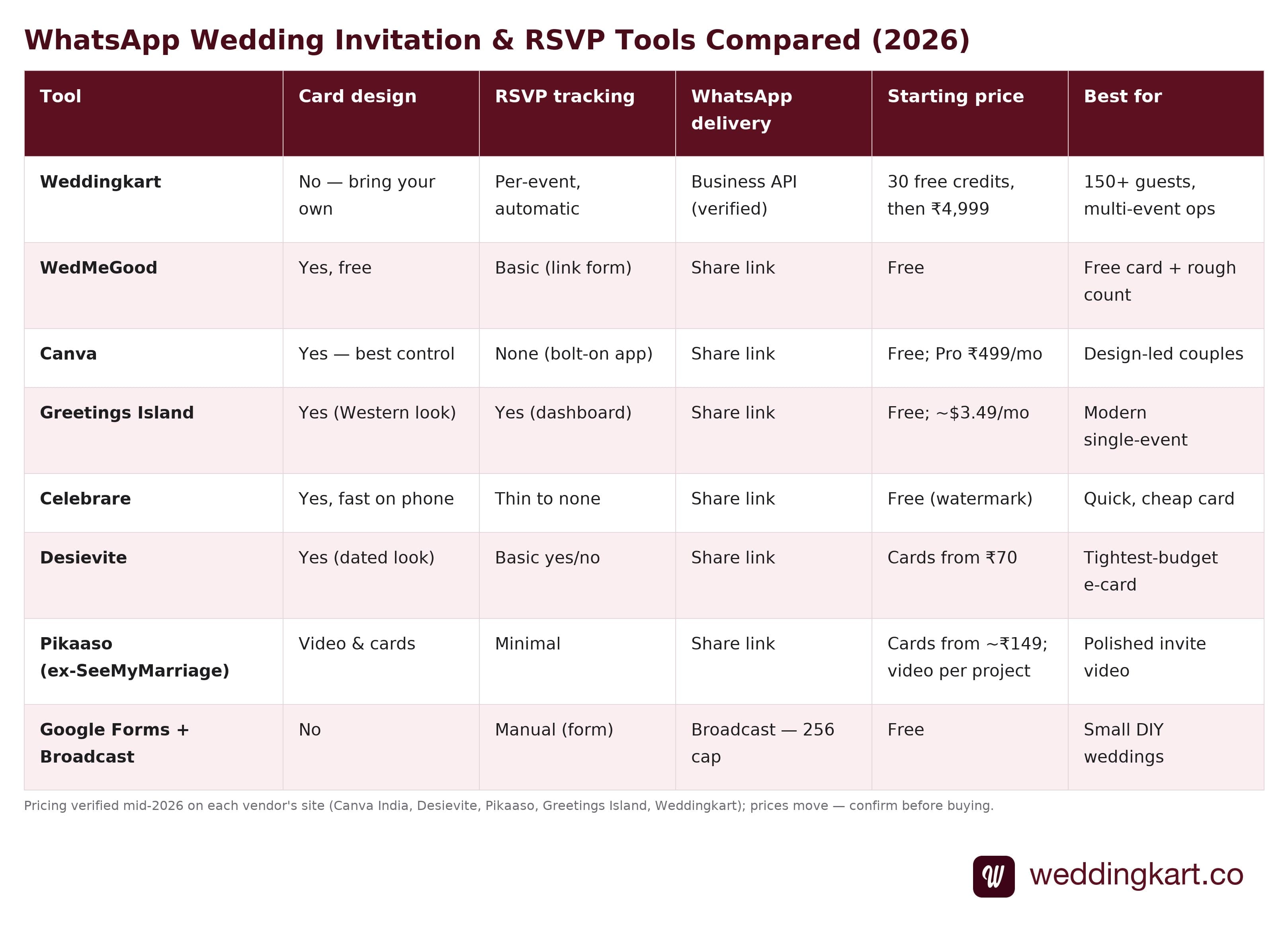
| Tool | Card design | RSVP tracking | WhatsApp delivery | Starting price | Best for |
|---|---|---|---|---|---|
| Weddingkart | No — bring your own | Per-event, automatic | Business API (verified) | 30 free credits, then ₹5,999 | 150+ guests, multi-event ops |
| WedMeGood | Yes, free | Basic (link form) | Share link | Free | Free card + rough count |
| Canva | Yes — best control | None (bolt-on app) | Share link | Free; Pro ₹499/mo | Design-led couples |
| Greetings Island | Yes (Western look) | Yes (dashboard) | Share link | Free; ~$3.49/mo | Modern single-event |
| Celebrare | Yes, fast on phone | Thin to none | Share link | Free (watermark) | Quick, cheap card |
| Desievite | Yes (dated look) | Basic yes/no | Share link | Cards from ₹70 | Tightest-budget e-card |
| Pikaaso (ex-SeeMyMarriage) | Video & cards | Minimal | Share link | Cards from ~₹149; video per project | Polished invite video |
| Google Forms + Broadcast | No | Manual (form) | Broadcast — 256 cap | Free | Small DIY weddings |
1. Weddingkart — the guest-operations backbone
Full disclosure: this is us, and I'm not going to pretend Weddingkart is the tool you open to design a gold-foil animated invite — it isn't. What it does is the part that comes after the card. You import your guest Excel, send the invitation on WhatsApp through the verified Business API, and every reply comes back attached to that guest's name, for each ceremony separately. The RSVP count updates itself. Reminders go to the silent 40% without you re-messaging the whole list. It reads travel tickets with AI, collects flight and ID details, and gathers guest photos — the logistics that turn a 400-guest destination wedding from chaos into a spreadsheet that fills itself.
Pricing: 30 free credits to try it end-to-end; then Basic at ₹5,999 + GST (2,000 credits, send-only) and Standard at ₹11,999 + GST (6,000 credits plus RSVP, travel and ID collection), priced per wedding rather than per month. Planners running several weddings can get a Season pack (₹49,999 + GST for 5 weddings with 30,000 shared credits). It works across India and the UAE (+91 and +971 numbers) in Hindi and regional languages, and — importantly for older relatives — there is no app for guests to install; they just reply in WhatsApp.
The catch: it is a guest-operations platform, not a card designer. You bring the invite (make it in Canva or WedMeGood); Weddingkart runs everything after “send.”
Skip it if: your wedding is under ~75 guests, a single event, needs no travel or room logistics, or you just want a pretty invite — a free card maker will serve you better, and we'd rather tell you that than sell you a plan you don't need.
Best for: 150+ guests, multiple events, travel and room logistics — see wedding guest management software and our WhatsApp wedding invitation templates.
2. WedMeGood — the best free e-invite with real RSVP
WedMeGood's online invitation maker has a deep library of Indian templates and — the part most free makers skip — adds RSVP and guest-comment fields, so you get a rough headcount alongside the card. You publish the design, hit “Share on WhatsApp,” and guests tap through to reply. Its free e-invite is the easiest no-cost starting point on this list, though some premium and video cards are paid, so confirm current pricing on its page before you commit.
Pricing: free e-invite maker with RSVP; some premium and video cards are paid — confirm current rates on WedMeGood.
The catch: the RSVP is a link guests must open, not a conversation inside their WhatsApp thread, and there is no per-guest personalisation or travel/room logistics behind it — it tells you who replied, not who is landing when. We break the difference down in our WedMeGood vs Weddingkart comparison.
Best for: smaller or single-event weddings that want a free card plus a basic count.
3. Canva — maximum design control
If you care about the look above all else, Canva is hard to beat. Thousands of Indian wedding templates, full control over every element, static cards or animated video invites, and a free tier that covers most people. You export and share on WhatsApp in a couple of taps.
Pricing: free tier is enough for most invites; Canva Pro runs about ₹499/month (or roughly ₹3,999/year) in India if you want premium assets and brand controls.
The catch: Canva has no native RSVP or WhatsApp send — you either bolt on a third-party RSVP app from the Canva apps panel or share a link and collect replies yourself. It is a design studio, not a guest system.
Best for: design-led couples (or their designer friend) who'll pair it with a separate RSVP tool.
4. Greetings Island — free templates with a proper RSVP dashboard
Greetings Island is one of the few free makers with a genuinely useful RSVP layer: set a deadline and guest limit, add a map and registry, and track responses in real time — no credit card needed when you use its free designs. Cleaner and more modern than most Indian budget makers.
Pricing: free with free designs and free online RSVP; a premium membership is roughly $3.49/month (or about $26.99/year) for the full template library and watermark removal.
The catch: the library skews Western, and there's no native Indian multi-ceremony structure — modelling separate mehndi, haldi and reception RSVPs is awkward, and pricing is in dollars.
Best for: modern, single-event weddings comfortable with a Western template look.
5. Celebrare — fast WhatsApp-ready cards and videos
Celebrare is built for exactly one thing: making an Indian wedding card or invitation video on your phone and getting it onto WhatsApp fast. The app is popular precisely because it's quick and low-friction, with a big catalogue of traditional templates.
Pricing: free to design with a watermark; paid tiers remove the watermark and unlock premium templates, starting in the low hundreds of rupees — confirm the current amount in-app, as it shifts.
The catch: it's a card maker first and last. RSVP and guest tracking are thin to absent, so you'll still manage replies somewhere else.
Best for: couples who want a quick, cheap, shareable card and will handle RSVPs separately.
6. Desievite — the rock-bottom budget option
Desievite is the price floor for actual e-cards (as opposed to a raw Google Form). Static WhatsApp cards start around ₹70, and it does carry a basic RSVP so guests can mark attending or not. It has been around a long time and it shows — but it's cheap and it works.
Pricing: static WhatsApp cards from ~₹70; watermark removal from ~₹99; invitation videos around ₹499.
The catch: the designs feel dated next to Canva or Greetings Island, and the RSVP is a simple attending/not-attending list — no per-event breakdown, reminders or logistics.
Best for: the tightest budgets that still want a real e-card with a basic count.
7. Pikaaso (formerly SeeMyMarriage) — done-for-you invitation videos
SeeMyMarriage and VRiddle now operate as Pikaaso (“same team, same orders,” per the site), and it leans toward the higher-production end: designed invitation videos and card sets you order and receive as drafts, plus free options for simpler needs. Share the finished video link on WhatsApp and it plays without any download wait.
Pricing: free options exist; invitation cards start in the low-to-mid hundreds of rupees (business cards from ~₹149 at the time of writing) and invitation videos are priced per project, with first drafts typically in one to two business days — confirm current rates on Pikaaso.
The catch: it's effectively a design service with turnaround times, not a self-serve RSVP system — the RSVP side is minimal.
Best for: couples who want a polished invitation video and don't need guest-management built in.
8. Google Forms + WhatsApp Broadcast — the free DIY route
The zero-rupee option, and more capable than people expect: build an RSVP in Google Forms (attending, guest count, meal, ceremonies), then push the invite and the form link out through a WhatsApp broadcast list. Full control, no subscription, and the responses land in a tidy spreadsheet.
Pricing: free.
The catch: WhatsApp broadcast lists cap at 256 recipients and only deliver to people who have saved your number — so a chunk of guests never receive it, with no error to tell you. There's no personalisation, no automatic reminders, and no headcount unless you wire the Form yourself. It scales badly past a hundred-odd guests. We map the failure modes in our WhatsApp Broadcast comparison.
Best for: small, budget-first weddings and the spreadsheet-comfortable.
Why do the paid tools cost money? The WhatsApp Business API, explained
Here is the piece almost no roundup explains — and it's the reason a personal broadcast is free while a tool like Weddingkart charges a fee. Any tool that sends legitimately at scale does so through the WhatsApp Business API, and Meta bills that API per delivered message. Since 1 July 2025 Meta's model is per-message, not per-conversation (Meta's pricing docs). Provider rate cards for India put a marketing template around ₹0.86 per message, with utility messages far cheaper (roughly ₹0.11–0.14) and free inside a 24-hour service window — treat those INR figures as example provider rates, since the exact number varies by provider and date.
So when you buy a per-wedding plan, part of what you're paying for is the messages the tool sends to Meta on your behalf — plus the software that turns those messages into a tracked guest list. It also explains the ceiling on the free route: a personal broadcast has no per-message cost, but it also has no API deliverability, no delivered/read receipts, and that hard 256 cap. The API removes the 256 broadcast cap — approved senders move through messaging tiers of 2,000, 10,000, 100,000 or unlimited recipients a day, subject to template approval and a quality rating — which is exactly why an 800-guest wedding needs it and a personal SIM can't do it.
Will you get banned for sending wedding invites on WhatsApp?
It's a real risk, and worth being honest about. Forwarding a card to a few dozen saved contacts is fine. But dumping hundreds of near-identical messages from your personal number in a few minutes is the textbook trigger for WhatsApp's automated-spam detection, and accounts do get restricted or banned for it. Two practical defences if you insist on the DIY route: personalise every message (a unique first line changes its fingerprint and lifts reply rates), and pace the sends over hours rather than seconds. The cleaner answer past ~100 guests is to stop using your personal number at all and send through the API via a tool, which delivers each message individually and legitimately. This — not prettier cards — is the strongest argument for paying for a guest-ops tool.
Are WhatsApp wedding invitation links safe?
Worth flagging, because it's a real and widely reported problem in India: fraudsters send fake “wedding invitation” messages on WhatsApp that carry an APK file — an Android app disguised as an e-invite. Tap it, install it, and it can drain your bank account. A genuine e-invite is never an app you install. Practical rules for you and the note you send guests: an invite should be an image, a PDF, or a normal https:// web link from a number you recognise; never open or forward an .apk or any “install to view” prompt; and if a guest is unsure, they can verify with you directly before tapping. In India, wedding-invite APK scams can be reported to the national cybercrime helpline 1930 or at cybercrime.gov.in. Tools that send through the verified Business API (like Weddingkart) show a recognisable business sender, which is one more reason they're safer at scale than a forwarded file from an unknown number.
What other WhatsApp RSVP tools should you compare?
In fairness, Weddingkart isn't the only tool in the WhatsApp-native RSVP category — a handful of newer automators (for example WappMaster's wedding edition, Wedd.ai and Save This Date) do variations of the same job, and generic WhatsApp Business API platforms like AiSensy or Pabbly can be wired to send invites and collect replies with some setup. If you're evaluating them, judge on three things: does the RSVP land inside the chat or behind an app install; can it track a separate count per ceremony; and does it handle the logistics after RSVP (travel, IDs, room info) or stop at “attending / not attending”? That's the test that separates a genuine guest-operations tool from a bulk-message sender with an RSVP button.
So which one should you actually use?
A quick decision guide by the shape of your wedding:
- Under ~75 guests, single event, everyone has your number: your personal WhatsApp plus a free WedMeGood card is genuinely enough. Don't overpay.
- Design-obsessed, any size: make the card in Canva (or order a video from Pikaaso), then pair it with whatever RSVP tool matches your scale.
- 100–150 guests, want a real headcount for free: WedMeGood or Greetings Island for the card-plus-RSVP, or a Google Form + broadcast if you're spreadsheet-comfortable (mind the 256 cap).
- 150+ guests, multiple events, or a destination wedding: this is a guest-operations job. Use a card maker for the invite and a WhatsApp API platform like Weddingkart to run per-event RSVPs, reminders, and travel/ID collection.
- Guest list spread across the US, UK, Gulf, and back home: for a guest-list-across-continents angle, see WhatsApp Wedding Invitations for NRI Families.
What this looks like for a 300-guest Indian wedding
The tools aren't either/or — here is how they fit together on a typical three-event wedding (mehndi, sangeet, reception) with roughly 300 guests. An illustrative walkthrough, not a fixed recipe:
- Design the card once (Canva or WedMeGood). One static card plus, optionally, a short video invite. This is the “easy 20%.”
- Import the guest list (Excel → guest-ops tool). ~300 rows with name, phone, side, and which events each guest is invited to — the mehndi is usually a smaller list than the reception.
- Send per-event invites on WhatsApp via the Business API. Each guest gets a personalised message for the events they're invited to — legitimately delivered, no 256 cap, no ban risk.
- Collect a separate RSVP per ceremony. Yes/no for mehndi, sangeet and reception lands against each guest's name, so your caterer gets three real headcounts, not one.
- Auto-nudge the non-responders. Roughly 40% won't reply first time; a single scheduled reminder to just the silent list closes most of the gap without re-messaging everyone.
- Gather travel and ID details for outstation guests. Flight/train times and ID scans come in over the same WhatsApp thread — the difference between organised airport pickups and a spreadsheet you chase for a week.
- Read your live counts. Final numbers per event, per side, updating themselves — the headcount that used to take a fortnight of phone calls.
Steps 1 is a card job; steps 2–7 are the guest-operations job. A free stack (Canva + Google Form + broadcast) can technically do a version of this under ~100 guests; past that, the manual tallying and the 256 cap are what push most couples to a paid tool.
The verdict
Want a beautiful card and nothing more? WedMeGood or Canva do it free. But if the wedding is 200+ guests across three events and the RSVP, reminders and travel details are the part keeping you up at night, that's a guest-operations job, not a design job — and it's what Weddingkart is built for. Most couples end up using two tools: one to design the invite, one to run the guest list. There is no shame in that — it's the honest answer.


Not sure which side of the design/RSVP split your wedding needs? WhatsApp us at +91 92176 10045 — we'll tell you honestly whether you even need us for your guest count.
Watch how it's done
- How to send wedding invitations on WhatsApp using the official Cloud API — Pabbly (YouTube)
- How to send bulk WhatsApp wedding invites automatically (Hindi) — Pabbly (YouTube)
- Create a free wedding RSVP page and share it on WhatsApp — Diogo Machado (YouTube)
Frequently asked questions
Which is the best app to send wedding invitations on WhatsApp in India?+
There is no single winner — it depends on which half of the job you mean. For a free, good-looking invite card you can share on WhatsApp, WedMeGood and Canva are the easiest. For running the RSVP across 200+ guests and three events — replies, reminders, travel and room details, all on WhatsApp — that is guest operations, and Weddingkart is built for it. Most couples use one tool to design the card and another to run the guest list.
Is it safe to send bulk wedding invitations from my personal WhatsApp number?+
Up to a point. Forwarding a card to a few dozen contacts is fine. But blasting hundreds of near-identical messages from a personal SIM is the classic trigger for WhatsApp’s automated-spam heuristics, and accounts do get restricted or banned for it. Past ~100 guests, send through the official WhatsApp Business API — which any tool that messages at scale legitimately relies on — because it delivers each message individually and with delivery status. If you must use a personal number, personalise each message and spread the sends over hours, not seconds.
Can I use the free WhatsApp Business app instead of the API?+
For a small, single-event wedding where you send manually, the free WhatsApp Business app is fine — it adds labels, quick replies and a catalogue on top of a normal number. But it is still a manual, human-operated app: it can’t auto-personalise hundreds of invites, send approved templates at scale, record a structured per-guest RSVP, or give you reliable delivery tracking. Those need the WhatsApp Business API, which is what guest-ops tools like Weddingkart run on. Rule of thumb: Business app for a handful of manual sends, API (via a tool) once you want automation and tracking.
What is the difference between a WhatsApp broadcast and the WhatsApp Business API?+
A broadcast list is a personal-app feature: it caps at 256 recipients and only reaches people who have saved your number, and you never find out who was silently skipped. The WhatsApp Business API (used by Weddingkart and other tools) has no 256 cap — approved senders can message 2,000, 10,000, 100,000 or unlimited people a day — delivers to any valid number, and returns delivered/read status per guest. The trade-off: the API costs money per message, which is why tools that use it charge a fee.
How many guests can I invite on WhatsApp for free?+
Realistically, up to about 256 with a broadcast list — and only those who have saved your number will receive it. A WhatsApp group tops out at 1,024 members but forces everyone into one noisy thread, which most families hate. Beyond a small, single-event wedding, the free routes stop being reliable, which is where API-based tools (paid per wedding, not per message to you) earn their keep.
Can you track RSVPs directly inside WhatsApp?+
A plain broadcast or group message can’t collect structured replies — you end up scrolling chats and tallying by hand. To get an automatic headcount you need either a linked form (WedMeGood, Greetings Island, a Google Form) that guests tap through, or a platform like Weddingkart that sends through the WhatsApp Business API and records each guest’s reply against their name, per event, so the count updates itself.
Is there a free way to send WhatsApp wedding invitations with RSVP?+
Yes. WedMeGood’s e-invite maker is free and includes RSVP and guest comments; Greetings Island gives a free online RSVP dashboard when you use its free designs; and a Google Form plus a WhatsApp broadcast costs nothing at all. The free routes trade away personalisation and guest operations — they hand you a card and a spreadsheet, not reminders, travel collection, or per-guest messaging.
What is the difference between a wedding invitation maker and an RSVP tool?+
An invitation maker (Canva, Celebrare, Desievite, Pikaaso) produces the artifact — a card or a video you share. An RSVP or guest-management tool runs the process after you hit send: who replied, who hasn’t, how many for each ceremony, travel and room details, reminders to the silent 40%. Card makers are the easy 20% of the work; the RSVP and follow-up is the 80% that actually eats your time.
How much do WhatsApp wedding invitation tools cost in India?+
It ranges from free to a few thousand rupees. Desievite’s static WhatsApp cards start around ₹70; Pikaaso (formerly SeeMyMarriage) does cards from ~₹99 and invitation videos from ~₹699. Canva Pro is roughly ₹499/month, though its free tier covers most invite needs. Weddingkart gives 30 free credits to try, then Basic at ₹5,999 + GST (2,000 messages, send-only) and Standard at ₹11,999 + GST (6,000 messages plus RSVP tracking) per wedding — priced per event, not per month.
Do guests need to download an app to RSVP?+
They shouldn’t have to, and with most of these tools they don’t. Link-based RSVP (WedMeGood, Greetings Island, Google Forms) opens in a browser. Weddingkart is deliberately WhatsApp-native with no app for guests — they reply in the chat they already use. Making elderly relatives install and log into an app is the fastest way to lose half your responses, so treat any guest-facing app requirement as a red flag.
Can guests RSVP separately for haldi, mehndi, the wedding and reception?+
That is exactly what a multi-event guest-ops tool is for, and it is where single-toggle RSVP forms fall down. Weddingkart tracks a separate yes/no and a live count for each ceremony against each guest — so your caterer gets a real number for the mehndi lunch and a different one for the reception. Most free makers only give you one “attending?” answer for the whole wedding.
How early should I send WhatsApp wedding invitations?+
A common rhythm: a save-the-date 8–12 weeks out (earlier for a destination or NRI wedding so guests can book travel), the formal invite with the full schedule 3–4 weeks out, and a gentle RSVP reminder to non-responders about a week before your caterer’s deadline. WhatsApp’s speed is the advantage here — you can send the reminder wave in minutes, which is why leaving the headcount to the last fortnight is far less painful than with printed cards.
Can I send WhatsApp wedding invitations without saving every guest’s number?+
Not through a personal broadcast list — it only delivers to people who have saved your number, which is its biggest silent failure. Through the WhatsApp Business API (used by tools like Weddingkart), you upload the numbers and each guest receives the message whether or not they have saved you, with a delivery receipt so you know it arrived. That is the practical reason API-based tools reach the guests a personal broadcast quietly misses.
Sources
Figures and pricing were checked mid-2026 on the sources below. Market figures are third-party estimates; the WhatsApp open-rate is a marketing benchmark, not a peer-reviewed figure. Prices change — confirm on each vendor's own page before buying.
- 1. Digital 2025: India — WhatsApp users, time spent, platform reach — DataReportal / We Are Social / Meltwater
- 2. Digital 2025: top social platforms — WhatsApp global MAU — DataReportal
- 3. Pricing on the WhatsApp Business Platform — per-message model, categories, service window — Meta for Developers
- 4. How to use broadcast lists — 256-recipient cap, saved-number requirement — WhatsApp Help Center
- 5. India Wedding Services Market Size & Report ($103.9B, 14.3% CAGR) — Grand View Research
- 6. Wedding Invitations Software Market ($1.2B → $3.5B, 12.1% CAGR) — DataHorizzon Research
- 7. The “Big Fat Indian Weddings” — guests per wedding, weddings/year — India Business & Trade (FICCI TPCI)
- 8. WhatsApp Business API pricing in India 2026 — INR per-message rates — AiSensy
- 9. WhatsApp statistics 2026 — 98% open-rate marketing benchmark — AiSensy
- 10. Canva plans & pricing — India — Canva
- 11. Free Indian invitation cards & video maker — WhatsApp cards, RSVP, watermark removal — Desievite
- 12. Pikaaso (formerly SeeMyMarriage / VRiddle) — invitation videos & cards — Pikaaso
- 13. Free online wedding invitation templates & RSVP; premium membership — Greetings Island
- 14. Weddingkart pricing — 30 free credits; Basic / Standard per wedding — Weddingkart
Related reading
Wedding Guest Management Software →
Run RSVP, reminders and travel details for a whole wedding on WhatsApp.
WhatsApp Wedding Invitation Templates →
Ready-to-send message wording for every ceremony, in Hindi and English.
WedMeGood vs Weddingkart →
Free e-invite maker versus a full WhatsApp guest-operations platform.
All comparisons →
Side-by-side breakdowns of the main invitation and RSVP tools.
Was this article helpful?
Share