
Quick Answer
What dishes are served at a Gujarati wedding?
A traditional Gujarati wedding thali is 100% vegetarian and features 25–40+ items across five categories: farsan (savoury snacks — dhokla, khandvi, patra, samosa), dal/kadhi/shaak (Gujarati dal, kadhi, undhiyu, sev tameta shaak), rice/khichdi, breads (puri, thepla, bhakri), and sweets (mohanthal, shrikhand, basundi, jalebi). Catering costs in Ahmedabad in 2026 range from ₹400–₹700 per plate for a standard thali to ₹2,000–₹3,500+ at luxury venues.
Last updated:
Last updated:
All PostsGujarati Wedding Food Menu: Traditional Dishes & Catering Guide (2026)
By Mayank JaiswalLast updated
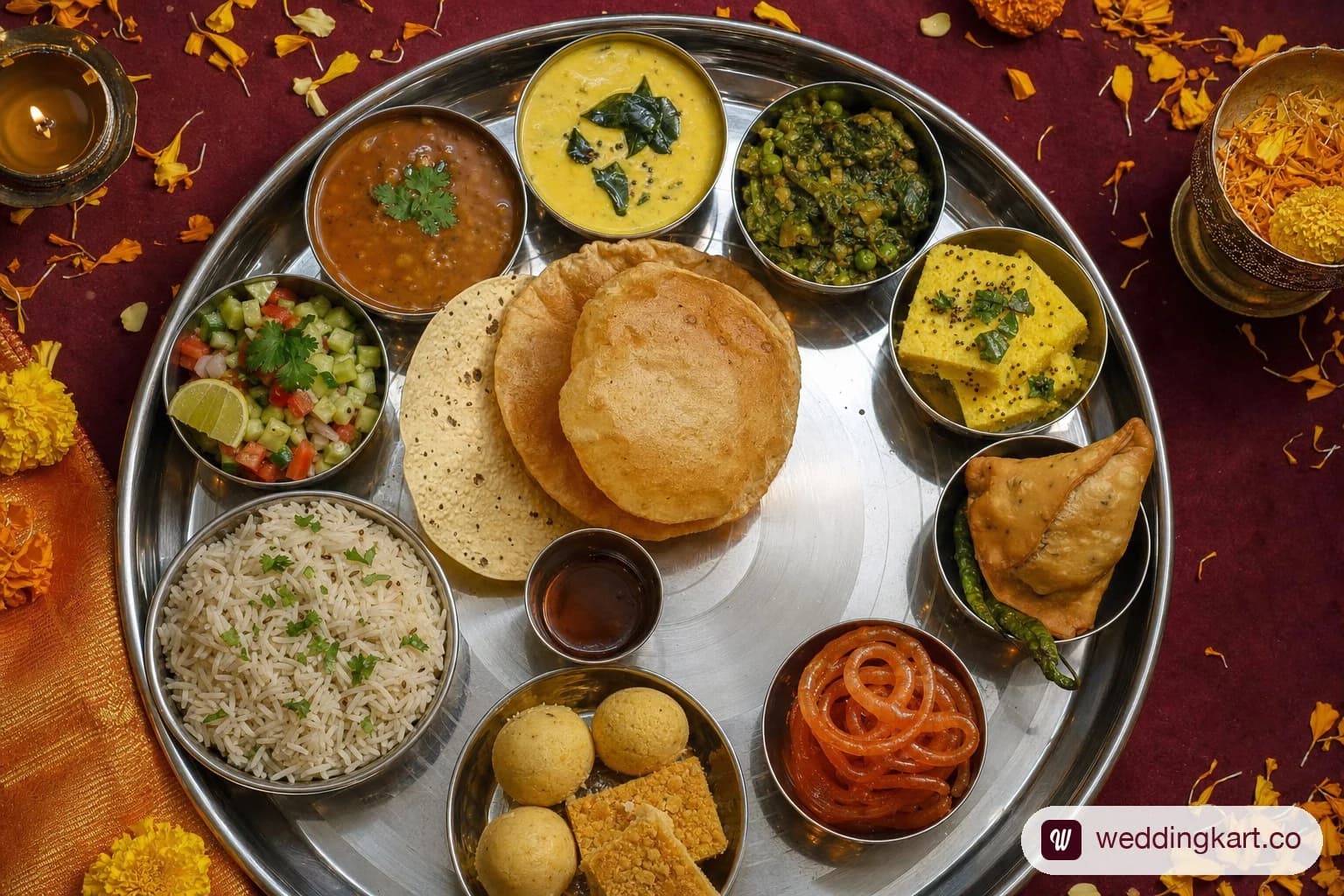
If there's one thing every Gujarati family takes as seriously as the wedding rituals themselves, it's the food. Gujarati weddings are almost always 100% vegetarian, and the spread isn't an afterthought — it's a central expression of hospitality, often the thing guests remember and talk about for years. A "good" Gujarati wedding is, in many ways, judged by how good (and how much) food was served.
This guide breaks down the traditional Gujarati wedding thali dish-by-dish, walks through function-wise menu planning (Mehendi vs Garba vs the main wedding vs reception), and gives you realistic 2026 catering cost estimates for Ahmedabad — plus a customisable menu template you can share with your caterer.
What Makes Gujarati Wedding Food Special
Gujarati cuisine is famous for its balance of sweet, salty, and tangy flavours — often within a single dish. Jaggery, tamarind, and yogurt are used liberally, and even savoury dishes like kadhi and dal carry a distinct sweetness that surprises first-time guests. Because the cuisine is entirely vegetarian (and for Jain families, also free of onion, garlic, and root vegetables), Gujarati caterers have developed an enormous repertoire of dishes that make a vegetarian spread feel anything but limited — often featuring 25–40+ items across a single wedding-day thali and accompanying counters.
Hospitality (atithi satkar) is a core value, and food is the primary vehicle for it. It's common for hosts to personally walk around urging guests to "just try one more thing" — and for caterers to keep refilling thalis without being asked. Portion sizes are generous, and running out of food is considered a serious social embarrassment for the host family.
The Traditional Gujarati Wedding Thali — Complete Breakdown
A full Gujarati wedding thali is built around five core categories: farsan (snacks), dal/kadhi/shaak (curries and gravies), rice/khichdi, breads, and sweets. Here's what you'll typically find in each.
Farsan (Snacks & Starters)
Farsan refers to Gujarat's famous category of savoury snacks — crispy, fried, and often served as both a starter and a side throughout the meal.
- Dhokla — Steamed, spongy fermented gram-flour cakes, tempered with mustard seeds and curry leaves.
- Khandvi — Delicate rolled gram-flour spirals tempered with mustard seeds and coconut.
- Patra (Patra/Aluvadi) — Colocasia (arbi) leaves rolled with a spiced gram-flour paste, steamed and pan-fried.
- Khaman — A softer, fluffier cousin of dhokla, often topped with grated coconut and coriander.
- Samosa — The classic potato-and-pea stuffed pastry, always a crowd favourite.
- Kachori — Deep-fried pastry filled with spiced lentils or peas.
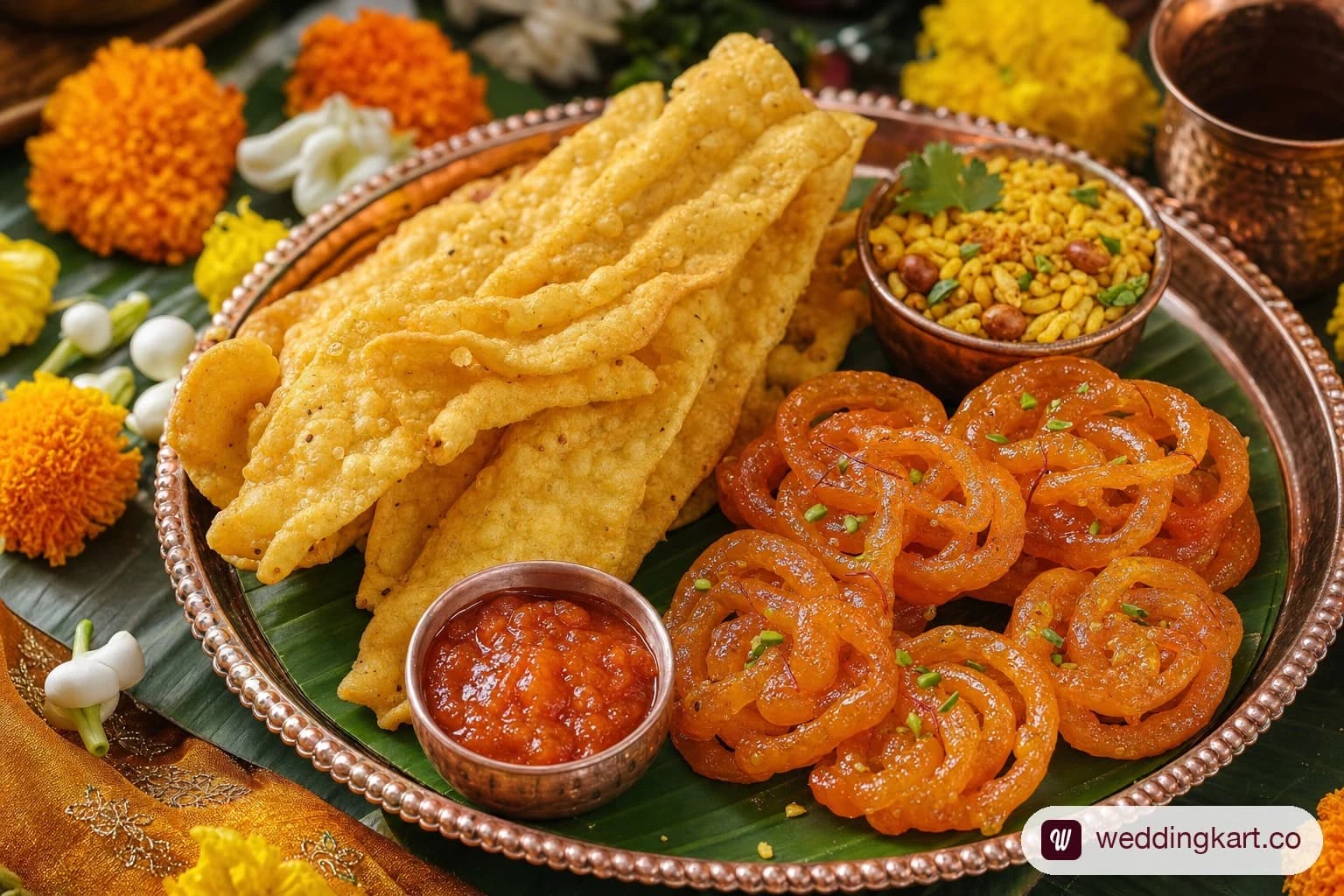
- Fafda — Crispy gram-flour strips, traditionally served with papaya chutney (often paired with jalebi for breakfast functions).
- Handvo — A savoury, dense rice-and-lentil cake baked with vegetables, often cut into wedges.
- Methi Gota — Deep-fried fenugreek-leaf dumplings, popular in winter weddings.
- Chevdo / Sev — Crunchy mixed snack mixes served as table nibbles throughout the event.
Dal, Kadhi & Shaak
The "wet" component of the thali — these are the dishes ladled fresh onto the plate by serving staff.
- Gujarati Dal — A distinctive sweet-and-sour lentil curry made with jaggery, tamarind, and a tempering of cumin, mustard seeds, and curry leaves.
- Kadhi — A yogurt-and-gram-flour based curry, lightly sweetened and tempered with curry leaves, mustard seeds, and sometimes fenugreek seeds (methi).
- Undhiyu — A slow-cooked mixed vegetable dish (a wedding-season specialty, especially in winter) combining surti beans, sweet potatoes, brinjal, and methi muthiya (dumplings).
- Sev Tameta nu Shaak — A tangy tomato curry topped with crispy sev.
- Bateta nu Shaak — A simple, comforting dry potato preparation, often spiced with mustard seeds and turmeric.
- Ringna no Olo — A smoky roasted eggplant mash, a regional favourite at larger spreads.
- Gujarati Mix Veg — A lightly spiced, sweet-leaning mixed vegetable curry that's a thali staple.
Rice & Khichdi
- Khichdi — A simple rice-and-lentil preparation, often served alongside kadhi as a comfort-food combination ("kadhi-khichdi") near the end of the meal.
- Vagharela Bhaat — Tempered/seasoned rice, lightly spiced with whole spices and sometimes peas.
- Jeera Rice — Cumin-flavoured steamed rice, a lighter alternative for the reception spread.
- Pulao / Biryani counters — Increasingly common at modern Gujarati wedding receptions as a "fusion" addition alongside the traditional thali.
Breads (Puri, Thepla & More)
- Puri — Deep-fried, puffed wheat bread — a thali essential, served piping hot.
- Thepla — Spiced, pan-fried flatbread made with fenugreek leaves or other greens, often part of the Mehendi/travel-day spread.
- Bhakri — A slightly thicker, often slightly sweet flatbread, sometimes served with the main thali.
- Naan / Roti counters — Common additions for the reception's "live counter" sections.
Sweets & Desserts (Must-Haves)
No Gujarati wedding thali is complete without at least 3–4 sweets — and often many more at the main event.
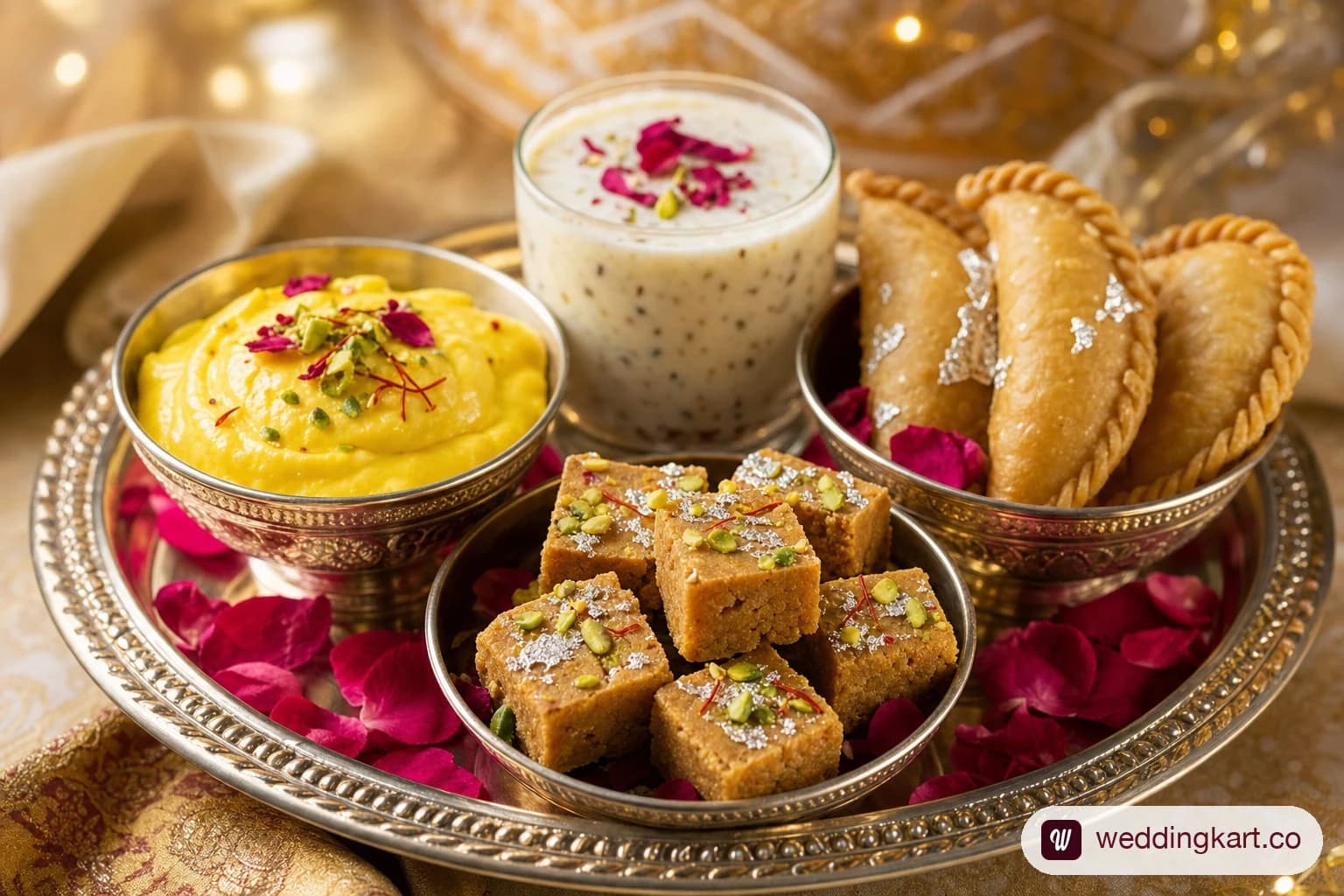
- Mohanthal — A dense, fudge-like sweet made from gram flour, ghee, and sugar, garnished with nuts — arguably the signature Gujarati wedding sweet.
- Shrikhand — Strained, sweetened yogurt flavoured with saffron and cardamom, often served with puri (a beloved combination).
- Basundi — A rich, reduced sweetened milk dessert similar to rabri, often garnished with pistachios and saffron.
- Jalebi — Crispy, syrup-soaked spiral sweets, classically paired with fafda for a breakfast/Mehendi-day combination.
- Ghughra (Gujiya) — Fried, crescent-shaped pastries filled with sweetened khoya/coconut, especially popular during winter weddings.
- Lapsi — Sweetened broken-wheat porridge, often made as a ceremonial offering as well as a dessert.
- Ice cream / kulfi counters — A near-mandatory modern addition to the reception dessert spread.
Function-Wise Menu Guide
Different functions call for very different menus — both in formality and in food style. Here's how Ahmedabad caterers typically structure each event's spread.
Mehendi Night Menu
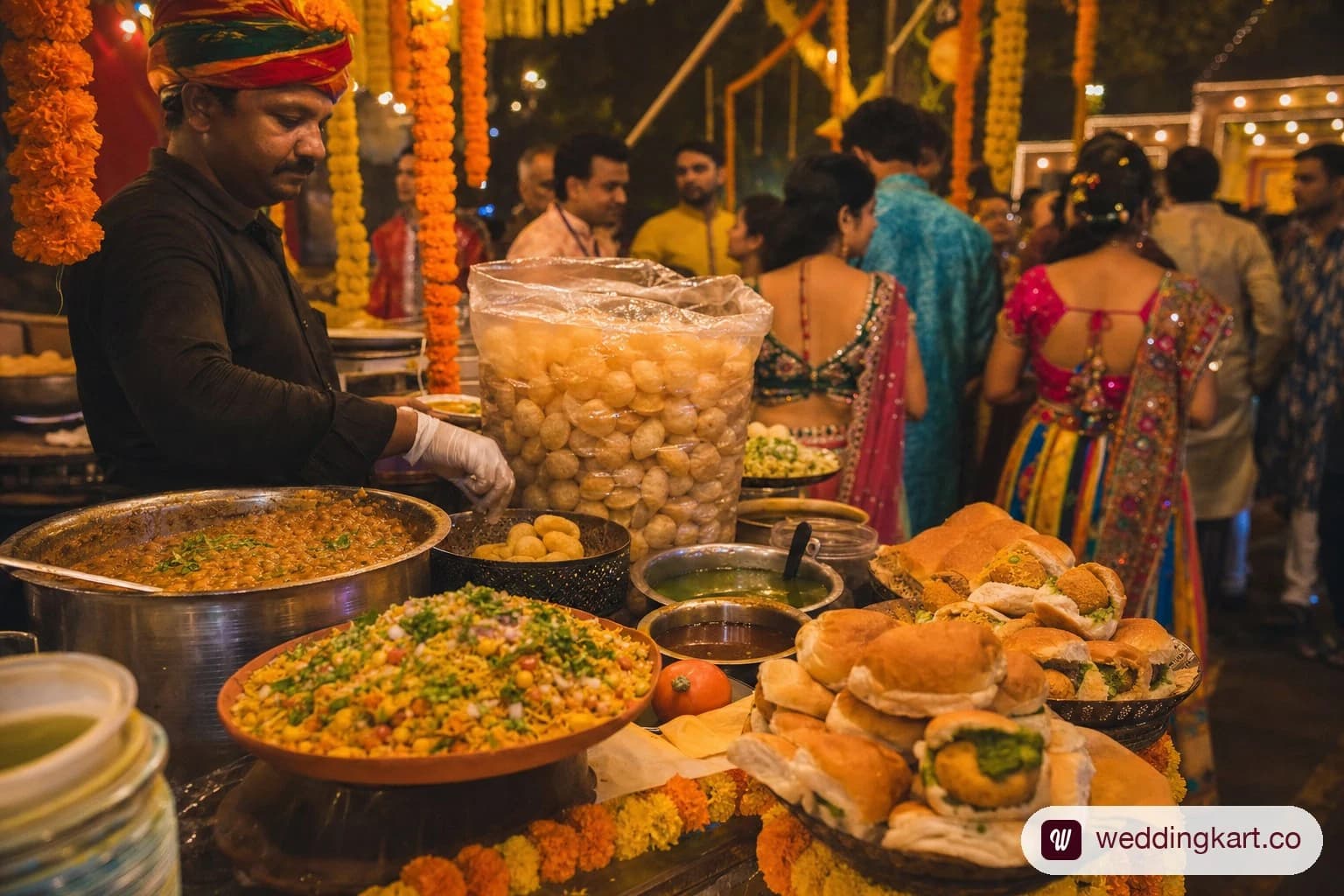
Since Mehendi often runs for several hours with guests seated for long stretches getting henna applied, the menu leans towards light, easy-to-eat snacks that don't stain hands or require cutlery: dhokla, khaman, fafda-jalebi, chaat counters (pani puri, bhel puri, sev puri), and cold beverages like chaas (buttermilk), aam panna, and flavoured lemonade. Tea and coffee counters are essential, especially for evening Mehendi functions that run late.
Garba Night Snacks
Garba nights are high-energy — guests are dancing for hours, so the food needs to be quick, portable, and replenishing. Expect multiple live counters: chaat stalls (pani puri, dahi puri), pav bhaji, vada pav, and grilled sandwich counters, plus a dedicated thandai or flavoured milk station (especially popular for evening functions in cooler months). Fruit and juice counters help guests rehydrate between dance sets.
Wedding Day Full Thali
This is the main event — the elaborate, sit-down (or buffet-style) thali described in the breakdown above, typically featuring 20–30+ items served across multiple courses: a farsan/starter round, the main thali with dal-kadhi-shaak-rice-roti, and a dedicated dessert counter. Live counters (chaat, pasta, or regional specialty stations) are increasingly added to the traditional thali for variety, especially at larger weddings (500+ guests).
Reception Dinner Menu
The reception is where Gujarati families tend to introduce more "fusion" and global cuisine options alongside (or sometimes instead of) the traditional thali — Italian/Mexican live counters, Asian/Chinese stations, North Indian curries, and elaborate dessert bars (chocolate fountains, live dessert counters) are common at mid-range and premium receptions. That said, many families still insist on at least a partial traditional Gujarati spread at the reception out of respect for older relatives who prefer it.
How to Plan Catering for 500–1,000 Guests in Ahmedabad
Catering for a wedding of this scale in Ahmedabad requires careful planning across several dimensions:
- Per-head cost estimation: Multiply your expected guest count by the per-plate rate (see cost table below) — but always negotiate based on the minimum guaranteed headcount the caterer will charge for, as most caterers set a minimum (often 70–80% of your invited list) regardless of actual attendance.
- In-house vs outside caterers: Most 5-star hotels and premium banquet venues in Ahmedabad mandate in-house catering (or charge a hefty "outside catering fee" if you bring your own). Party plots and farmhouses are generally more flexible, allowing you to hire independent caterers — often at a lower overall cost.
- Live counters vs plated/buffet service: Live counters (where food is cooked or assembled in front of guests) are more expensive per item but reduce overall food wastage since items are made fresh in smaller batches. For very large weddings (800+), a hybrid of buffet stations plus 2–3 live counters tends to balance cost and guest experience.
- Dietary restrictions: Always confirm with your caterer about Jain food requirements (no onion, garlic, or root vegetables) if any portion of your guest list follows Jain dietary practices — this typically requires a separate cooking setup/counter, so flag it early.
- Headcount accuracy is everything: With 500–1,000 guests spread across multiple functions (Mehendi, Garba, wedding, reception), knowing exactly how many people are attending each specific function — not just the wedding overall — is the single biggest factor in avoiding both food shortages and wastage.
Top Catering Tips — Avoiding Common Mistakes
- Don't underestimate the Garba night. Many families under-order for Sangeet/Garba nights assuming it's "just snacks," but guests dancing for 4–6 hours eat (and drink) more than expected. Budget for at least 2–3 live counters plus a hydration station.
- Order a tasting session 3–4 weeks before the wedding. Never finalise a menu without tasting it — caterers often use different recipes for tastings vs. bulk-cooked event food, so ask specifically for bulk-batch samples if possible.
- Confirm the "minimum guarantee" clause in writing. Most Ahmedabad caterers bill based on a minimum guest count regardless of no-shows — know this number before signing.
- Plan for seasonal adjustments. Summer weddings (March–June) need significantly more chilled beverage stations (chaas, juices, flavoured water) and lighter fare, since heavy fried snacks wilt in the heat and guests eat less. Winter weddings (November–February) can lean into heavier, fried items (methi gota, ghughra) and hot beverage counters (tea, coffee, soup).
- Account for staggered serving times. If your Mehendi and Garba run back-to-back on the same evening, stagger the food service so the Mehendi snacks wind down as the Garba snacks ramp up — overlapping spreads create both waste and confusion.
- Get headcounts function-by-function, not just for the wedding overall. Many guests attend only 1–2 of the 5+ functions — caterers need per-function numbers, not a single blanket guest list.
Estimated Catering Costs in Ahmedabad (Per Plate)
Per-person estimates for the main wedding-day meal in 2026. Mehendi and Garba night spreads are priced separately — typically ₹150–₹400 per head depending on number of counters.
| Tier | Per-Plate Cost | What's Included |
|---|---|---|
| Budget / Standard Gujarati thali | ₹400 – ₹700 | Core thali (farsan, dal, kadhi, shaak, rice, roti, 2 sweets) |
| Mid-range | ₹700 – ₹1,200 | Expanded thali + 1–2 live counters + dessert station |
| Premium | ₹1,200 – ₹2,000 | Multi-cuisine spread, multiple live counters, premium ingredients, elaborate dessert bar |
| Luxury / 5-star venues | ₹2,000 – ₹3,500+ | Gourmet multi-cuisine, chef-curated menus, premium service staff ratios |
Sample Full Menu Template
Use this as a starting point with your caterer — customise based on your guest profile and budget:
Welcome drinks: Aam Panna, Masala Chaas, Jal Jeera
Farsan/Starters: Dhokla, Khaman, Patra, Samosa, Methi Gota (winter) / Khandvi (summer)
Live counter (choose 2): Pani Puri, Pav Bhaji, Dabeli, or a Pasta/Chinese station
Main thali: Gujarati Dal, Kadhi, Undhiyu (seasonal) or Mix Veg, Bateta nu Shaak, Puri, Bhakri, Jeera Rice/Khichdi
Sweets: Mohanthal, Shrikhand with Puri, Basundi, Jalebi
Dessert counter: Ice cream/kulfi station + seasonal fresh fruit
Beverages: Tea/coffee counter, soft drinks, mineral water
With 500+ guests across multiple functions, accuracy is everything.
Knowing who confirmed for Garba night vs the wedding lunch vs the reception is crucial for your caterer to plan portions and avoid both shortages and waste. Weddingkart tracks per-event attendance through simple WhatsApp RSVPs, so your caterer always has an accurate, function-wise headcount — no more guessing games three days before the big event.
Try Weddingkart free todayFrequently Asked Questions
What are the must-have dishes in a Gujarati wedding thali?
A traditional Gujarati wedding thali must include Gujarati dal (sweet-and-sour lentil curry), kadhi (yogurt-gram flour curry), at least one shaak (vegetable preparation), puri (deep-fried bread), rice or khichdi, and a minimum of 3–4 sweets — mohanthal, shrikhand, basundi, and jalebi being the most essential. Farsan (savoury snacks) like dhokla, khandvi, and patra are served throughout. A full wedding thali typically features 25–40+ items.
How much does Gujarati wedding catering cost per plate in Ahmedabad (2026)?
Gujarati wedding catering costs in Ahmedabad in 2026 range from ₹400–₹700 per plate for a standard vegetarian thali, ₹700–₹1,200 for a mid-range thali with 1–2 live counters, ₹1,200–₹2,000 for premium multi-cuisine with elaborate dessert bars, and ₹2,000–₹3,500+ for luxury/5-star venues with chef-curated menus. Mehendi and Garba night snack spreads are priced separately, typically ₹150–₹400 per head.
What food is served at a Gujarati Garba night?
Garba night food is designed to be quick, portable, and replenishing for guests dancing for 4–6 hours. Expect multiple live counters: chaat stalls (pani puri, dahi puri), pav bhaji, vada pav, grilled sandwiches, plus a thandai or flavoured milk station. Fruit and juice counters help guests rehydrate between dance sets. Budget for at least 2–3 live counters plus a dedicated hydration station.
What food is served at a Gujarati Mehendi function?
Gujarati Mehendi menus lean towards light, easy-to-eat snacks that don't require cutlery and won't stain henna-covered hands: dhokla, khaman, fafda-jalebi, chaat counters (pani puri, bhel puri, sev puri), and cold beverages like chaas (buttermilk), aam panna, and flavoured lemonade. Tea and coffee counters are essential, especially for evening Mehendi functions that run late.
Is Gujarati wedding food always vegetarian?
Yes — Gujarati weddings are almost always 100% vegetarian. For Jain families, the menu is also free of onion, garlic, and root vegetables, which requires a separate cooking setup at the catering level. This should be communicated to your caterer early, as it affects ingredient sourcing, cooking equipment, and the number of counters needed.
What is mohanthal and why is it served at Gujarati weddings?
Mohanthal is a dense, fudge-like sweet made from gram flour (besan), ghee, and sugar, garnished with slivered nuts. It is arguably the signature Gujarati wedding sweet — rich, aromatic, and deeply associated with festive occasions. No Gujarati wedding thali is considered complete without it.
What is undhiyu and when is it served at a Gujarati wedding?
Undhiyu is a slow-cooked mixed vegetable dish combining surti beans, sweet potatoes, brinjal, and methi muthiya (fenugreek dumplings). It is a winter-wedding specialty — best from October through February when the seasonal vegetables are at their peak. If your wedding falls in this window, undhiyu is virtually mandatory on the main wedding day thali.
What is the difference between dhokla and khaman in a Gujarati thali?
Both are steamed gram-flour snacks from Gujarat, but they differ in texture and preparation. Dhokla is made from fermented batter and is denser with a slightly sour tang. Khaman uses a baking-soda leavened batter and is softer, fluffier, and more neutral in flavour. At a wedding, both are typically served — khaman is more common as a lighter farsan option, while dhokla appears on its own at breakfast functions and Mehendi nights.
Was this article helpful?
Share
By Mayank JaiswalLast updated