
Quick Answer
What does a Gujarati bride wear?
A Gujarati bride wears a Panetar saree — white or cream Gajji silk with a red Bandhani-and-zari border — gifted by her mama (maternal uncle) for the main ceremony. For Garba night she wears a bridal chaniya choli in heavy silk with Kutchi mirror work or zardozi. The jewellery set is layered and specific: Damani tikka, large Nath nose ring, Timaniya choker, Rani Haar, Choodla bangles, and Hathphool. Prices range from ₹5,000 for a starter Panetar to ₹50,000+ for heirloom hand-embroidered pieces.
Last updated:
Last updated:
3–5
Distinct looks a Gujarati bride curates across events
₹5k–₹50k+
Panetar saree price range in Ahmedabad
Source: Khatri Jamnadas Bechardas, Asopalav
7–9
Pleats in the traditional Gujarati seedha pallu drape
₹399+
Bridal rental start price at Ahmedabad boutiques
Source: Rentashion, Gota
Gujarati Wedding Saree & Bridal Attire Guide 2026
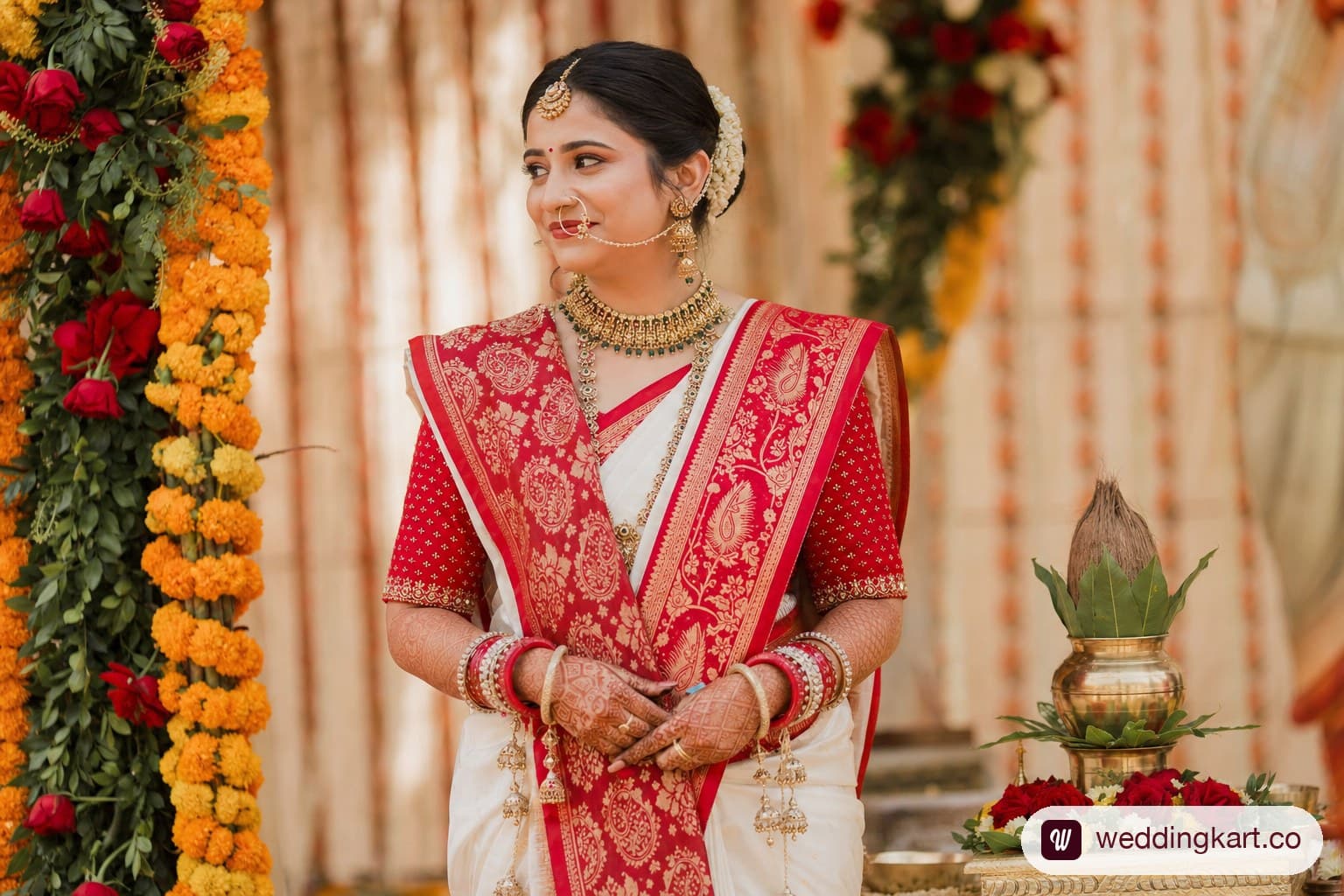
Most bridal attire guides treat tradition and fashion as a tradeoff. Wear the traditional outfit for the ceremony, the contemporary one for the reception, and manage the awkward middle ground of Garba night somehow. Gujarati bridal dressing rejects this framing entirely. The tradition is so visually specific — and so deeply tied to ritual — that the two vocabularies reinforce each other rather than compete. The Panetar is not an obligation you fulfil before changing into something you actually want to wear. For most Gujarati brides, it is the outfit.
This guide covers the full Gujarati bridal wardrobe in sequence: the Panetar and its ritual significance, how to drape it correctly, the chaniya choli for Garba and Mehndi, modern interpretations with Gharchola and Patola-inspired lehengas, a colour guide by occasion, the layered jewellery set, the guest dress code, and where to shop or rent in Ahmedabad — with 2026 prices and real store names throughout.
What makes Gujarati bridal attire different
A Gujarati wedding is typically a multi-day affair — Pithi, Mehndi, Garba night, the main ceremony, and Reception — and each event demands its own look. Unlike some regional Indian traditions where the bride wears one primary outfit for the core ritual, a Gujarati bride curates three to five looks across the celebrations. That wardrobe density is partly cultural and partly practical: Garba night runs for three to four hours and needs a different fabric calculus than the ceremony itself.
Several elements set the Gujarati bridal dress code apart from the rest of India:
- The Panetar is non-negotiable. It is the one outfit gifted by the mama (maternal uncle) and worn at the core wedding ritual. No other regional Indian tradition has a direct equivalent of this specific mama-gift-and-wear custom.
- Bandhani and Patola textiles — both originating in Gujarat — are woven into nearly every bridal outfit, from the saree body to the dupatta overlay.
- The colour palette favours auspicious saturation: red, saffron, orange, green, and gold dominate. Yellow and turmeric tones feature prominently at Pithi.
- Kutchi mirror work, Gamthi embroidery, and zari borders are the hallmark embellishments — not decorative additions but identifiers that signal the textile as authentically Gujarati.
- The Gharchola dupatta — a red or green tie-dyed silk with gold squares — is draped over the head during the second half of the ceremony, layering meaning over the Panetar beneath and marking the bride's transition to her husband's family.
The Panetar saree — the traditional Gujarati bridal saree
What is Panetar and why it matters
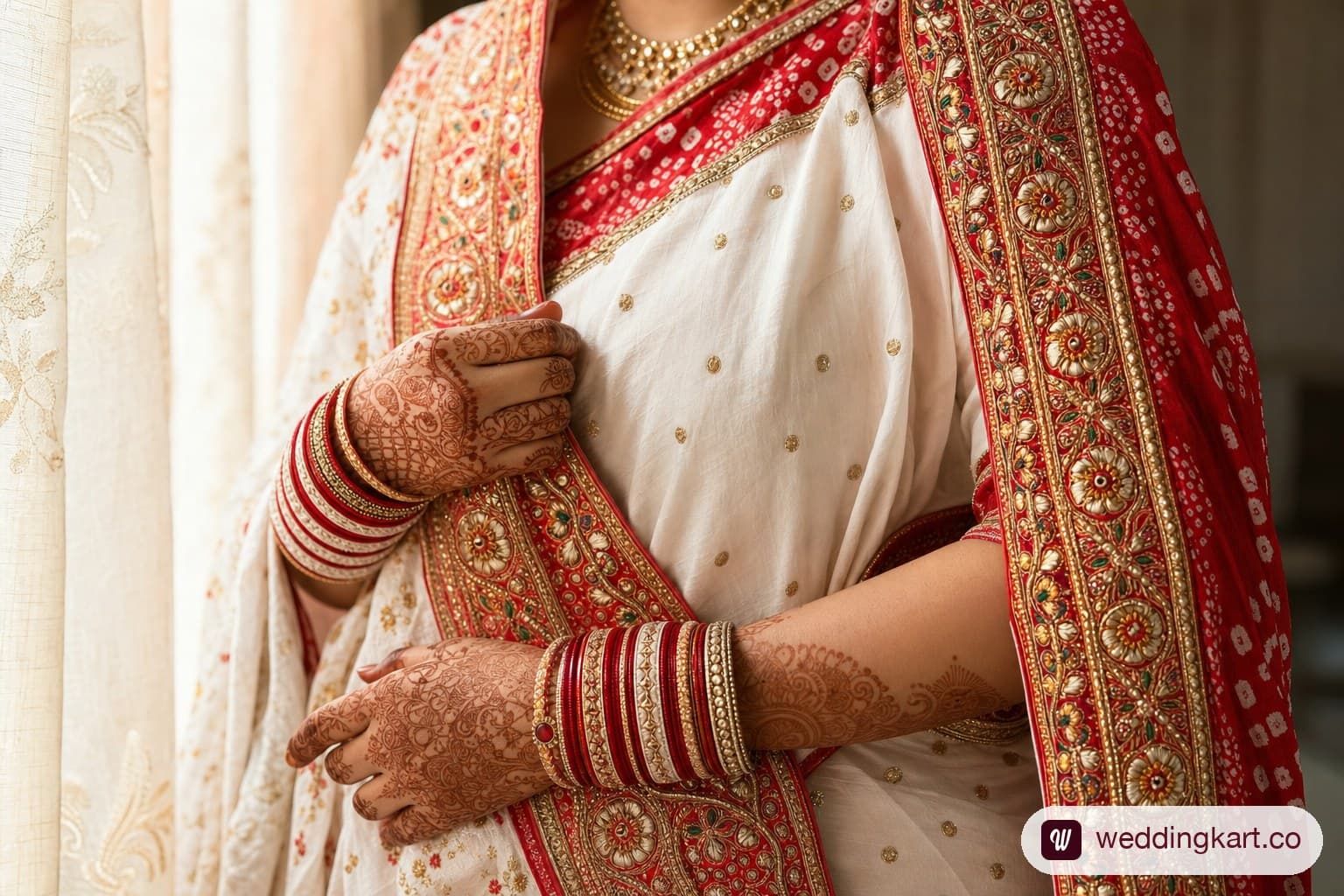
The Panetar is a silk saree distinguished by its white or cream body and a vivid red, maroon, or golden border. Crafted historically by the Chhipa and Khatri communities of Gujarat, it typically features a Gajji silk base with fine zari stripes, while the border and pallav are richly worked in Bandhani tie-dye, embroidery, sequins, and stones.
The ritual is the point. The Panetar is gifted to the bride by her mama (maternal uncle) before the wedding — one of the most emotionally charged moments of the pre-wedding ceremonies. The mama's gift is a blessing from the maternal side of the family, symbolising his acceptance and joy at the bride's new journey. The bride wears the Panetar for the first half of the wedding ceremony, then changes into a Gharchola — or drapes a Gharchola dupatta over the Panetar — for the second half, marking her transition from her natal family to her husband's.
The colour symbolism is deliberate. Red signifies love, fertility, and auspicious new beginnings. White stands for purity and peace. Together, the red-white pairing links the Panetar to the fierce grace of Goddess Durga — a union of power and serenity. Early Panetar sarees carried green or saffron borders; the now-iconic red-and-maroon combination settled into place after independence and has held ever since.
How to drape the Panetar saree
The Panetar is draped in the seedha pallu style — the traditional Gujarati drape that differs fundamentally from the far more common Nivi style of North and South India. The defining characteristic is where the pallav falls:
- Tuck the saree starting at the right side of the waist, going anti-clockwise around the body.
- Create 7–9 neat pleats at the front and tuck them into the waistband slightly to the left of centre.
- Bring the remaining fabric (the pallav) over the left shoulder, letting it fall in front of the body rather than over the back. This forward-falling pallav is the visual signature of the Gujarati drape.
- Drape the Gharchola dupatta over the head, covering the hair and framing the face.
The result is a dignified, front-weighted drape that keeps the embellished pallav — and all the craftsmanship — prominently visible throughout hours of rituals. Most brides today work with a professional saree draper who specialises in this style to ensure it holds securely from the phera to the vidaai.
Where to buy Panetar sarees in Ahmedabad
Ahmedabad is the undisputed capital of Panetar shopping. Prices range from approximately ₹5,000 for machine-finished options to ₹50,000 and above for hand-embroidered heirloom pieces. The most trusted stores:
- Khatri Jamnadas Bechardas — One of the oldest and most respected names for authentic hand-crafted Panetar sarees. Classic white-and-red designs in Gajji and pure silk; the go-to for families seeking heritage-quality pieces meant to be passed down.
- Asopalav — Gujarat's premier ethnic fashion house, with multiple Ahmedabad locations and an online store. Stocks a wide range from traditional to contemporary Panetar styles across multiple price brackets.
- Vinod Textiles — A wholesale and retail supplier with a large selection of Panetar styles. Good for families buying multiple pieces across a budget.
- Kasab / Ashavali — For heirloom Ashavali brocade sarees, a distinct Gujarati textile tradition dating to the 1400s. Priced from ₹10,000 upwards; these are investment pieces passed down generations.
Chaniya choli for the Gujarati bride
If the Panetar is the outfit of the ceremony, the chaniya choli is the outfit of joy. A three-piece ensemble — wide flared skirt (chaniya), fitted blouse (choli), dupatta — it is the definitive Gujarati bridal choice for Garba night and Mehndi. The flared chaniya allows full freedom of movement through hours of dancing in a way no saree can match, and the silhouette is designed specifically for Garba: the spin, the clap, the full-circle turn.
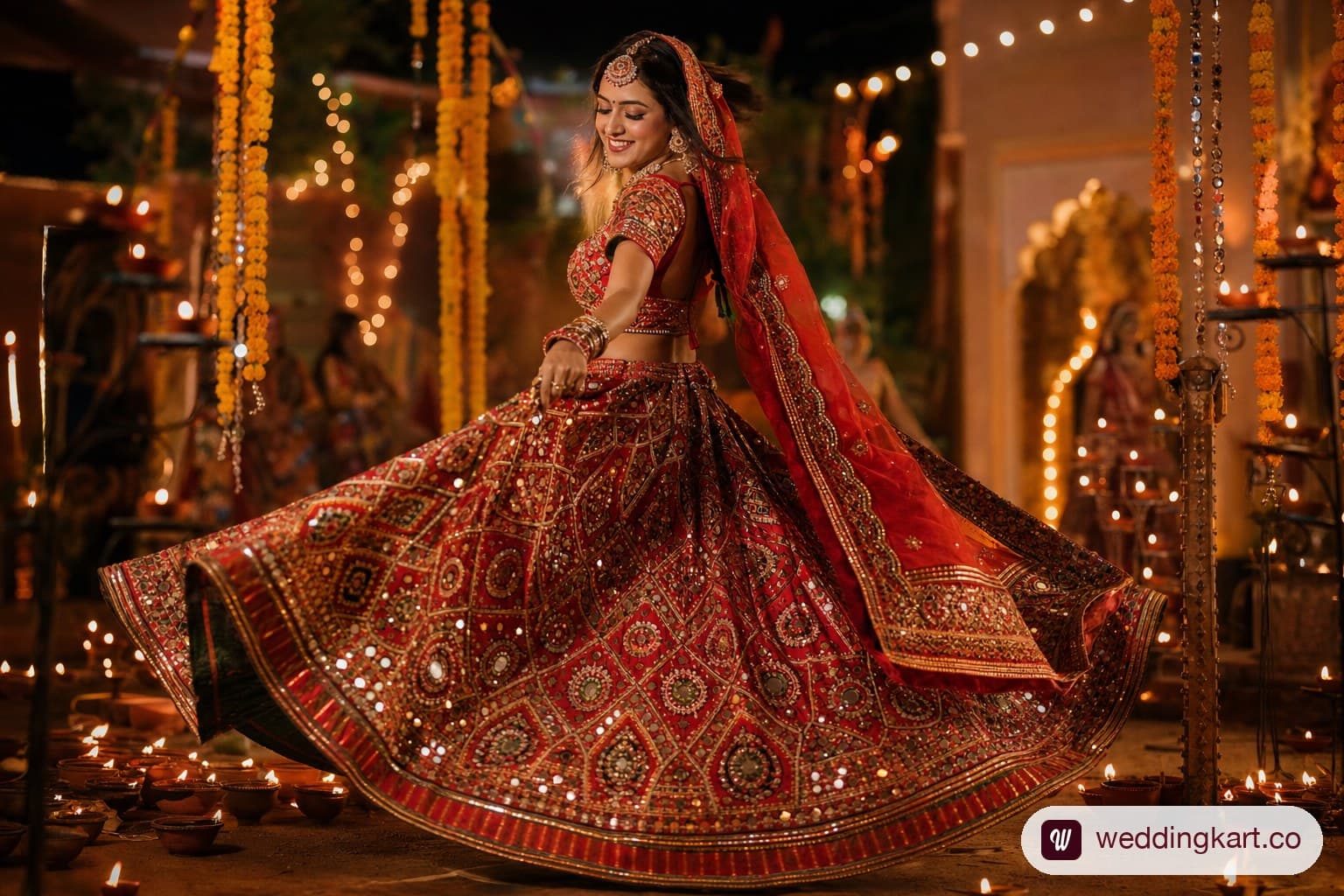
Modern brides choose chaniya choli for two distinct pre-wedding events, and the fabric calculus is different for each:
Garba Night (Sanji / Sangeet): Chaniya choli is practically mandatory for Garba. Brides choose bridal-weight fabrics — heavy silk or velvet with zardozi work — and pair them with statement jewellery. The outfit must balance visual impact with wearability; three to four hours of dancing in stilettos while wearing heavy embroidery is its own test. Avoid anything too fitted or structured through the hips.
Mehndi: A more intimate setting calls for lighter fabrics — georgette or cotton silk — in softer colours. Green, yellow, and mint are popular in 2026 because they photograph beautifully against mehndi-stained hands. Heavy embroidery is not needed and tends to feel out of place at an event where everyone is seated for long periods.
- Fabrics: Silk, velvet, and heavy georgette for Garba (impact over comfort); cotton, chiffon, and light georgette for Mehndi (comfort over formality).
- Embroidery styles: Kutchi mirror work (the signature Gujarati style with small reflective discs), Gamthi embroidery (geometric folk patterns), zardozi (gold thread work), and sequin-heavy contemporary work.
- Colours: Red-gold for the classic look; green with mirror work, orange and white, or pink and silver for a contemporary feel.
- Price range: ₹3,000–₹8,000 for ready-to-wear; ₹10,000–₹40,000+ for boutique or heavily embroidered bridal pieces.
Modern Gujarati bridal looks: Gharchola, Patola, and fusion
The 2026 Gujarati bride is fluent in both tradition and fashion. The Panetar is irreplaceable, but beyond that she has a rich vocabulary to draw from — regional textiles in modern silhouettes, fusion interpretations that preserve the visual identity while updating the weight and structure.
Fusion Panetar: Designers are reinterpreting the white-and-red combination in lighter Organza and Tissue silk, giving the sacred saree an airy contemporary elegance while preserving the visual identity that makes it recognisable from across the mandap.
Gharchola as a standalone saree: The Gharchola — traditionally red or green tie-dyed silk with distinctive golden squares — is increasingly worn as a full bridal saree in its own right, not just a dupatta. Modern colour variations in blue, saffron, and maroon satin silk have expanded the palette considerably.
Patola-inspired lehenga: The double ikat Patola is one of Gujarat's most precious textiles. Modern designers translate its geometric patterns into lehenga skirts paired with contrast cholis — a bridal outfit that photographs magnificently and reads as unmistakably Gujarati to any audience.
Bandhani lehenga: Tie-dye Bandhani prints — either as the lehenga fabric or as dupatta overlays — bring an unmistakably Gujarati signature to any look. Current trends pair Bandhani dupattas with plain embroidered lehenga sets.
Designer blouse cuts: Off-shoulder, sweetheart neckline, deep-V back, and corset blouses create a striking contrast between the traditional textile and a fashion-forward silhouette. The rule of thumb among stylists: keep one element deeply traditional — the textile, the drape, or the jewellery — and let everything else be contemporary. This balance ensures the bride looks current without losing her cultural identity.
For a deeper guide to saree options that cross regional styles, see the complete wedding saree shopping guide and the companion lehenga shopping guide for Indian brides.
Colour guide — traditional vs contemporary
Colour is not merely aesthetic at a Gujarati wedding — it is ceremonially significant. Wearing the wrong colour to the wrong event is the kind of mistake guests quietly notice. Here is the full reference by occasion:
| Occasion / Outfit | Traditional colours | Contemporary choices |
|---|---|---|
| Panetar (main ceremony) | White + red/maroon border | White + rose gold; ivory + saffron |
| Gharchola dupatta | Red or green with gold squares | Maroon, blue, or peach Gharchola |
| Chaniya Choli (Garba) | Red-gold, green-mirror, orange-white | Cobalt blue, fuchsia, emerald + silver |
| Mehndi outfit | Yellow, turmeric, lime green | Mint green, blush pink, lavender |
| Pithi / Haldi | Yellow, mustard | Pastel yellow, soft cream |
| Reception lehenga | Deep red, maroon, magenta | Blush pink, champagne gold, dusty rose |
A note for guests: Gujarati weddings celebrate bold, saturated colour more than almost any other regional celebration in India. Avoid black (considered inauspicious by many families) and pure white (associated with mourning in some communities). Bright colours — fuchsia, royal blue, emerald, orange — are welcomed and actively encouraged. Wearing yellow at Garba night echoes Gujarati folk tradition and will be noticed appreciatively.
Gujarati bridal jewellery
Gujarati bridal jewellery is layered, intentional, and every piece carries a specific meaning. The full traditional set is not decorative accumulation — each element marks a relationship, a ritual, or a transition.
Damani / Maang Tikka: A Gujarati-specific forehead ornament on a chain that extends back into the hair. Encrusted with gemstones and hung with pearl or gold drops, it sits at the centre of the forehead and represents divinity and protection. The Damani is slightly different from the pan-Indian maang tikka — more elaborate and more architectural.
Nath (Nose Ring): Perhaps the single most iconic element of the Gujarati bride look. Large and circular, adorned with pearls, diamonds, or coloured stones, and attached to the hair via a delicate chain. A well-chosen nath instantly identifies the bride as distinctly Gujarati — it is the piece that carries the most regional specificity.
Timaniya Choker + Rani Haar: The classic Gujarati necklace combination. A Timaniya choker — a broad, flat necklace in gold or kundan work — sits at the collarbone, layered with a longer Rani Haar: a two- or three-strand gold, kundan, or pearl necklace with meenakari detailing on the reverse. The layering creates regal depth without looking heavy.
Choodla Bangles: Red-and-white bangles gifted by the mother-in-law, which the bride cannot see until her wedding day. These are considered deeply auspicious and are worn throughout the early months of marriage. Kundan-embellished gold bangles are typically layered over them on the wedding day itself.
Hathphool: A hand harness that connects a central ornament to rings on the fingers via chains across the back of the hand. Unique to Gujarati (and Rajasthani) bridal traditions, the hathphool symbolises feminine grace and is one of the most photographed elements of the bridal look.
Jhumkas + Anklets + Toe Rings: Heavy gold jhumka earrings complete the look. Silver or gold anklets (payal) and toe rings signal the transition to married life — pieces traditionally added by the groom's family.
Materials of choice: Kundan (glass stones set in gold foil), Polki (uncut diamonds), and Jadau (intricate stone-inlay work) are the hallmarks of authentic Gujarati bridal jewellery. Many families own heirloom pieces spanning generations — the jewellery is as much a family archive as it is adornment.
Guest dress code at Gujarati weddings
Navigating a multi-event Gujarati wedding as a guest can feel daunting. Here is a clear event-by-event guide:
Pithi / Haldi (Day 1 or 2): Intimate and messy. Dress casually in cotton or linen in yellow, mustard, or lime green. The turmeric paste will likely reach your outfit — save your finery for the events that follow.
Mehndi (Evening): Semi-formal. A salwar suit, anarkali, or light lehenga in soft, auspicious colours — yellow, green, white, or floral prints. No heavy embroidery needed. Comfortable footwear matters; you will be seated for long periods.
Garba Night / Sangeet: Chaniya choli is the unspoken requirement — and the more embroidered and vibrant, the better. Choose a flared chaniya with good movement and footwear you can actually dance in for three to four hours. Mirror work and Kutchi embroidery are perfect here. Anything too fitted or restrictive will be a problem by the second hour.
Wedding Ceremony (Main Day): Traditional sarees or lehengas in deep, rich colours. Silk sarees — Bandhani, Patola, or Kanjivaram — are all excellent choices. Men typically wear sherwanis or Indo-western ensembles.
Reception: Your most glamorous look — embellished gowns, saree gowns, heavily embroidered lehengas. The reception is unambiguously festive-formal. Bold colours are entirely appropriate; this is not the place to underplay.
Where to buy or rent Gujarati bridal outfits in Ahmedabad
Ahmedabad's textile heritage makes it one of the best cities in India to shop for bridal attire. The most recommended stores, whether buying or renting:
Asopalav — Ahmedabad's most celebrated ethnic fashion house. Multiple city locations plus an online store. Stocks traditional and contemporary Panetar sarees, Bandhani, Patola, chaniya choli sets, and lehengas. Wide price range from accessible to luxury.
Khatri Jamnadas Bechardas — The definitive destination for authentic hand-crafted Panetar sarees. A family-run institution with deep expertise in Gujarati bridal textiles. Best for heirloom-quality Panetar purchases.
Roopkala — Two branches (Ashram Road and Ambawadi). Specialists in handpicked sarees, lehenga-chunni, and suits. Known for flawless craftsmanship and a curated selection. A favourite for families seeking something distinctive.
Ashavali / Kasab — The only place for authentic Ashavali brocade sarees, a Gujarati weaving tradition dating to the 1400s. Priced from ₹10,000 upwards. These are heirloom investments, not seasonal purchases.
Vijay Stores — A long-established retailer offering a broad range of traditional Gujarati bridal outfits including Panetar, Gharchola, and chaniya choli at competitive prices. Ideal for families outfitting multiple members.
For rentals: Rentashion (Gota, Ahmedabad) offers designer lehenga choli, bridal sarees, and Indo-western outfits from as low as ₹399, up to ₹2,499 for premium pieces. WedMeGood and Sulekha list additional boutiques across Ahmedabad for rental bridal wear.
If you are planning your Ahmedabad wedding alongside attire shopping, the Ahmedabad wedding venue guide and the Ahmedabad wedding clothes on rent guide cover the full picture. For the complete Gujarati wedding communication tradition, the Kankotri and Tahuko invitation guide covers every detail of the written and digital invitation customs. And if you are attending rather than marrying, our guide to what to wear to an Indian wedding as a guest breaks down the dress code for the haldi, mehendi, sangeet, wedding and reception.
The Gujarati bridal wardrobe is a sequence, not a collection
Most bridal attire decisions feel like separate, disconnected choices. The Panetar, the Garba chaniya choli, the reception lehenga — each gets planned in isolation, and the result can feel like a mood board rather than a wardrobe with coherence.
Gujarati bridal dressing works differently: the sequence is the point. The Panetar gifted by the mama anchors everything with ritual weight. The chaniya choli on Garba night is pure joy and movement. The reception look is the deliberate finale. And even the guest outfits carry an expectation of colour, craft, and genuine participation in the celebration.
Whether you are a bride choosing between a fusion Panetar and a Gharchola lehenga for the ceremony, or a guest trying to work out what to wear to Garba night, the Gujarati wedding has a clear answer: go bold, honour the craft, and let the colour speak.
Managing your Gujarati wedding guest list?
Weddingkart coordinates RSVPs, WhatsApp invites, and event communication across all your wedding events — so the operational side of a multi-day celebration stays as organised as the outfits.
Frequently Asked Questions
What saree does a Gujarati bride wear?
The traditional Gujarati bride wears a Panetar saree for the main wedding ceremony — a Gajji silk saree with a white or cream body and a rich red or maroon Bandhani-and-zari border. The Panetar is gifted by the bride's mama (maternal uncle) before the wedding. After the first half of the ceremony, she typically drapes a Gharchola dupatta over it, or changes into a full Gharchola saree, symbolising her transition to her husband's family.
What is a Panetar saree and what makes it special?
A Panetar is a traditional Gujarati bridal saree distinguished by its white or cream Gajji silk base and a vivid red, maroon, or golden border in Bandhani, zari, and embroidery work. What makes it unique is the ritual: it is always gifted by the bride's mama (maternal uncle) as a blessing from the maternal side of her family. No other regional Indian tradition has a direct equivalent of this mama-gift-and-wear custom. Prices range from ₹5,000 for machine-finished options to ₹50,000+ for heirloom hand-embroidered pieces.
How is the Gujarati saree draped differently?
The Panetar is draped in the seedha pallu style — the defining Gujarati drape. Unlike the common Nivi style where the pallav falls over the back left shoulder, in the Gujarati seedha pallu drape the pallav falls in front over the left shoulder, keeping the embellished border and pallav prominently visible. The pleats (7–9) are tucked to the left of centre at the waist, and the saree wraps anti-clockwise from the right side.
What does a Gujarati bride wear for Garba night?
For Garba night, a Gujarati bride wears a bridal chaniya choli — a three-piece ensemble of a wide flared skirt (chaniya), fitted blouse (choli), and dupatta. Brides typically choose heavy silk or velvet with Kutchi mirror work or zardozi embroidery, paired with statement kundan jewellery. The flared chaniya allows full freedom of movement through hours of Garba dancing. Red-gold is the classic choice; cobalt blue, fuchsia, and emerald with mirror work are popular contemporary options.
How much does a Gujarati bridal saree cost?
A Panetar saree ranges from ₹5,000 for machine-finished options to ₹50,000 and above for hand-embroidered heirloom pieces at stores like Khatri Jamnadas Bechardas in Ahmedabad. Ashavali brocade sarees start at ₹10,000 and are considered investment pieces. Chaniya choli sets range from ₹3,000–₹8,000 for ready-to-wear to ₹10,000–₹40,000+ for boutique or heavily embroidered bridal pieces. Rental options at Ahmedabad boutiques start from ₹399.
What jewellery does a Gujarati bride wear?
The complete traditional Gujarati bridal jewellery set includes: a Damani maang tikka (a forehead ornament on a chain extending to the hair), a large circular Nath nose ring with pearls and coloured stones, a Timaniya kundan choker layered with a Rani Haar necklace, red-and-white Choodla bangles gifted by the mother-in-law, a Hathphool hand harness, heavy gold jhumka earrings, silver or gold anklets (payal), and toe rings. Materials of choice are Kundan, Polki (uncut diamonds), and Jadau work.
What is the difference between Panetar and Gharchola?
The Panetar is a white or cream silk saree with a red or maroon Bandhani border — worn during the first half of the wedding ceremony, always gifted by the mama (maternal uncle). The Gharchola is a red or green tie-dyed silk with distinctive gold squares in a grid pattern — traditionally used as a dupatta over the Panetar during the second half of the ceremony, symbolising the bride's transition to her husband's family. In 2026, Gharchola is also increasingly worn as a standalone bridal saree.
What should guests wear to a Gujarati wedding?
For Garba night, chaniya choli is the unspoken dress code — the more embroidered and vibrant, the better. For the main ceremony, traditional sarees or lehengas in deep, rich colours (Bandhani, Patola, or Kanjivaram silk all work). For Pithi/Haldi, go casual in cotton — turmeric will reach your outfit. For the reception, full festive-formal is appropriate. Avoid black (considered inauspicious by many families) and pure white (associated with mourning in some communities). Bold, saturated colours are celebrated.
Where can I buy a Panetar saree in Ahmedabad?
The most trusted Ahmedabad stores for Panetar sarees are: Khatri Jamnadas Bechardas (the definitive heritage destination for authentic hand-crafted Panetar), Asopalav (Gujarat's premier ethnic fashion house with multiple locations and an online store), Vinod Textiles (good for families buying multiple pieces across a budget), and Kasab/Ashavali (for authentic Ashavali brocade sarees priced from ₹10,000 upwards). For rentals, Rentashion in Gota offers designer bridal wear from ₹399.
What is Bandhani and why does it matter in Gujarati weddings?
Bandhani is a traditional Gujarati tie-dye technique originating in the Kutch and Saurashtra regions. Tiny portions of fabric are tied with thread before dyeing, creating intricate dot patterns across the cloth. In Gujarati weddings, Bandhani appears on Panetar saree borders, Gharchola dupattas, chaniya choli fabrics, and lehenga overlays. A genuine hand-done Bandhani saree can take days to produce and is significantly more valuable than machine-printed imitations.
Was this article helpful?
Share
By Mayank JaiswalLast updated