
Quick Answer
What should you wear to an Indian wedding as a guest?
Indian wedding guest outfits should match the function, not the wedding as a whole — dress for the ceremony in front of you. Wear light cottons and yellows to the daytime haldi (something you do not mind staining), greens to the mehendi, dance-ready jewel tones to the evening sangeet, your richest silk saree or lehenga — or a kurta with a Nehru jacket — to the wedding, and glamorous Indo-western to the reception. On colours: skip a full bridal red-and-gold look, avoid all-white at many Hindu ceremonies, and keep black off the religious rites — unless the hosts set a theme, which always wins. On budget, as a planning range: roughly ₹15,000–₹50,000 buys a main-ceremony look in India (many guests spend less), or about $150–$350 to rent one in the US. Dress modestly enough to sit on the floor, and wear shoes you can slip off at the mandap.
Last updated:
What to Wear to an Indian Wedding: A Guest's Guide
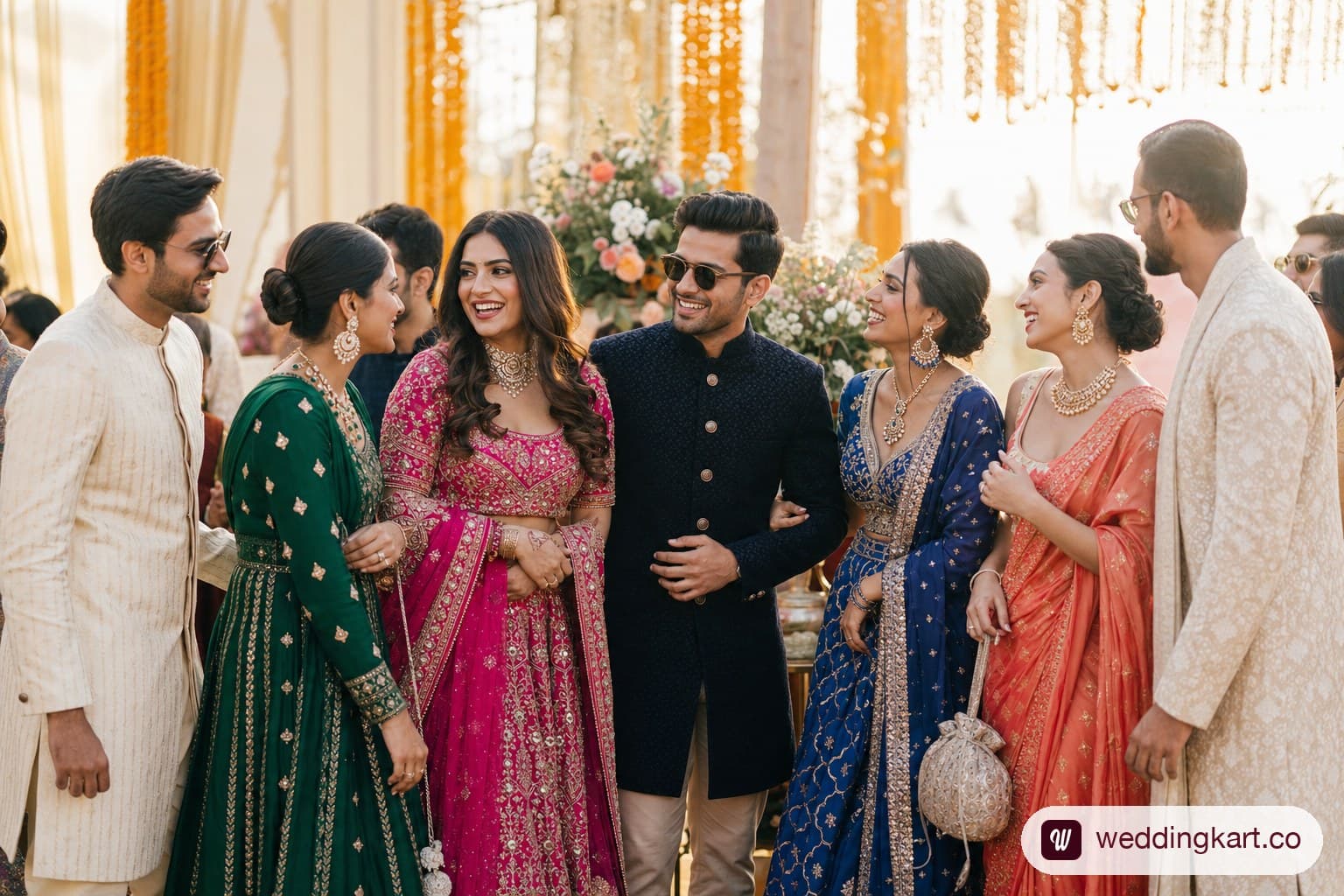
The panic text is always some version of the same thing: “It says mehendi at 11 and sangeet at 8 — what do I actually wear?” People obsess over one question (is red banned?) and completely miss the one that matters. At an Indian wedding you are not dressing for “a wedding.” You are dressing for three to five separate events with their own light, mood and rules, spread over two or three days.
Get that framing right and the rest falls into place. The single most common guest mistake is not a colour at all — it is overdressing the haldi and underdressing the reception. A sequinned gown at a turmeric ceremony is as off-key as jeans at the pheras. So this guide goes function by function, then covers the money question nobody answers (what to actually spend, and whether to rent or buy), the non-Indian first-timer's playbook, the colours, the regional differences, and the footwear and jewellery that quietly finish the look.
5–7
Functions at a North Indian wedding (over 2–4 days)
Source: Saathiya
₹15k–50k
Main-ceremony guest planning range (India)
Source: Rashika Mittal
$150–350
To rent a guest outfit (US, 3–4 days)
Source: Cbazaar
40–50%
Of an outfit budget on the main ceremony
Source: Rashika Mittal
What should you wear to each Indian wedding function?
One rule covers ninety per cent of it: dress for the ceremony, not the wedding. Each function has a different job, and your outfit should do that job. Daytime functions are lighter and more forgiving — pastels, cottons, florals. Evening functions get progressively grander — richer fabrics, deeper colours, more embellishment. The rule of thumb every stylist repeats holds up: the later and the grander the function, the more elaborate you go.
This is also why one outfit never covers it. A North Indian wedding typically runs five to seven events across two to four days, with attendance swinging from roughly 20–60 at an intimate haldi to 100–250+ at the sangeet (Saathiya). You are not buying “a wedding outfit” — you are dressing a small campaign. For most guests, the table below is the safest function-by-function plan; here is the whole thing on one screen. If you read nothing else, read this.
| Function | Women | Men | Western fallback | Skip |
|---|---|---|---|---|
| HaldiCasual · daytime, messy | Old cotton kurta or suit in yellow / marigold | Old cotton kurta you do not mind staining | A yellow cotton sundress you can ruin | Anything you would mourn if it stained |
| MehendiSemi-casual · daytime, seated | Greens & florals in light cotton or georgette | Light printed or pastel cotton kurta | Floral midi or maxi dress | Stacks of bangles, stiff fabrics |
| SangeetDressy · evening, dance floor | Jewel-tone lehenga or sharara you can move in | Silk kurta or bandhgala in a jewel tone | Sequinned cocktail dress or jumpsuit | Anything you cannot actually dance in |
| WeddingFormal · mandap or temple | Richest silk saree / embellished lehenga | Silk kurta with a Nehru jacket | Embellished floor-length gown, modest | Bridal red, all-white, black |
| ReceptionBlack-tie glam · evening | Statement lehenga or Indo-western gown | Bandhgala or Indo-western; black-tie if asked | Formal evening gown (black is fine here) | Underdressing — this is the glam one |
Not every wedding has every function, and some couples combine them — always defer to what the hosts actually tell you.
Haldi — the one where you wear old clothes
The haldi is a daytime function where turmeric paste is smeared on the couple — and, gleefully, on guests within reach. Wear something in yellow, marigold or ivory that you genuinely do not care about, because turmeric can stain permanently — especially pale or natural fabrics — so assume it will not come out. Every year someone shows up in a nice new outfit “just to watch” and goes home with a ruined one. Light cotton, cheap, expendable. That is the entire brief.
Mehendi — light, and easy on the arms
Greens, florals and bright daytime colours in cotton, georgette or chiffon. The mehendi has a specific constraint most guides skip: you spend a long time seated, often on the floor, and if you are getting henna done your hands are out of action for a while. So pick a flowy silhouette that photographs well seated, and go easy on the wrists — heavy bangles and stiff sleeves get in the way. This is the function to be comfortable at, not to peak at.
Sangeet — dressy, but you have to be able to move
The sangeet is performances and a dance floor, usually in the evening. This is where you bring out an embellished lehenga, a sequinned anarkali or a sharp Indo-western look in jewel tones — royal blue, emerald, magenta, wine. The test is simple: can you dance in it for two hours? A gorgeous outfit you have to stand still in is the wrong outfit for a sangeet. Sequins and mirror work, yes; a silhouette that pins your arms, no.
The wedding — your richest piece, and a mandap to respect
This is the formal one. A rich silk saree, a Banarasi, or an embellished lehenga in maroon, gold, royal blue or deep pink; for men, a silk kurta with a Nehru jacket. Two practical notes people forget: the ceremony is often long and may be at a temple or under a mandap, so you will likely be barefoot and seated for a stretch — factor that into your fabric and your footwear. And this is the one function where the colour rules below matter most.
Reception — full glam, modern rules
The reception is usually the grandest and most contemporary event. Indo-western gowns, statement lehengas, structured bandhgalas, metallics, midnight blue, sculpted saree drapes — this is where you go all out and where Western-leaning formalwear is most at home. It is also, notably, the one function where black is genuinely fine (more on that below). Underdressing is the only real mistake here.
What if the invite says festive Indian, cocktail, or black tie?
When there is a dress code on the invite or the save-the-date, follow it over any general rule — it is the single clearest signal the couple can give you. The labels below are the ones that trip guests up most, translated into what to actually wear.
| If the invite says… | Wear | Avoid |
|---|---|---|
| Festive Indian / Indian traditional | Ethnic wear: saree, lehenga, anarkali or a kurta set with a Nehru jacket | A plain Western suit or a cocktail dress |
| Indo-western / fusion | A blend — a cape lehenga, a dhoti-jumpsuit, or a bandhgala with tailored trousers | Head-to-toe traditional bridal styling |
| Cocktail / semi-formal | A midi or floor-length dress, or a lighter ethnic set in a happy colour | Jeans, casual daywear, anything too revealing |
| Black tie / formal | A floor-length gown or a sharp suit; ethnic still welcome if you prefer it | Daytime cottons or an under-dressed look |
| Colour theme (e.g. pastel, green) | Match the named palette for that function — the theme beats every other rule | Off-theme colours, even “safe” jewel tones |
If the invite says nothing at all, default to festive Indian for the ceremony and lean glam for the reception — and when in doubt, it is always fine to ask the hosts what they are expecting for a given function.
How much should a guest spend on an Indian wedding outfit?
There is no fixed norm here, and plenty of guests spend far less than the headline figures — so treat everything below as a planning range, not a rule. In India, a polished look for the main ceremony tends to fall between ₹15,000 and ₹50,000 — printed sarees and kurta sets at the lower end, lehenga sets, couture kurtas and heavy hand-work sarees toward the top — while under ₹15,000 comfortably covers the lighter day functions like the haldi and mehendi (Rashika Mittal's budget guide). The trap is treating each function as a fresh ₹30k decision. Because a wedding is five to seven events, the smarter move is to set a season budget and spend it deliberately across the week. The bands below are a planning guide, not a quote — prices swing hard by city and store.
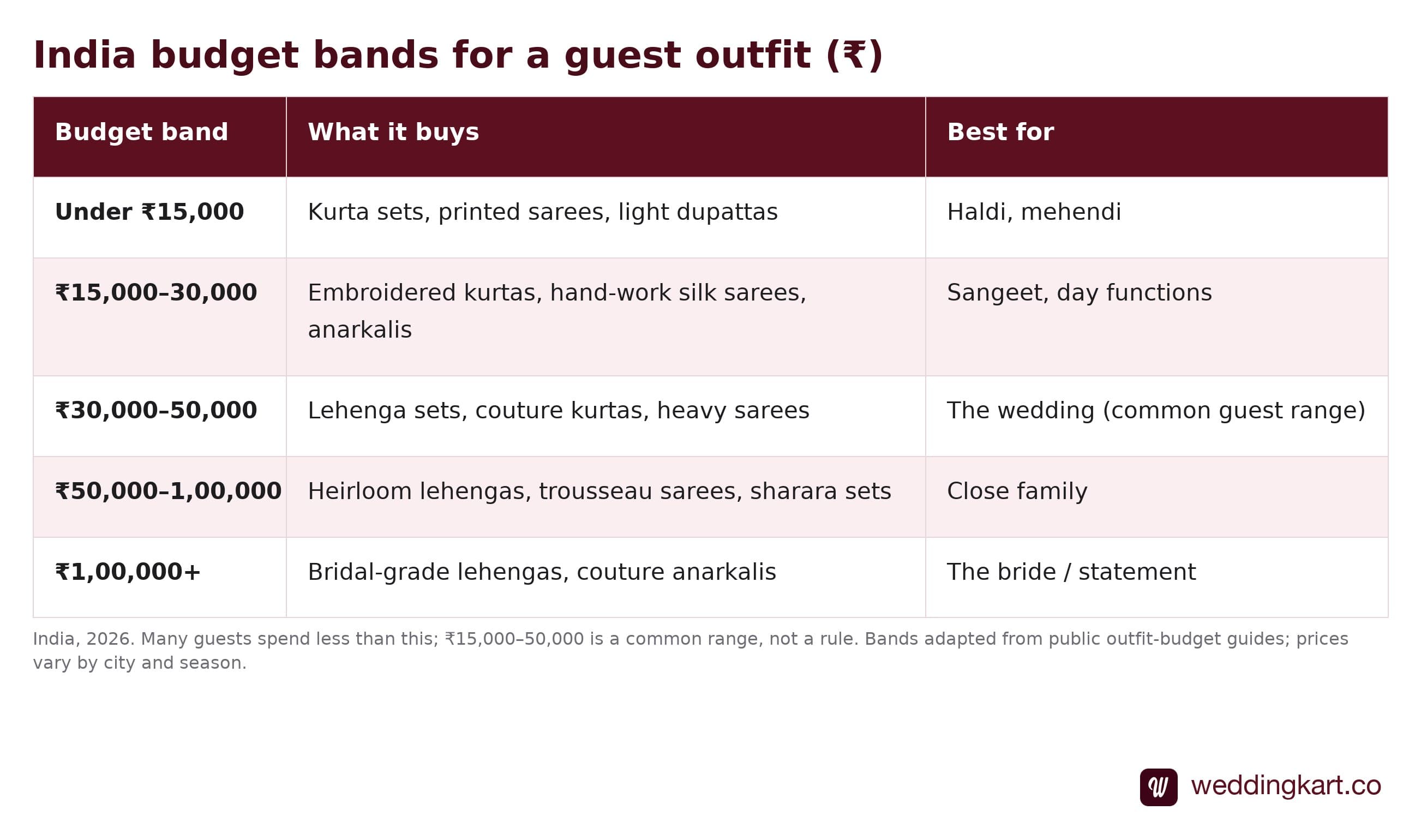
| Budget band | What it buys | Best for |
|---|---|---|
| Under ₹15,000 | Kurta sets, printed sarees, light dupattas | Haldi, mehendi |
| ₹15,000–30,000 | Embroidered kurtas, hand-work silk sarees, anarkalis | Sangeet, day functions |
| ₹30,000–50,000 | Lehenga sets, couture kurtas, heavy sarees | The wedding (common guest range) |
| ₹50,000–1,00,000 | Heirloom lehengas, trousseau sarees, sharara sets | Close family |
| ₹1,00,000+ | Bridal-grade lehengas, couture anarkalis | The bride / statement |
Two framings make this budget go further. First, cost-per-wear: a ₹30,000 handcrafted piece worn to ten events over a wedding season works out to just ₹3,000 a wear — which is exactly why an investment outfit can beat a cheaper single-use one. Second, a function split: stylists suggest roughly 40–50% of your outfit budget on the main ceremony, 25–30% on the reception or cocktail, 15–20% on the mehendi and sangeet, and the last 10% on accessories and dupattas (Rashika Mittal). Spend where the cameras and the crowd are — the wedding and the reception — and go light on the daytime functions.
Should you rent or buy your outfit?
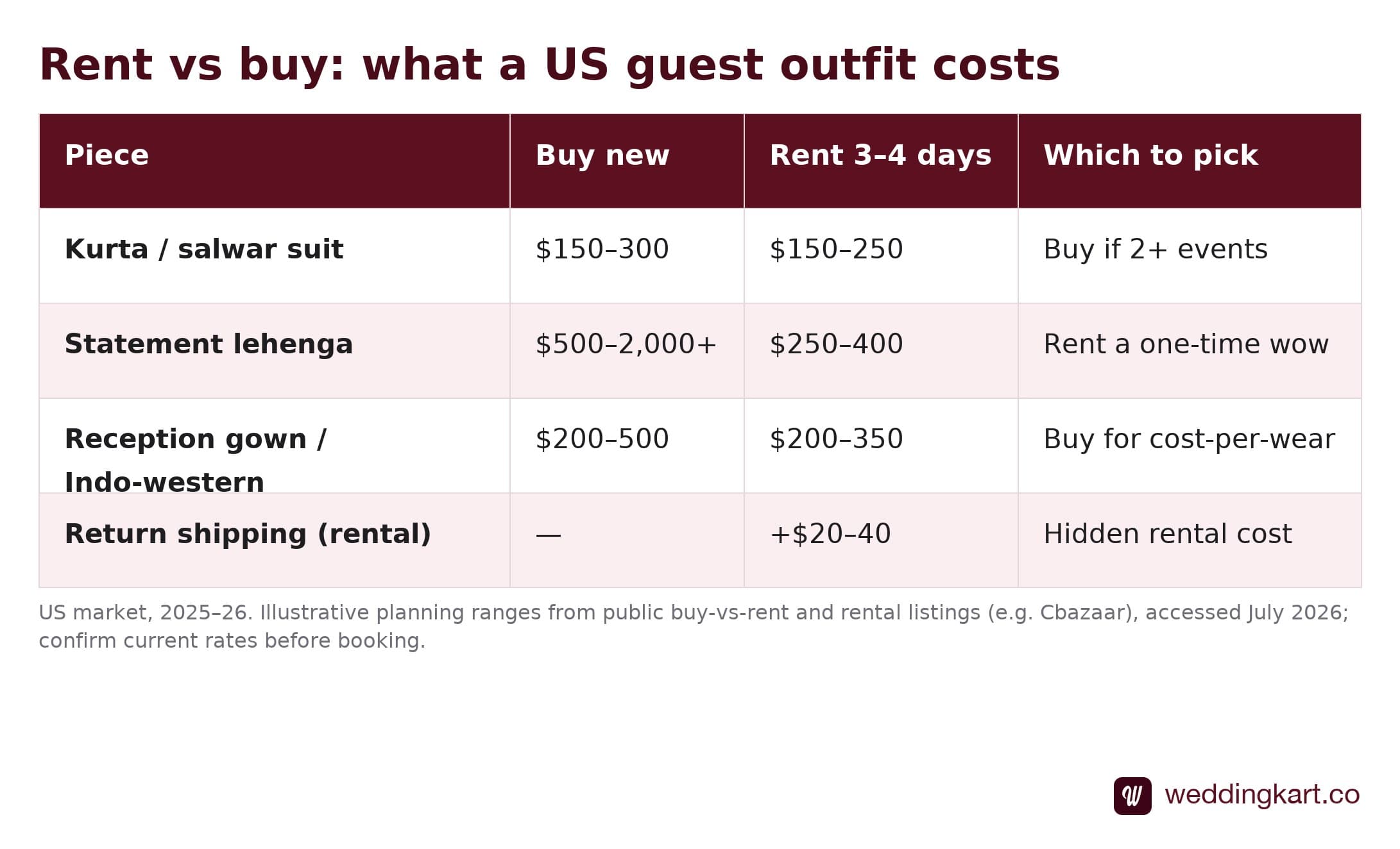
Short answer: rent a one-time show-stopper, buy if you have two or more weddings this season. Renting lets you wear a designer-look lehenga for a fraction of its retail price without owning it; buying wins the moment cost-per-wear kicks in. In the buy-vs-rent example Cbazaar works through, a roughly $200 outfit costs an effective ~$130 after a 40% store-credit buyback, versus about $225–$275 all-in to rent one — and when you rent you own nothing at the end (Cbazaar). Rent when the event is under two weeks away and you want to try it on, or when it is a genuine one-off. Buy when you need guaranteed fit and alterations, want something nobody has worn, or will re-wear it across the season.
| Your situation | Rent or buy | Why |
|---|---|---|
| A simple kurta or day-function set | Buy | Cheap enough to own, and a rental fee rarely beats it — you will re-wear it |
| A one-off statement lehenga or gown | Rent | Wear a designer-look piece for a fraction of retail (US rentals ~$150–$350), nothing to store |
| Two or more weddings this season | Buy | Cost-per-wear collapses — a ₹30,000 piece over ten events is ₹3,000 a wear |
| You need a guaranteed fit and alterations | Buy | Rentals ship as-is; you cannot tailor a borrowed piece |
| Event under two weeks away, want to try it on | Rent locally | Faster than ordering and tailoring something new |
Where can you buy or rent Indian wedding guest outfits in the US?
Short answer: rental platforms and a growing set of South-Asian retailers ship across the US — start early, because online fit and alterations are the real risk. Order or reserve three to four weeks out if you can, so there is room to swap a size, hem a lehenga or take in a blouse, and build in a return-shipping buffer for rentals so a late arrival does not leave you scrambling. Platforms like Glamourental, By Rotation, All Borrow and Saris & Things carry South-Asian guest wear, and David's Bridal now stocks a KYNAH South-Asian collection. Eshita Kabra-Davies, who founded the rental platform By Rotation, makes the case plainly: renting across a run of events, and mixing Indian and Western pieces, is how you dress well for a full wedding without buying five outfits you will wear once. In India, the equivalent is buying smart in the wholesale markets — a market like Ahmedabad's gets you the same look for a fraction of a boutique price.
What should a non-Indian guest wear to an Indian wedding?
First, the reassurance behind the question: wearing Indian ethnic wear as a non-Indian guest is usually read as respect, not appropriation — especially when the couple or dress code signals festive or Indian attire. Most hosts genuinely love the effort, and you will photograph into the celebration rather than standing beside it (David's Bridal). The only real mistakes are dressing too plainly or too revealingly for the ceremony — not the act of wearing a lehenga.
The easiest way in is not a saree. Start with an anarkali (it wears like a formal floor-length dress) or a salwar suit — both move like Western formalwear with no draping learning curve. A first-time, un-pinned saree is a day-long anxiety; save it for a later wedding once you have the confidence. Men can default to a kurta-pajama and be perfectly dressed at almost any function.
Fit checks before you leave the shop
- Have the boutique pre-pin your dupatta — ask them to show you exactly how it sits, and consider a couple of hidden safety pins so it stays put on the day.
- Sit, reach and take a few dance steps in the fitting room. Check the blouse covers when you raise your arms, the waistband is comfortable seated, and the sleeves let you move — a lehenga or saree blouse that pins your arms is the most common regret.
- Try the hem with the actual shoes you will wear (flats vs a block heel changes the length), and get the fall stitched or hemmed if it pools on the floor.
- Practice-wear the full outfit for at least an hour at home. This is the single biggest confidence fix for anyone new to ethnic wear.
- Pick slip-on shoes (juttis or flats) and pack a small kit — safety pins, fashion tape, a spare bindi — since you will be taking shoes off at the mandap or temple.
Can I just wear a Western dress?
Yes — a vibrant, floor-length or midi dress is perfectly acceptable when you are short on time or budget. Keep it colourful and modest, with shoulders and knees covered for the ceremony, and skip the plain black cocktail dress and anything too revealing. Think of it as “festive formal, in a happy colour” rather than “evening cocktail.” Ethnic wear leans in harder and photographs better, but a well-chosen Western dress rarely puts a foot wrong. When in doubt, jewel tones and florals do the heavy lifting.
What colours should you avoid at an Indian wedding?
Three colours get flagged, and every over-simplified list gets them slightly wrong. The nuance is the whole point.
The quick version
- Red — avoid full bridal red, not red itself. Wine, rust, coral and maroon are welcome.
- White — skip all-white at the ceremony; fine as an accent, or if the couple set a white / pastel theme.
- Black — keep it off the pheras; perfectly fine at an evening reception or cocktail.
Safe anywhere: jewel tones (emerald, royal blue, magenta, teal) and daytime pastels.
Can you wear red to an Indian wedding?
Yes — just not a full bridal red-and-gold look. In most North Indian and many other communities the bride wears red or maroon, so the instinct “don't wear red” is really “don't turn up in a bridal silhouette that reads as competing with her.” A wine saree, a coral lehenga, a rust kurta — all completely fine, and often the most flattering thing in the room. The thing to avoid is the bridal silhouette, not the hue.
Can you wear white to an Indian wedding?
Best avoided head-to-toe for the ceremony, but not banned outright. White (and stark cream) carries a mourning and funeral association in many Hindu communities, which is why an all-white outfit can feel off at the sacred rites. But this one is shifting fast: white-and-pastel is now a popular theme for daytime mehendis and haldis, and white works beautifully as a border or secondary colour. The rule collapses the moment the couple ask for it — if the dress code says white, wear white.
Can you wear black to an Indian wedding?
Keep it off the ceremony, but it is welcome in the evening. Black is traditionally read as inauspicious for the sacred rites, so leave it out of the actual pheras. At a modern evening reception or cocktail, though, black is not only accepted, it is often the sharpest thing there — pair it with gold, emerald or fuchsia rather than wearing it flat. Context decides.
Above all: if the hosts set a colour theme for a function, that overrides every rule here. Themed functions are increasingly common — a green mehendi, a pastel brunch, an all-white sangeet — and turning up off-theme is a bigger miss than any traditional colour rule. So before you pack, it is worth asking the couple for the dress code function by function; many now share it per event over WhatsApp (a multi-event RSVP is one way hosts do this) so no guest is guessing.
How does it differ for South Indian, Bengali, Sikh and Muslim weddings?
The function-and-colour logic above is broadly pan-Indian, but the specifics shift by community — and these conventions vary by family and region, so treat the table as a starting point and confirm with your hosts. Here is the quick version, then the detail:
| Community | Signature guest look | Cover / remove | Colours to skip |
|---|---|---|---|
| South Indian | Pure silk saree (Kanjivaram, Pochampally, Mysore) with temple jewellery | Shoes off for temple rites | The bride's palette if you know it (often red/maroon) |
| Bengali | Bright silk saree or lehenga in yellow, orange or blue | Modest coverage at rituals | A predominantly red look; stark white-and-black together |
| Gujarati | Bandhani or bright silks; a chaniya choli for the garba | Modest coverage at rituals | The bride's exact bridal shade |
| Sikh (Anand Karaj) | Bright salwar suit or modest kurta set | Head covered + shoes off in the gurdwara | Somber all-black or bridal-red looks |
| Muslim (nikah) | Well-covered anarkali or sharara, higher neckline | Head scarf if at a mosque | All-black where it reads as mourning |
| Christian Indian | Western formal (suit or midi/floor-length dress) or a saree | Modest coverage inside the church | All-white (the bride’s colour); anything too revealing |
South Indian. A pure silk saree is the gold standard — Kanjivaram from Tamil Nadu, Pochampally from Andhra, Mysore silk from Karnataka. Green is considered auspicious for married women in many South Indian communities, and the whole aesthetic tends to be more understated than the North's lehenga extravagance, with temple jewellery over heavy embellishment (Manyavar). Palettes vary a lot by community (Tamil, Telugu, Kannada, Malayali), so there is no single banned colour — but where you know red or deep maroon is the bride's look, it is polite not to match it.
Bengali. Bright silk sarees and lehengas tend to rule. The bride typically wears the red-bordered white laalpaar saree with plenty of red, so as a guest it is safest to avoid a predominantly red look, or a stark white-and-black combination — bright yellows, oranges and blues read well instead. As always, customs vary by family, so follow the hosts' lead.
Sikh (Anand Karaj). At a gurdwara, everyone covers their head — a dupatta or scarf works — and removes their shoes. Keep shoulders, knees and torso covered; many gurdwara etiquette guides also advise leaning to modest, festive colours over a somber all-black or all-white look (Sikhism.net). A bright salwar suit or a modest kurta set is the safe, respectful call, but follow any family guidance.
Muslim (nikah). Cover your arms and legs and lean to higher necklines; carry a scarf for your head if the ceremony is at a mosque. Some communities associate black with mourning, so avoid an all-black look. A well-covered anarkali or a sharara set is both modest and festive.
These are common examples, not the full map — Marathi, Christian, Marwari, Punjabi and other communities each have their own conventions. When in doubt, ask a family member on the host side what guests usually wear.
What should men wear to an Indian wedding?
A kurta, not a sherwani — men have it easier and still manage to overthink it. For almost every guest, at almost every function, the answer is a kurta-pajama — cotton and simple for the haldi and mehendi, then a richer silk or raw-silk one for the wedding and reception. To make a kurta read as formal, add a Nehru jacket (the single highest-leverage move in men's ethnic wear) or step up to a bandhgala / Jodhpuri for the reception. A Pathani suit is a good lighter alternative for day functions.
For the reception there is a genuine fork: an Indo-western bandhgala (ethnic, sharp, very photogenic) or straight Western black-tie if the invite leans that way — both work, so read the couple's dress code (The Bear House). The kurta-first advice is North-India-leaning; at a South Indian ceremony a veshti (mundu/dhoti) with a shirt or kurta may be more locally appropriate if close family invite you into it, and for a nikah a modest kurta, bandhgala or plain suit all read well.
The one to be careful with: an ornate, groom-style sherwani. Unless the dress code explicitly asks for one, skip it as a guest — a heavily embellished sherwani is traditionally the groom's garment (he is meant to stand apart), and it is heavier, pricier and worse to dance in than a good kurta anyway. A crisp silk kurta with a Nehru jacket, or a lighter achkan or bandhgala, looks every bit as formal and lets you actually make it through a four-hour reception. Save the full bridal sherwani for the day you are the one getting married.
What jewellery, shoes and accessories complete the look?
The finishing pieces are where good outfits become great — and where over-accessorising quietly undoes them. The rule is balance: pair heavy statement earrings (jhumkas or chandbalis) with a minimal necklace, or a bold neckpiece with small studs — one hero piece, and let the rest stay quiet. If the outfit is already heavily embellished, pick a single accent and stop. Finish with a potli or an embroidered clutch and a few stacked bangles.
For footwear, plan around one fact: shoes often come off at the mandap (customs vary by venue and family), and a temple or gurdwara ceremony means shoes off entirely. That makes juttis, mojris or kolhapuris the smart pick — authentic, comfortable for a long day, and easy to slip off without crouching over laces. For the standing, walking and dancing that fills the rest of the event, block heels or wedges beat stilettos every time; grass lawns and marble floors punish thin heels equally. A small bonus if you are on the groom's side: guarding his shoes when he slips them off is its own tradition — the joota chupai, where the bride's side hides them and negotiates a ransom.
What fabric works for the season?
Match fabric to the weather, not just the function — it is the difference between glowing in the photos and wilting in them. In summer (and monsoon), reach for cotton, chanderi, mulmul, organza and georgette in pastels; they breathe and survive humidity. In winter, this is the season for velvet, brocade and heavier silk in deep jewel tones — richer, warmer, more dramatic. The classic mistake is a heavy silk or velvet outfit at a summer haldi: you will cook before the turmeric even lands. When in doubt for a monsoon event, georgette and silk blends drape well and dry fast.
Indian wedding outfit glossary for guests
If half the words on the dress code are new to you, here are the ones worth knowing — snippet-sized, so you can shop with confidence.
Anarkali
A long, floor-sweeping kurta that flares from a fitted bust — wears like a formal maxi dress and is the easiest ethnic piece for a first-timer.
Lehenga choli
A three-piece look: an embroidered skirt (lehenga), a fitted blouse (choli) and a draped dupatta — the North Indian statement outfit.
Sharara / gharara
Wide, flared trousers worn with a short kurta and dupatta — a comfortable, dance-friendly alternative to a lehenga.
Bandhgala / Jodhpuri
A structured, closed-neck menswear jacket — as formal as a sherwani but lighter, and the sharp pick for a reception.
Pathani suit
A long, straight kurta with matching trousers — a relaxed, all-day men’s option for day functions.
Jutti / mojri
Flat, embroidered slip-on shoes — authentic, comfortable, and easy to step out of at a mandap or temple.
Potli
A small drawstring pouch, often embroidered — the traditional evening bag that finishes an ethnic look.
Dupatta
A long scarf draped over the shoulders or head — doubles as coverage in temples and gurdwaras.
How modest should Indian wedding guest outfits be?
Leaning modest is appreciated, and it is less about rules than about the setting. The religious parts of the day may be in a temple, a gurdwara, or under a mandap where you sit on the floor for a while — so coverage over the shoulders and a hemline that lets you sit cross-legged just make the day easier. A dupatta earns its keep here: drape it over the shoulders for coverage, and use it to cover your head where that is expected. None of this means dressing down; it means reading the room the couple are actually in.
If you are travelling in for the wedding, the same “pack for every function” logic applies to the whole trip — our destination wedding guest guide covers what hosts should send you so you are never guessing, and if it is a Gujarati wedding, the complete Gujarati wedding guide walks through functions like the garba where the dress code has its own flavour.
In short: what to wear to an Indian wedding as a guest
Stop asking “what do I wear to the wedding” and start asking “what do I wear to this function.” Old cottons for the haldi, light and easy for the mehendi, dance-ready jewel tones for the sangeet, your richest piece for the wedding, full glam for the reception. Budget for the season, not a single outfit; rent the one-off show-stopper and buy what you will re-wear. Keep bridal red, all-white and ceremony-black off the list, wear shoes you can slip off, and when the hosts name a theme, the theme wins. Do that and you will be the well-dressed guest nobody had to send a panic text to.
For hosts: the single kindest thing you can do for guests is send the dress code and timing for each function, not just the wedding date — a multi-event RSVP is one way to do that over WhatsApp. If you want to see how, you can message us.
Further watching
- BEST Indian Wear Brands For Wedding Guests & Festivities — Sana Grover (YouTube)
- FOREIGNER invited for an INDIAN WEDDING — How to dress up — Elena the Expat (YouTube)
- Shaadi Outfit for Men | What to wear in an Indian Wedding? — TipTop Gents (YouTube)
Frequently asked questions
What colours should a guest avoid at an Indian wedding?+
Skip full bridal red (a red-and-gold look reads as competing with the bride — but wine, coral, rust and maroon are fine), avoid all-white for the ceremony (it carries a mourning association in many Hindu communities), and keep black off the actual pheras, though it is welcome at an evening reception. The safe zone is jewel tones — emerald, royal blue, magenta, teal — or daytime pastels. If the couple set a colour theme, follow it over any of these rules.
How much should a guest spend on an Indian wedding outfit?+
There is no fixed norm — plenty of guests spend far less. As a planning range, a polished main-ceremony look in India often lands around ₹15,000–₹50,000 (many are happy at the lower end), while under ₹15,000 comfortably covers day functions like the haldi and mehendi. In the US, expect roughly $150–$500 to buy or about $150–$350 to rent a good guest outfit. Because a wedding is 5–7 functions, budget for the season, not one look. These are third-party market estimates that move with city and store.
Should I rent or buy my Indian wedding guest outfit?+
Rent when it is a one-time statement look you want to wear big without owning — a designer-look lehenga for a fraction of its retail price (US rental listings run roughly $150–$350). Buy when you are attending two or more weddings this season (cost-per-wear collapses), need a guaranteed fit and alterations, or want something brand-new. A ₹30,000 piece worn to ten events is only ₹3,000 a wear.
What do non-Indian guests wear to an Indian wedding?+
Wearing Indian ethnic wear is usually welcomed as a mark of respect rather than appropriation — most hosts love the effort, especially when the celebration signals festive or Indian attire. The easiest entry is an anarkali or salwar suit: both move like a formal maxi dress with no draping skill needed, so save the saree for later. Men can default to a kurta-pajama. Pick bright, festive colours, avoid religious symbols or bridal-level styling, and ask the couple if you are unsure.
Can I wear a Western dress to an Indian wedding?+
Yes. A vibrant floor-length or midi dress is perfectly acceptable when you are short on time or budget — just keep it colourful and modest, with shoulders and knees covered for the ceremony. Avoid a plain black cocktail dress and anything too revealing. Ethnic wear photographs better into the celebration, but a well-chosen Western dress rarely puts a foot wrong.
Can I wear jeans to an Indian wedding?+
No — jeans read as too casual for any Indian wedding function, even a daytime haldi or mehendi. If you want comfort over full ethnic wear, choose a kurta with leggings or palazzos, or a modest maxi dress in a festive colour. Denim is fine for the airport, not the celebration.
Can I wear sleeveless or show my midriff at an Indian wedding?+
For the sangeet and reception, yes — sleeveless blouses and the bare midriff of a saree are completely normal and stylish. For the religious ceremony (temple, gurdwara, mandap or a nikah), lean more covered: carry a dupatta or shrug for the shoulders and choose a higher-coverage look. The simple rule is cover up for the rites, dress down for the party.
Can I wear the same saree or lehenga to every function?+
No — match the outfit to the ceremony. A heavy silk saree or embellished lehenga is right for the wedding or reception but far too much for a daytime haldi, where light cotton you can stain is the point. The rule: the later and grander the function, the more elaborate you go. Save your best piece for the pheras or the reception.
What should men wear to an Indian wedding as a guest?+
A kurta-pajama is the guest default and almost always right — cotton for the haldi and mehendi, silk with a Nehru jacket for the wedding and reception. A bandhgala or Jodhpuri suit reads as formal as a sherwani but you can actually dance in it. A Pathani suit is a good lighter alternative. Avoid a full groom-style sherwani unless the dress code explicitly calls for one — an ornate sherwani is traditionally the groom's garment and can read as competing with him.
What's different about attire at a South Indian wedding?+
A pure silk saree is the gold standard — Kanjivaram from Tamil Nadu, Pochampally from Andhra, or Mysore silk from Karnataka. Green is auspicious for married women, and the overall tone is more understated than the North’s lehenga extravagance. Red and deep maroon read as the bride’s colours, so guests usually give them a wide berth.
What do I wear to a Sikh (gurdwara) or Muslim (nikah) ceremony?+
For a Sikh Anand Karaj in a gurdwara, everyone covers their head (a dupatta or scarf works) and removes shoes; keep shoulders, knees and torso covered, and skip black and white. For a Muslim nikah, cover your arms and legs with a higher neckline, carry a scarf if it is at a mosque, and avoid all-black, which some communities read as mourning.
Do I need to take my shoes off or cover my head?+
Usually yes for shoes — footwear generally comes off at the mandap, and a temple ceremony means shoes off entirely, so wear slip-ons. In a gurdwara everyone covers their head and removes shoes; a dupatta or scarf handles the head covering. Modest coverage over the shoulders is appreciated at the religious parts, where you may sit on the floor.
What jewellery and shoes go with a guest outfit?+
Balance is the rule: pair heavy statement earrings (jhumkas or chandbalis) with a minimal necklace, or the other way round — one hero piece, the rest quiet. Add a potli or embroidered clutch and a few bangles. For shoes, juttis, mojris or kolhapuris are authentic and comfortable; block heels or wedges (not stilettos) survive grass lawns and marble.
What fabric should I wear for a summer versus winter wedding?+
Match fabric to the season, not just the function. Summer and monsoon favour cotton, chanderi, mulmul, organza and georgette in pastels and lighter weights that breathe. Winter is the time for velvet, brocade and heavier silk in deep jewel tones. A heavy silk or velvet outfit at a summer haldi will cook you before the turmeric even lands.
How this guide was built
This guide combines hands-on Indian-wedding planning experience at Weddingkart with the guest dress-code patterns we see across events, cross-checked against the cited retail, rental and etiquette references below. Prices are third-party market estimates, not a market survey, and were checked in July 2026. Etiquette varies by family, region and community — where sources disagree or a custom is local, we say so, and the safest move is always to ask your hosts.
Sources
Pricing and budget figures below are third-party market estimates (India in ₹, US in $), accessed July 2026, and move with season, city and store — treat them as planning ranges and confirm current rates before you buy or rent. Etiquette and regional conventions vary by family and community; when in doubt, follow what your hosts tell you.
- 1. Indian wedding outfit budget guide (₹ bands + function allocation) — Rashika Mittal
- 2. Is It Better to Buy or Rent an Indian Wedding Guest Outfit? — Cbazaar
- 3. How to Dress for an Indian Wedding as a Non-Indian Guest — Shehnai Bridal Boutique
- 4. What to Wear to an Indian Wedding as a Guest (Honest US Guide) — David's Bridal
- 5. What You Should (and Shouldn't) Wear as a Guest at an Indian Wedding — By Rotation Journal — Eshita Kabra-Davies
- 6. What to Wear to an Indian Wedding, As Told By a Fashion Expert — Who What Wear
- 7. Here's What You Need to Know About Indian Wedding Guest Attire — The Knot
- 8. South Indian vs North Indian Wedding: A Vivid Contrast — Manyavar
- 9. Wedding Guest Outfit Guide for Indian Men — 5 Looks for Every Function — The Bear House
- 10. Gurdwara Dress Code: How to Dress Respectfully When Visiting a Sikh Temple — Sikhism.net
- 11. How Long Are Indian Weddings? (events + guest-count data) — Saathiya
Related reading
Multi-Event RSVP →
How hosts send the schedule and dress code for every function to each guest.
Destination Wedding Guest Guide →
Packing and logistics when the whole wedding is out of town.
The Complete Gujarati Wedding Guide →
Function-by-function, including the garba and its own dress code.
Gujarati Wedding Saree & Bridal Attire →
If you are the one shopping for the wedding, not just attending it.
Best Chaniya Choli Markets in Ahmedabad →
Where to buy the garba and sangeet outfit if you are shopping in person.
Indian Wedding Timeline, Day by Day →
Know which event is which before you pack.
Was this article helpful?
Share