
Quick Answer
What are the main Hindu wedding rituals, in order?
Hindu wedding rituals are the pre-wedding, wedding-day and post-wedding rites that carry a couple from family consent to sacred vows before Agni, the fire. In order, the common backbone runs: roka (the families’ formal yes), then haldi (turmeric), mehendi (henna) and sangeet (a music night); on the wedding day the baraat, Ganesh Puja under the mandap, jaimala (garland exchange), kanyadaan (the bride’s parents place her hand in the groom’s), the pheras around the fire — seven steps (saptapadi) in most communities, four rounds (mangal phera) in others — then sindoor and the mangalsutra, and finally vidaai, the farewell. Names, count and order vary by region and community.
Last updated:
Hindu Wedding Rituals Explained, Ceremony by Ceremony
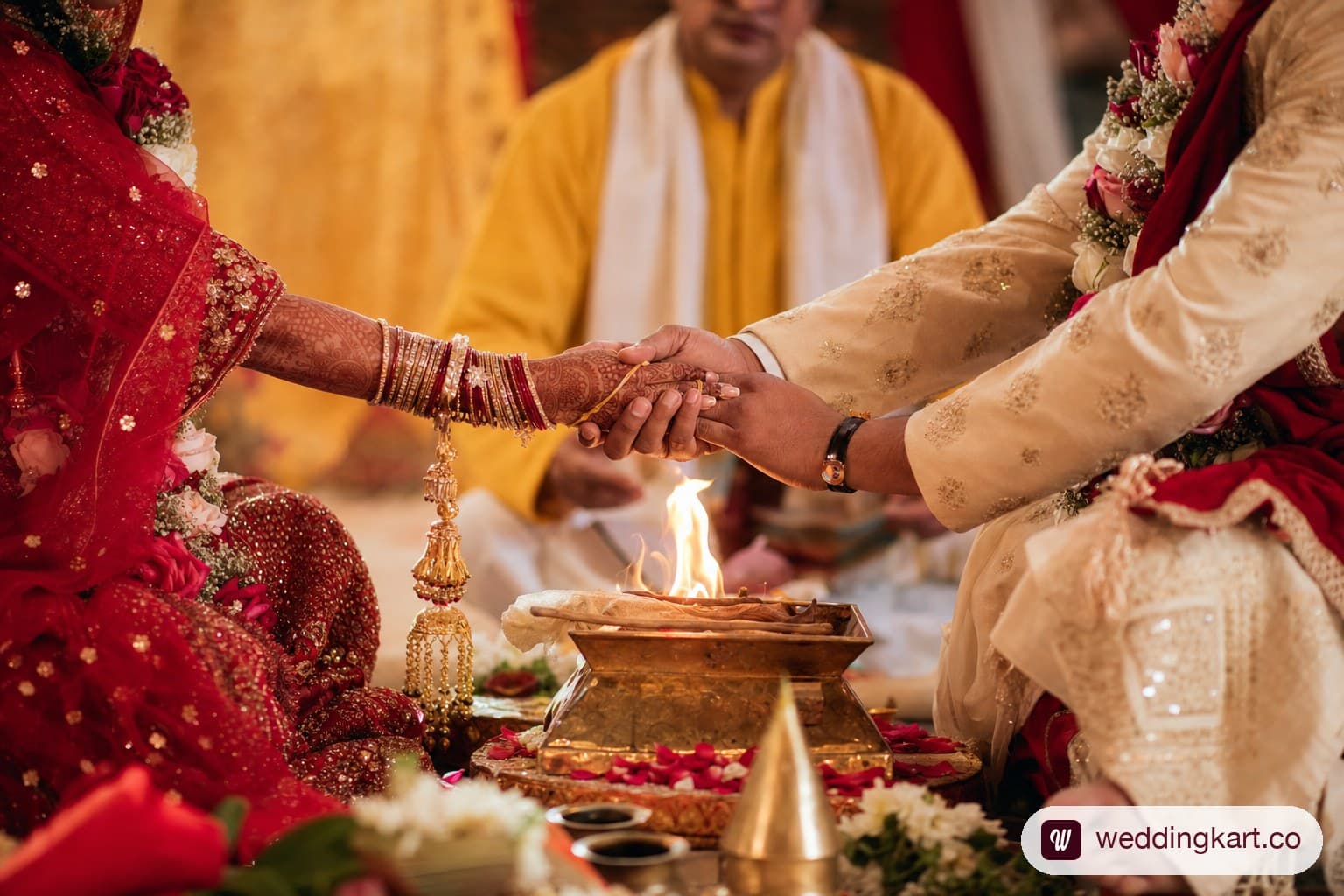
Most guests read a Hindu wedding as a run of back-to-back parties — turmeric one afternoon, henna the next, a dance night, then the big day. That is not wrong, but it misses the shape. The rituals run in a deliberate order, from loud and public to quiet and sacred, and somewhere in the middle — not at a registrar's desk — is the exact moment two people become married.
Here is the throughline, ceremony by ceremony: roka (the families' formal commitment) → haldi (turmeric) → mehendi (henna) → sangeet (music) → baraat (the groom's arrival) → Ganesh Puja (the opening prayer) → jaimala / varmala (garlands) → kanyadaan (giving the bride's hand) → the pheras around the sacred fire → sindoor and mangalsutra → vidaai (the farewell). One thing to say plainly up front: there is no single standard Hindu wedding. The names, the count of some rituals, and which ones a family includes all change by region and community — a Tamil, Bengali, Punjabi, Marwari and Gujarati wedding each run their own way. What follows is the common backbone, and what it actually means.
Why do Hindu wedding rituals run from public party to private vows?
The order is not random. A Hindu wedding is built as a widening, then a narrowing. The early functions — haldi, mehendi, sangeet — are loud, informal and communal; half the guest list is there, phones out, nobody sitting still. As the wedding day arrives, the circle tightens: the garlands, the fire, the vows, and finally a farewell watched by very few. By the time you reach vidaai, the party is over and it is just a family letting a daughter go.
It happens at scale, too — which is part of why the logistics get so heavy. The Confederation of All India Traders projected roughly 46 lakh weddings in a single 45-day peak season (1 November to 14 December 2025), worth an estimated ₹6.5 lakh crore in trade; weddings are India's fourth-largest industry by some estimates. But scale is not the point here — knowing the arc is the single most useful thing for a guest: it tells you which events are come-as-you-are fun and which ones are the actual marriage. So — in order.
How long does a Hindu wedding last?
The core rites under the mandap run about two to three hours; the whole wedding spans three days, sometimes up to five. The two-to-three-hour window is the ceremony proper — Ganesh Puja through the pheras, sindoor and mangalsutra (Westmount Country Club's ceremony guide). Everything else — haldi, mehendi, sangeet, the reception — is spread across the surrounding days. For how those surrounding days typically break down function by function, see the full day-by-day Indian wedding timeline.
7th step
When a saptapadi marriage is complete under s.7(2)
Source: Hindu Marriage Act, 1955, s.7(2)
7 vows
One promise taken per step of the saptapadi
Source: Hindu Marriage Act, 1955, s.7
2–3 hrs
Typical length of the core rites under the mandap
Source: Common planning range
3–5 days
How long a full wedding usually spans
Source: Common planning range
If a function seems to start at a strange hour — a 2 a.m. muhurat is not unusual — that is by design. A priest fixes the wedding date and the exact ceremony window (the muhurat) from the couple's birth charts, and the pheras are timed to fall inside that auspicious slot. The clock bends to the stars, not the other way round.
What is the order of Hindu wedding rituals?
Here is the common backbone in one view — each ritual, where it sits in the arc, what actually happens, and the moment to watch for. This is closest to the sequence many guests meet at North and urban Indian weddings; South Indian, Bengali, Maharashtrian and other ceremonies may move, rename or replace steps. Read it as a map, not a fixed checklist.
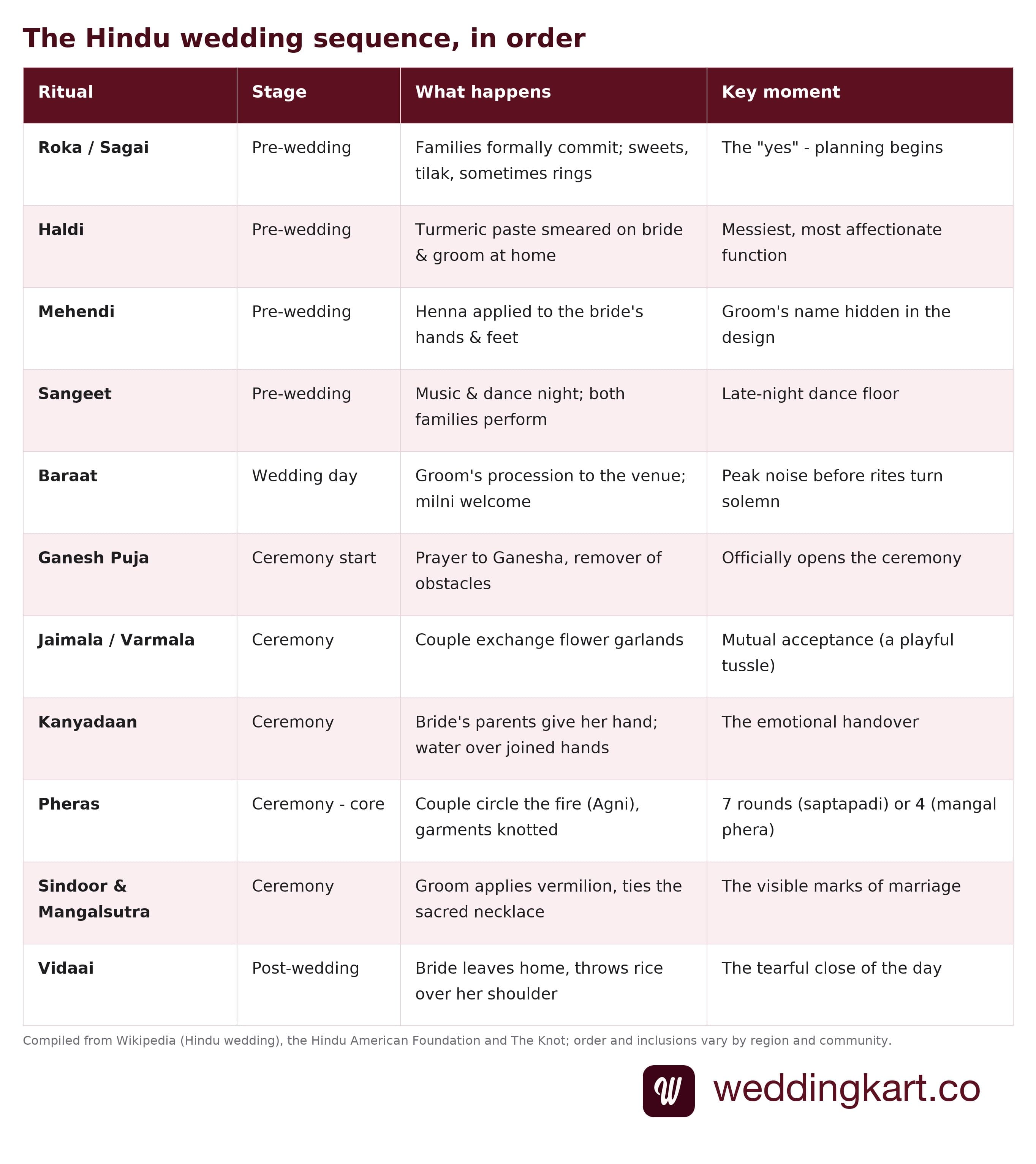
| Ritual | Stage & role | What happens | Key moment |
|---|---|---|---|
| Roka / Sagai | Pre-wedding · social | Families formally commit; sweets, tilak, sometimes rings | The “yes” — planning begins |
| Haldi | Pre-wedding · social | Turmeric paste smeared on bride & groom at home | Messiest, most affectionate function |
| Mehendi | Pre-wedding · social | Henna applied to the bride’s hands & feet | Groom’s name hidden in the design |
| Sangeet | Pre-wedding · social | Music & dance night; both families perform | Late-night dance floor |
| Baraat | Wedding day · social | Groom’s procession to the venue; ends in the milni welcome | Peak noise before rites turn solemn |
| Ganesh Puja | Ceremony · opening rite | Prayer to Ganesha, remover of obstacles | Officially opens the ceremony |
| Jaimala / Varmala | Ceremony · rite | Couple exchange flower garlands | Mutual acceptance (a playful tussle) |
| Kanyadaan | Ceremony · rite | Bride’s parents place her hand in the groom’s; water over joined hands | The emotional handover |
| Pheras | Ceremony · core rite | Couple circle the fire (Agni), garments knotted | 7 rounds (saptapadi) or 4 (mangal phera) |
| Sindoor & Mangalsutra | Ceremony · rite | Groom applies vermilion, ties the sacred necklace | The visible marks of marriage |
| Vidaai | Post-wedding · farewell | Bride leaves home, throws rice back over her shoulder | The tearful close of the day |
Compiled from Wikipedia (Hindu wedding), the Hindu American Foundation and The Knot; order and inclusions vary by region and community.
Pre-wedding rituals
Roka
The roka is the formal go-ahead — the point where both families publicly commit to the match. Sweets and dry fruits are exchanged, sometimes small gifts and a tilak for the couple. It is less a ceremony than a handshake with witnesses: after the roka, the wedding is on, and planning begins in earnest. In many families the roka and the engagement (sagai, where rings are exchanged) blur into one event.
Haldi
In the haldi, a paste of turmeric, sandalwood and often rosewater or oil is smeared on the bride and groom by family members, usually at their own homes on the morning of or day before the wedding. It is meant to purify, to calm nerves, and to bring a glow to the skin — but in practice it is the messiest, most affectionate function of the lot, everyone in old clothes, turmeric on faces and hands. Yellow is the dress code for a reason.
Mehendi
At the mehendi, henna is applied in intricate patterns to the bride's hands and feet, and often to the other women too. The designs frequently hide the groom's name or initials for him to find; a common bit of folklore holds that the darker the stain, the deeper the love (and the more the mother-in-law will dote). It is a long, chatty afternoon — the bride can't use her hands for hours, so she is fed and fussed over while musicians play.
Sangeet
Sangeet literally means “sung together.” It is the music-and-dance night, traditionally where the two families performed songs to welcome each other; today it is often a full choreographed show with rehearsed group dances, roasts of the couple, and a dance floor that runs late. Some families merge the mehendi and sangeet into one evening. If there is one event where you will meet everyone and remember none of their names, it is this one.
What happens first under the mandap? Ganesh Puja and the sacred canopy
In many North and West Indian ceremonies, the rites under the mandap open with Ganesh Puja — a prayer to Ganesha, the remover of obstacles, invoked at the start of any auspicious Hindu event. It is easy to miss because guests are still filing in and the garlands haven't happened yet, but this invocation — not the jaimala — is usually the first real rite of the marriage ceremony. Some traditions open with other preliminaries first (a kalash or Ganapati sthapana), then the sequence follows.
All of it happens under the mandap, the canopy built for the rites, with the sacred fire (Agni) at its centre as the witness to the vows. The mandap is not just decoration: its four poles are widely read as symbolising the four Purusharthas — dharma, artha, kama and moksha — as well as the four stages of life, the four walls of a home, and the four parents of the couple (Hindu American Foundation). The whole structure is a small, temporary house the two families raise together for a couple of hours.
Wedding-day rituals
Baraat
The baraat is the groom's procession to the venue — the groom traditionally on a decorated horse (sometimes an elephant, now often a car), surrounded by his family and friends dancing to a live band or dhol, blocking traffic without apology. It ends at the venue gate, where the bride's family receives the party in a welcome called the milni. The energy peaks here; it is the last purely joyful noise before the ceremony turns solemn.
Jaimala (Varmala)
The jaimala — also called varmala — is the first thing the couple do together on the wedding day: they exchange thick flower garlands, placing them around each other's necks. It signals mutual acceptance. Expect it to be playful — the groom's side lifts him so the bride can't reach, her side lifts her back; the garland exchange becomes a friendly tussle before the couple sit down for the sacred rites. Jaimala and varmala are two names for the same ritual.
Kanyadaan, panigrahana and gath bandhan
Popular accounts fold the “giving of the bride” into one paragraph, but authoritative sources treat it as three distinct beats. Kanyadaan is the moment the bride's parents place her hand in the groom's, often with sacred water poured over the joined hands. Then comes panigrahana (also called hasta melap) — the groom clasps the bride's right hand, formally accepting responsibility for the shared life ahead. Finally, gath bandhan: the couple's garments (the groom's scarf and the bride's dupatta) are knotted together before they circle the fire — a literal tie you will see photographed at almost every wedding.
Kanyadaan is also the rite modern couples most often reinterpret. Some reframe it as a blessing rather than a handover, have both sets of parents participate, or drop the “giving away” language entirely because they reject the ownership-transfer symbolism. None of that affects legal validity — the marriage is sealed at the pheras, not at kanyadaan — so it is a values-and-family-comfort decision, not a legal one.
What are the pheras? Saptapadi and mangal phera
This is the heart of the ceremony. The couple circle the sacred fire — Agni, treated as the witness to their vows — with the ends of their garments knotted together. The number of circuits is where communities diverge:
- Saptapadi — literally the seven steps, each bound to a vow. In many ceremonies the seven steps are performed as seven circuits of the fire; some traditions keep the steps and the circling distinct. Most North and South Indian communities perform seven.
- Mangal phera — four rounds: Gujaratis, Sindhis and some others circle the fire four times, the groom leading the first three (tied to dharma, artha and kama — duty, prosperity and desire) and the bride leading the fourth (moksha, liberation).
The seven vows (saptapadi), step by step
Each step is a specific promise, not decoration. In the common reading (The Art of Living), the couple vow:
- To nourish and provide for the household — food and sustenance.
- To grow together in strength of body and mind.
- To prosper by righteous means and share their spiritual duty (dharma).
- To keep mutual happiness, trust and respect.
- To raise noble children and care for the family.
- To stay healthy and steady through all the seasons of life.
- To be lifelong friends and loyal companions.
The exact wording shifts by priest and tradition, but the shape is constant: seven promises, spoken into the fire, one per step.
What is the most important Hindu wedding ritual?
If one rite matters most, it is the saptapadi — the pheras. It is the ceremony's core, the point at which the vows are actually taken, and, for saptapadi communities, the moment the marriage becomes complete in law. Everything before it prepares the couple and the families; everything after marks and celebrates what the fire has witnessed.
When is a Hindu marriage complete under the Hindu Marriage Act?
The distinction between seven rounds and four is not just ceremonial — it decides the exact moment the law considers the marriage done. Under the Hindu Marriage Act, 1955, where saptapadi is part of a community's customary rites, Section 7(2) states that “the marriage becomes complete and binding when the seventh step is taken”. So for saptapadi communities, the ceremony at the fire — not a signature — is the moment the law treats as the marriage. Communities whose customs don't include saptapadi are bound by their own prescribed rites instead, so the “moment of marriage” can fall at a different point by tradition. Either way, registration is a separate legal step for the certificate — covered below — and courts have held that sindoor or a mangalsutra alone, without the prescribed rites, does not make a valid marriage.
What do sindoor and mangalsutra mean?
Right after the pheras, the groom draws a line of vermilion — sindoor — into the parting of the bride's hair, and ties the mangalsutra, a black-and-gold beaded necklace, around her neck. These are the visible, everyday marks of a married woman in much of India: the sindoor renewed daily, the mangalsutra worn for years. If the pheras are the vow, these are the ring — the signal to the world that the marriage is done.
The mark itself varies by region. In many South Indian ceremonies the central symbol is the thaali or mangalyam (the sacred thread or pendant) tied in three knots, along with toe-rings (metti); a Bengali bride wears shakha-pola, the white-and-red conch and coral bangles, and the sindoor is applied under a cloth. Same idea — a worn, visible sign of marriage — expressed in different objects.
What happens after the pheras? Laja homam, vidaai and griha pravesh
Two more beats close the ceremony and are photographed at nearly every wedding. Laja homam comes near the end of the fire rites: the bride's brother pours handfuls of puffed rice into the flames as an offering for the couple's prosperity — a small, tender role for her family in the middle of the vows.
Vidaai (or bidaai) is the bride's departure from her parental home. In the classic gesture she throws handfuls of rice or coins back over her shoulder toward her family — a symbolic repaying of what they gave her, and a wish that prosperity stays in the house she leaves. It is quiet, tearful, and short, and it is the true end of the wedding day.
Then comes griha pravesh — the bride's first entry into the groom's home, often stepping over the threshold after gently kicking a small pot of rice, welcoming abundance into the household she is joining. Everything before vidaai was building up; this is the release, and the start of the new home.
How much do Hindu weddings differ by region?
A lot — which is why “the Hindu wedding” is a useful fiction. The backbone above is real, but each community keeps its own names, count and signature rites. Here is a quick guest comparison of how five traditions diverge on the same core moments — indicative, not exhaustive.
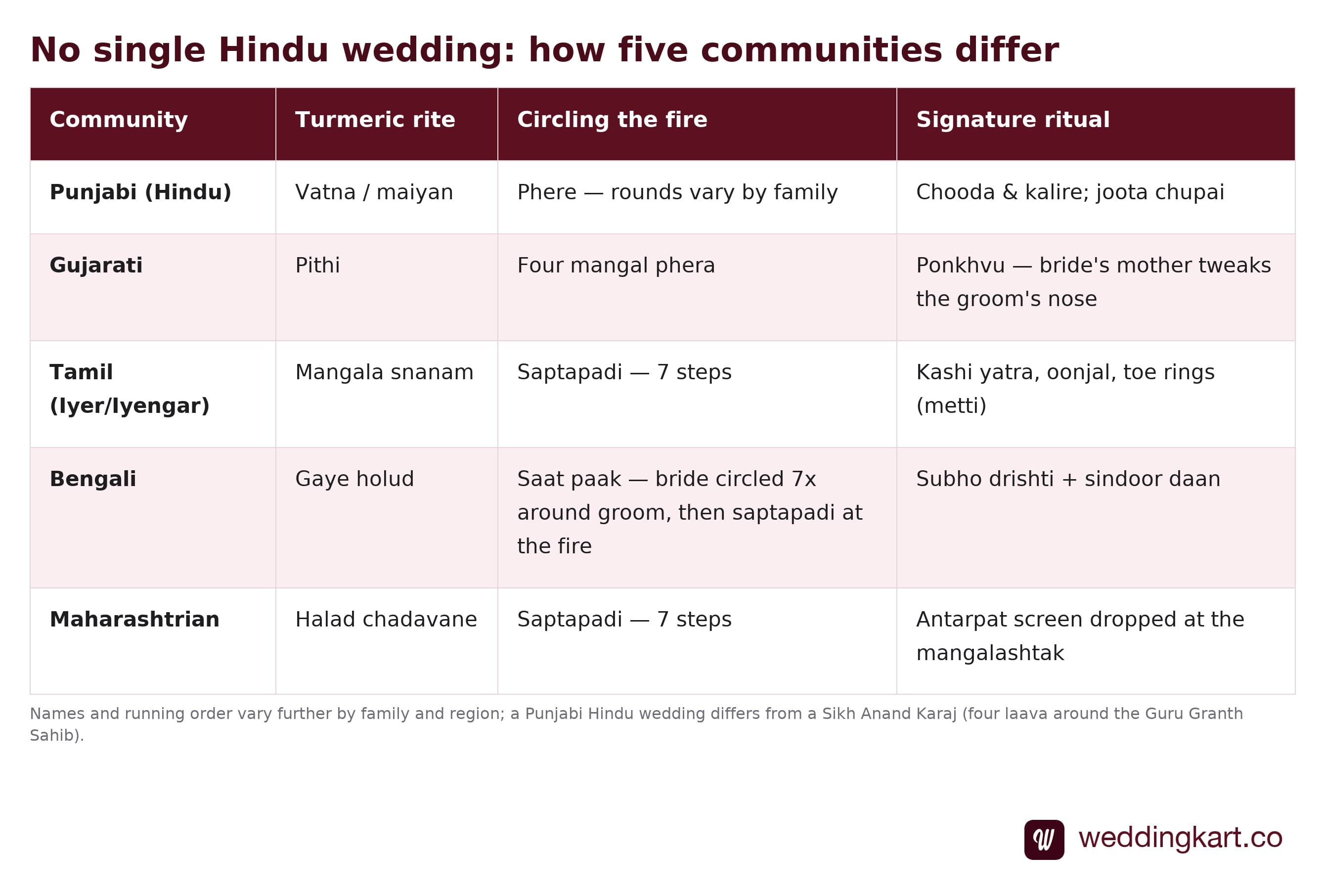
| Tradition | Turmeric rite | Circling the fire | A signature rite |
|---|---|---|---|
| Punjabi (Hindu) | Vatna / maiyan | Phere around the fire — number of rounds varies by family | Chooda & kalire; joota chupai (shoe ransom) |
| Gujarati | Pithi | Four mangal phera | Ponkhvu — the bride’s mother playfully tweaks the groom’s nose as he arrives |
| Tamil (Iyer / Iyengar) | Mangala snanam (turmeric bath) | Saptapadi — seven steps | Kashi yatra (mock pilgrimage), oonjal (swing) and toe-rings (metti) |
| Bengali | Gaye holud | Saat paak — bride circled around the groom seven times, then saptapadi at the fire | Subho drishti (the first look) and sindoor daan |
| Maharashtrian | Halad chadavane | Saptapadi — seven steps | Antarpat screen dropped at the mangalashtak |
Indicative, not exhaustive — names and running order vary within every community. Note that Bengali saat paak (the bride circled around the groom) is distinct from the fire-circling saptapadi; both can appear in one wedding.
None of this is exhaustive — even within a community, two families will run things differently. The point is the opposite of a single template: the sequence is a shared grammar that every tradition speaks with its own accent.
Other Hindu wedding rituals you may also see
The backbone above is the shared spine, but a real wedding threads many smaller rites through it — which ones appear depends entirely on region, community and family. A handful you are likely to run into:
- Tilak (or nischitartham / sagai): the bride's side honours the groom with a tilak and gifts, formally sealing the engagement — common in North Indian weddings, with parallels across communities.
- Ganpati Sthapana & graha shanti: pre-wedding prayers at each family's home to invoke Ganesha and settle planetary influences before the ceremony.
- Sehra bandi & ghari puja: the groom is dressed and a floral or beaded veil (sehra) tied to his turban before the baraat sets off.
- Havan / agni poojan: the priest lights and consecrates the sacred fire before the couple begin the pheras — the fire that becomes the witness to the vows.
- Joota chupai: the bride's sisters and cousins steal the groom's shoes during the rites and return them only for a cash ransom — pure mischief, taken seriously.
- Mangalashtak & antarpat: chiefly Maharashtrian — a cloth screen is held between the couple while blessing verses are chanted, then dropped at the auspicious moment.
- Aashirwad & reception: after the wedding, elders formally bless the couple, and a reception introduces them to the wider circle of family and friends.
None of these is universal — treat them as rites you might see, not ones every wedding includes. Our wedding glossary defines each in plain language if a name on the invite is unfamiliar.
Do you need to register the marriage separately?
Yes — for different reasons than the ceremony. The fire ceremony makes you married in custom, and for saptapadi communities in law at the seventh step. But the certificate is what institutions want: a registered marriage certificate is typically required or requested for a spouse visa, a joint bank account, a name change, insurance, or a court proceeding. Practically, do both — the mandap for the marriage, the registrar for the paperwork.
Registration is under the Hindu Marriage Act (for two Hindus) or the Special Marriage Act (for inter-faith or civil marriages). Fees, documents and timelines vary by state, so confirm on your state registrar's official portal rather than trusting a fixed figure online. If one partner lives abroad, the paperwork has extra steps — we cover those in our guide to registering an NRI marriage in India.
What guests should actually know
Two practical things, from having watched a lot of these run.
First, the priority order. If you can only make part of a multi-day wedding, be there for the pheras and the sindoor-and-mangalsutra moment — that is the marriage. Vidaai, if you can stay, is the most moving few minutes of the day. The haldi, mehendi and sangeet are the warm-up: the most fun, the most relaxed, and where you'll actually get to know both families — but nobody minds if you miss one.
Second, the modern reality. A wedding that once unfolded over five unhurried days is now routinely compressed into two or three, across two or three venues — haldi at home, sangeet at a banquet hall, the wedding at a farmhouse an hour away. Compression wins on cost and on out-of-town or NRI guests' time budgets; the leisurely version wins on ritual completeness and letting elders lead each rite properly. The real casualty of compression is guest clarity: which function am I invited to, at what time, at which address, and do I need to be at the haldi or just the wedding?
That is the guest-ops problem more than the ritual one, and it is what Weddingkart is built for. With a multi-event RSVP, each guest sees only the functions they are invited to and confirms per event over WhatsApp — no separate app for anyone to install. If your wedding is small and single-event, or everyone already has your number, a group chat will do just as well.
The short version
A Hindu wedding runs from the roka's formal yes, through the turmeric-and-henna celebrations, into Ganesh Puja and the sacred core at the fire, and out through the bride's farewell. Read it as an arc — public to private, celebration to vow — and the individual rituals stop being a confusing blur of names and start making sense as one ceremony with a beginning, a turning point, and an end. If you remember only one thing: for most communities the marriage is sealed at the fire, and the paperwork is a separate step.
Planning a wedding with several functions across a few days? WhatsApp us at +91 92176 10045 — we'll help you set up per-event invites for haldi, sangeet, wedding and reception.
Further watching
- A Hindu wedding — the symbolism, for a general audience — BBC Teach / TrueTube (YouTube)
- Sacred Vows: the meaning behind Hindu wedding rituals, with a priest — Beyond Vows & Veils (Pandit Neall Prasad) (YouTube)
- The Seven Steps of a Hindu Wedding Explained (Saptapadi) — YouTube explainer (YouTube)
Frequently asked questions
What is the order of Hindu wedding rituals?+
The common sequence runs: roka (the formal go-ahead), then haldi (turmeric), mehendi (henna) and sangeet (a music-and-dance night) in the days before; on the wedding day, the baraat (groom’s procession), Ganesh Puja to open the ceremony, jaimala or varmala (garland exchange), kanyadaan (the bride’s parents place her hand in the groom’s), the pheras around the sacred fire, and finally sindoor and the mangalsutra; then vidaai, the bride’s farewell. Order and inclusions vary by region, community and family — not every wedding has every ritual.
How long does a Hindu wedding ceremony last?+
The core rites under the mandap — from Ganesh Puja through the pheras, sindoor and mangalsutra — typically run about two to three hours. The wedding as a whole spans three days, and sometimes up to five, once you count the haldi, mehendi, sangeet and reception. Some functions start at odd hours because the priest fixes an auspicious window (muhurat) from the couple’s birth charts, which is why a ceremony can begin close to midnight or before dawn.
What is the first ritual in a Hindu wedding ceremony?+
In many North and West Indian ceremonies, the rites under the mandap open with Ganesh Puja — a prayer to Ganesha, the remover of obstacles, invoked at the start of any auspicious Hindu event. Some traditions begin with other preliminaries first (a kalash or Ganapati sthapana, punyahavachanam or nandi), but a prayer to invoke blessings is the usual opening. The pre-wedding functions such as haldi and sangeet come earlier; the invocation is the first act of the marriage ceremony itself.
What is the mandap, and why does it have four poles?+
The mandap is the canopy under which the marriage rites are performed, with the sacred fire (Agni) at its centre as the witness to the vows. Its four poles are widely read as symbolising the four Purusharthas (dharma, artha, kama, moksha), the four stages of life, the four walls of a home, and the four parents of the couple — the two families who build the new household together.
Why is the sacred fire (Agni) important in a Hindu wedding?+
Agni, the fire god, is treated as the divine witness to the marriage. The couple take their vows before the fire and circle it during the pheras, so that the promises are made not just to each other but in the presence of a sacred witness — offerings of ghee, grain and puffed rice (in the laja homam) are poured into it. This is why, under the Hindu Marriage Act, the rite at the fire, rather than a signature, is treated as the moment a saptapadi marriage becomes complete.
What is the difference between mangal phera and saptapadi?+
Both are the couple circling the sacred fire, but the count differs by community. Most North and South Indian communities perform saptapadi — seven steps or seven rounds, each tied to a vow. Gujaratis, Sindhis and some others perform mangal phera (mangal fera): four rounds, with the groom leading the first three and the bride leading the fourth. The number of circuits is the real distinction, and it also decides the exact moment the marriage is considered complete.
Are the pheras and the saptapadi the same thing?+
Closely related, but not identical. "Pheras" (or feras) is the general act of circling the sacred fire; "saptapadi" is the specific form of seven steps or seven rounds, each bound to a vow, and it is the version the Hindu Marriage Act, 1955 names by name. So every saptapadi involves pheras, but a four-round mangal phera (as in many Gujarati and Sindhi weddings) is pheras without saptapadi. When people say "saat phere," they mean the seven-round saptapadi.
What is the difference between jaimala and varmala?+
None — jaimala and varmala are two names for the same ritual: the couple exchanging thick flower garlands at the start of the wedding-day rites, placing them around each other’s necks as a sign of mutual acceptance. "Varmala" is the more common term in North India, "jaimala" is used widely too; some regions call it jayamala or var mala. Expect it to be playful, with each side lifting their own so the other can’t reach.
What are the seven vows (saptapadi) of a Hindu marriage?+
Across the seven steps, the couple promise, in the common reading: (1) to nourish and provide for the household; (2) to grow together in strength of body and mind; (3) to prosper by righteous means and share spiritual duty; (4) to keep mutual happiness, trust and respect; (5) to raise noble children and care for the family; (6) to stay healthy through all the seasons of life; and (7) lifelong friendship, loyalty and companionship. Exact wording varies by priest and tradition.
Which ritual actually makes a Hindu marriage official?+
Traditionally the marriage is sealed at the fire, not at a registrar’s desk. Under the Hindu Marriage Act, 1955, where saptapadi forms part of a community’s customary rites, the marriage becomes complete and binding when the seventh step is taken. Communities whose customs do not include saptapadi are bound by their own prescribed rites. Couples still register the marriage separately for the certificate that institutions demand, but the ceremony is what makes it a marriage.
Do you need to register a Hindu marriage separately?+
The ceremony makes you married in custom, and for saptapadi communities in law at the seventh step — but a registered marriage certificate is typically required or requested for a spouse visa, a joint bank account, a name change, insurance, or court matters. Practically, do both: the mandap for the marriage, and registration under the Hindu Marriage Act or Special Marriage Act for the paperwork. Fees and timelines vary by state — confirm on your state registrar’s official portal.
Do all Hindu weddings include every one of these rituals?+
No. There is no single standard Hindu wedding — regional variation is the rule, not the exception. A Tamil, Punjabi, Bengali, Marwari and Gujarati wedding each have their own rites, names and running order. The rituals here are the ones most weddings share in some form. Treat this as a map of the common backbone, not a fixed checklist every family follows.
As a guest, which rituals should you not miss?+
If you can attend only part of it, be there for the pheras and the sindoor-and-mangalsutra moment — that is the marriage itself; everything before is celebration. Vidaai is the emotional close and often the most moving few minutes. Haldi, mehendi and sangeet are the warm-up: joyful, informal, and where you actually get to know the families.
What should guests wear to Hindu wedding functions?+
Bright, festive colours are welcome and expected — Indian ethnic wear (kurta, sherwani, saree, lehenga, salwar suit) or smart formal outfits both work. A few conventions worth knowing: wear yellow to a haldi, since turmeric will stain anything; many families avoid all-black or all-white for the main ceremony, as white is linked to mourning in much of Hindu tradition; and if the rites are at a temple, cover shoulders and knees and expect to remove your shoes. When in doubt, ask the hosts — most weddings now list a dress code per function on the invite.
Sources
Ritual names, order and meaning here were cross-checked against the Hindu American Foundation's wedding primer and the text of the Hindu Marriage Act, 1955; regional variations reflect widely documented community customs. The legal wording is quoted from the statute; market and season figures are third-party estimates that change year to year. Registration fees and timelines vary by state — confirm on your state registrar's official portal before relying on a number.
- 1. The Hindu Marriage Act, 1955 — Section 7 (Ceremonies for a Hindu marriage), official text — India Code, Government of India
- 2. The Hindu Marriage Act, 1955 — Section 7 (full text and case notes) — Indian Kanoon
- 3. Saptapadi — the seven steps of marriage — Wikipedia
- 4. Hindu wedding — rites, regional variation and running order — Wikipedia
- 5. What’s a Hindu wedding like? (Hindu Wedding Primer) — Hindu American Foundation
- 6. Saptapadi: all you need to know about the seven steps of marriage — The Art of Living
- 7. Seven Vows of Hindu Marriage — significance of the saat pheras — Cultural India
- 8. 37 Hindu Wedding Traditions, Customs & Rituals: An Expert’s Guide — The Knot
- 9. Wedding Season 2025 to generate ₹6.5 lakh crore from 46 lakh weddings — Confederation of All India Traders (CAIT)
- 10. India’s fourth-largest industry — the wedding blitz (Jefferies figures) — Kotak Mutual Fund
- 11. Hindu Wedding: A Complete Guide To The Hindu Marriage Ceremony — Westmount Country Club
Related reading
Gujarati Wedding Rituals & Ceremonies →
How one community's rites differ — including the four-round mangal phera.
Wedding Glossary →
Plain-language definitions for every ritual, role and custom named here.
Registering an NRI Marriage in India →
The paperwork side of the wedding — how the certificate works when one partner lives abroad.
Indian Wedding Guest List & RSVP Playbook →
Running the headcount across several functions without losing the thread.
Was this article helpful?
Share