
Quick Answer
What does planning a complete Gujarati wedding involve?
A Gujarati wedding is a series of 6 to 8 separate events over four to five days — Chandlo Matli, Gol Dhana, Mehendi Night, Garba Night, Pithi, Mandvo, Jaanmano & Baraat, and the Reception — each with its own rituals, dress code, and guest list. A mid-range Ahmedabad wedding involves 400–600 guests, a minimum of 4 bridal outfits, and a budget of ₹15 lakh to ₹1 crore. Planning it well means locking the venue and big vendors 9–12 months out, building a master guest list with per-event sub-lists early, and running RSVP and logistics communication over WhatsApp rather than phone calls.
Last updated:
6–8
separate events across four to five days
400–600
guests at a mid-range Ahmedabad wedding
₹15L–₹1Cr
typical total budget range
3–5
bridal looks across the wedding week
Last updated:
All PostsThe Complete Gujarati Wedding Guide 2026: Rituals, Planning & Everything You Need
Every event, ritual, venue, attire, budget line, and guest-list step — the one guide you need to plan or understand a Gujarati wedding in 2026
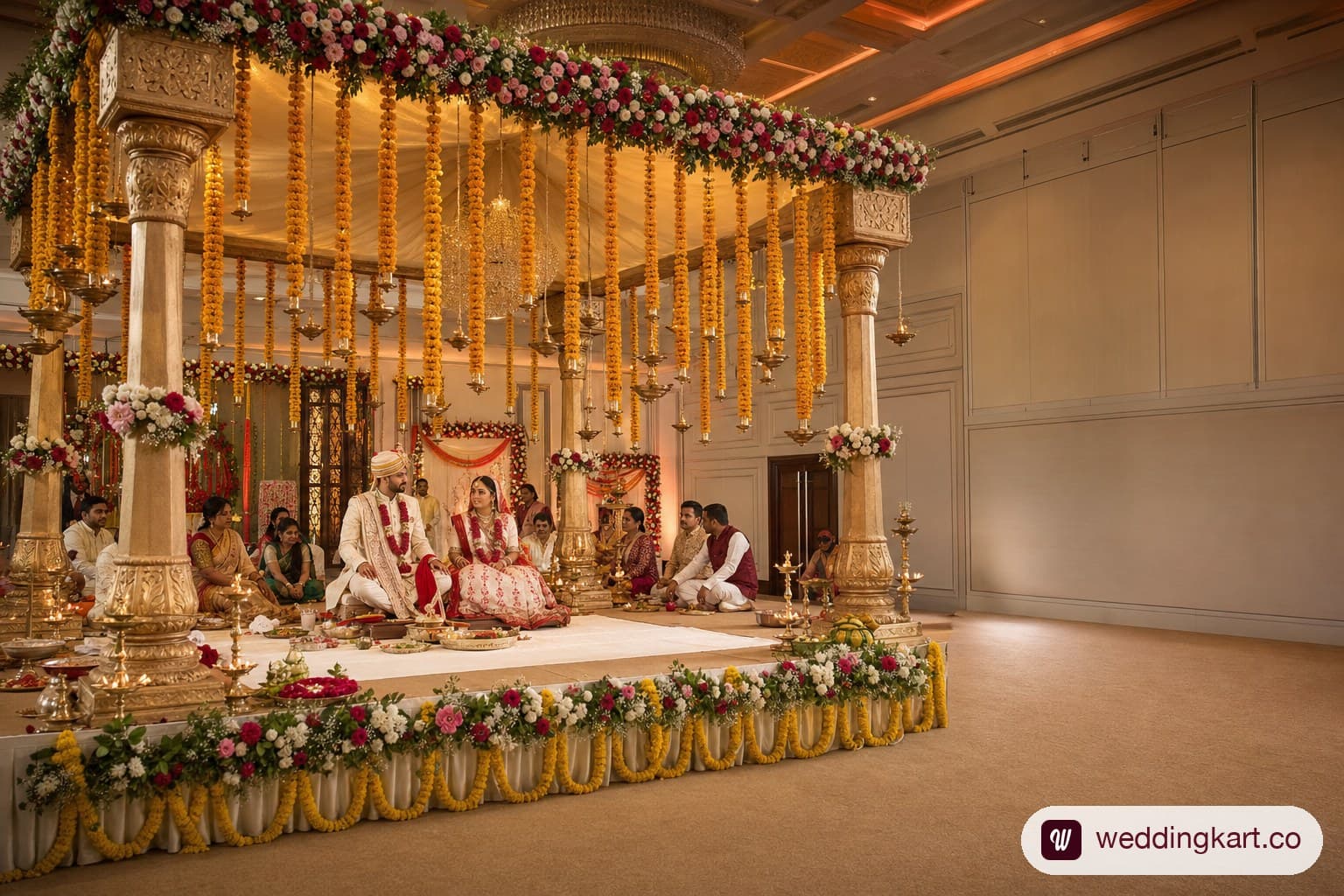
A Gujarati wedding is not a single event. It is a series of celebrations — each one distinct in its rituals, its dress code, its food, and its emotional weight — woven together across four to five days that families remember for generations. If you are planning one for the first time, the scale can feel daunting. If you are attending one as a guest, you may feel beautifully bewildered.
This is the guide you need. Whether you are a couple planning your Gujarati wedding in Ahmedabad, a family member coordinating one of the events, or a curious guest trying to understand what you are walking into, this 2026 pillar guide covers everything: the full events list, detailed rituals, bridal attire, venue choices, food and catering, budget breakdowns, guest list management, and a month-by-month checklist.
Let's start at the very beginning.
What Is a Gujarati Wedding? Overview & Cultural Significance
Gujarati weddings are rooted in the Vaishnavite tradition of Hinduism, with customs that reflect the cultural values of the Gujarati community: hospitality, celebration, commerce, and family bonds. Ahmedabad, as Gujarat's largest city and commercial capital, is home to an extraordinary wedding culture — one that blends centuries-old rituals with contemporary style and remarkable scale.
What makes a Gujarati wedding distinctive is not just the rituals — it is the philosophy behind them. Every ceremony connects the two families, not just the couple. The mama (maternal uncle) plays a central role, gifting the Panetar saree and performing specific rituals. The Garba night is a community event, not just a party. Even the food at a Gujarati wedding is an expression of identity: the vegetarian thali served at weddings is considered a form of hospitality and devotion.
In Ahmedabad, weddings have also become large-scale social occasions. A mid-range Gujarati wedding in the city today involves 400–600 guests, 6–8 separate events, a minimum of 4 different outfits for the bride, and a budget that typically ranges from ₹15 lakh to ₹1 crore depending on the family.
The Full List of Gujarati Wedding Events
A complete Gujarati wedding in Ahmedabad typically includes the following events. Not every family observes all of them — some rituals vary by sub-community (Patel, Brahmin, Jain-influenced families, etc.) — but this is the comprehensive list:
| Event | Timing (before wedding) | Who Attends | Duration |
|---|---|---|---|
| Chandlo Matli | 2–3 weeks before | Close family | 2–3 hours |
| Gol Dhana (Engagement) | 1–3 months before | Both families + close friends | 3–4 hours |
| Mehendi Night | 2 days before wedding | All female guests | 4–6 hours |
| Garba Night (Sanji) | 1 day before wedding | All guests | Full evening (4–6 hours) |
| Pithi Ceremony | Morning of wedding | Close family | 2–3 hours |
| Mandvo (Wedding Day) | Wedding day | All guests | 6–10 hours |
| Jaanmano & Baraat | Wedding day (afternoon) | Groom's side + all guests | 2–3 hours |
| Reception Dinner | Evening after wedding / next day | All guests | 4–5 hours |
For a full breakdown of each ceremony with planning details, see our deep-dive guide: Gujarati Wedding Rituals & Ceremonies: A Complete Step-by-Step Guide (2026).
To see how Gujarati rites compare with other communities' — Punjabi, Tamil, Bengali and Maharashtrian — read Hindu wedding rituals explained, ceremony by ceremony. And if you are attending as a guest, our guide to what to wear to an Indian wedding covers the dress code for every function.
Gujarati Wedding Rituals Explained
Each ceremony in a Gujarati wedding carries specific rituals. Here is a concise guide to the most important ones:
Chandlo Matli — The First Formal Ritual
The Chandlo Matli is an intimate family ceremony where the groom's family visits the bride's home to formalise the match. The groom's mother applies a chandlo (red tilak) to the bride's forehead. The bride's family offers gifts. This is the first official step in the wedding process and typically involves only the immediate family on both sides.
Gol Dhana — The Engagement
Gol (jaggery) and Dhana (coriander seeds) are the symbolic elements of this engagement ceremony. Both families come together; the couple exchange garlands; the priest formalises the match with Vedic prayers. Unlike Western engagements, Gol Dhana is a full ceremony with a formal guest list, music, food, and gifts.
Mehendi Night
The night before the wedding (or two nights before for larger weddings), female guests gather for the Mehendi ceremony. The bride has elaborate bridal Mehendi applied to her hands and feet by a professional Mehendi artist — a process that takes three to six hours. Guests have simple Mehendi applied too. The event features music, light food, and typically a small performance or Garba session.
Garba Night (Sanji / Sangeet)
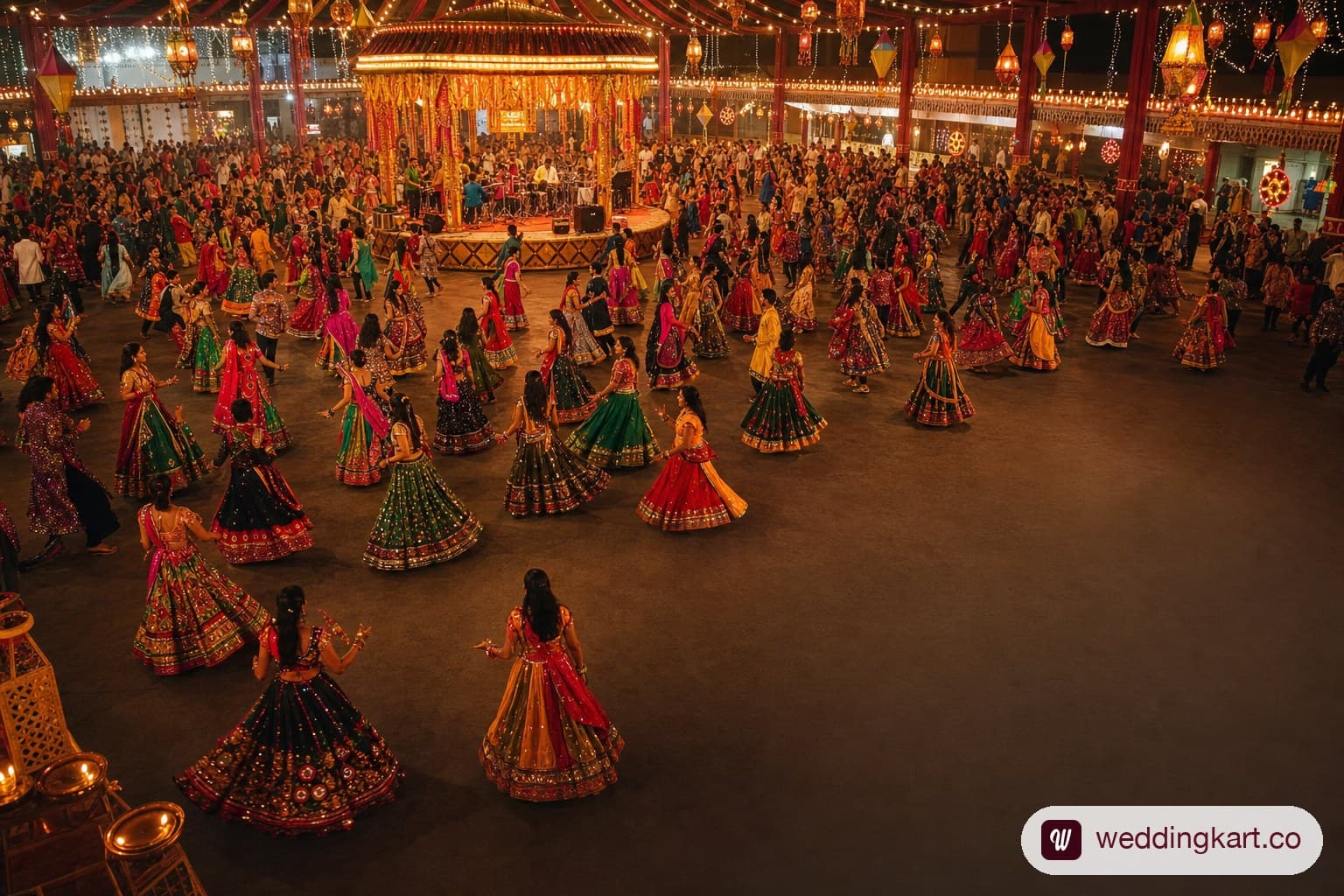
Garba is the soul of a Gujarati pre-wedding. Guests dance in concentric circles to traditional Garba and Dandiya music — sometimes accompanied by a live orchestra, sometimes a DJ. Everyone wears traditional attire: women in chaniya choli, men in kediyu (traditional Gujarati kurta). The Garba night can run from 8 PM well past midnight and is the most joyous, high-energy event of the wedding week.
Pithi Ceremony
On the morning of the wedding, the Pithi ceremony takes place simultaneously at the bride's and groom's homes. Family members apply a paste of turmeric (haldi), sandalwood, and rosewater to the couple's skin — it is believed to cleanse, beautify, and bless them before the ceremony. The ritual is intimate, joyful, and often accompanied by traditional folk songs.
Mandvo — The Main Wedding Ceremony
The Mandvo is the heart of the Gujarati wedding. Under a ceremonially constructed mandap (canopy), the priest guides the couple through Vedic rituals including the Saptapadi (seven vows around the sacred fire), the Kanyadaan (gift of the bride by her father), and the Hasta Milap (joining of hands). The bride wears the Panetar saree gifted by her maternal uncle. The ceremony typically lasts four to six hours.
Jaanmano & Baraat
The Jaanmano is the groom's processional arrival. In Ahmedabad, this is typically a full procession — the groom arrives on a decorated horse or in a luxury car, accompanied by dancing family members and a brass band. At the venue entrance, the bride's family formally receives the Baraat. The Jaanmano is one of the most photographed and celebrated moments of the entire wedding.
The Perfect Gujarati Wedding Venue in Ahmedabad
Venue selection is one of the first and most consequential decisions of your wedding planning. In Ahmedabad, the right venue needs to accommodate multiple events, provide catering facilities or allow outside caterers, and have the spatial layout for a Garba night (open floor, high ceilings).
The city's wedding venue landscape broadly divides into three categories:
- Banquet halls and wedding halls — The most common choice for Ahmedabad weddings. Facilities like The Grand Bhagwati, The Ummed, and Fortune Landmark offer end-to-end wedding packages with in-house catering, decoration, and accommodation.
- Farmhouses and open lawns — Increasingly popular for Garba nights and daytime ceremonies. Areas around Sanand, Bopal, and Sarkhej have large farmhouse venues. The open setting is ideal for large Garba nights but requires a generator backup and a weather contingency plan (especially May–June).
- Five-star hotels — The Hyatt Ahmedabad, Marriott, and ITC Narmada are premium choices for families wanting hotel-quality service with the wedding. Hotel venues are the best option for destination weddings where outstation guests need accommodation.
For venue research, use WedMeGood or WeddingWire to compare venues with real reviews, photos, and package details.
Gujarati Bridal Attire & Panetar
Gujarati bridal attire is one of the richest and most visually distinctive in India. At its centre is the Panetar — a white and red silk saree gifted by the mama and worn during the main ceremony. Beyond the Panetar, a Gujarati bride curates three to five looks across the different events.
For the Garba night, the chaniya choli (a flared skirt-blouse ensemble) is the definitive choice. For the reception, most modern Gujarati brides choose a lehenga — often in a Patola-inspired design, Bandhani fabric, or a contemporary fusion piece.
For a complete guide to Gujarati bridal attire — including Panetar draping, chaniya choli fabrics, bridal jewellery, colour guides, and where to shop in Ahmedabad — see our dedicated guide: Gujarati Wedding Saree & Bridal Attire Guide 2026.
Gujarati Wedding Food & Catering
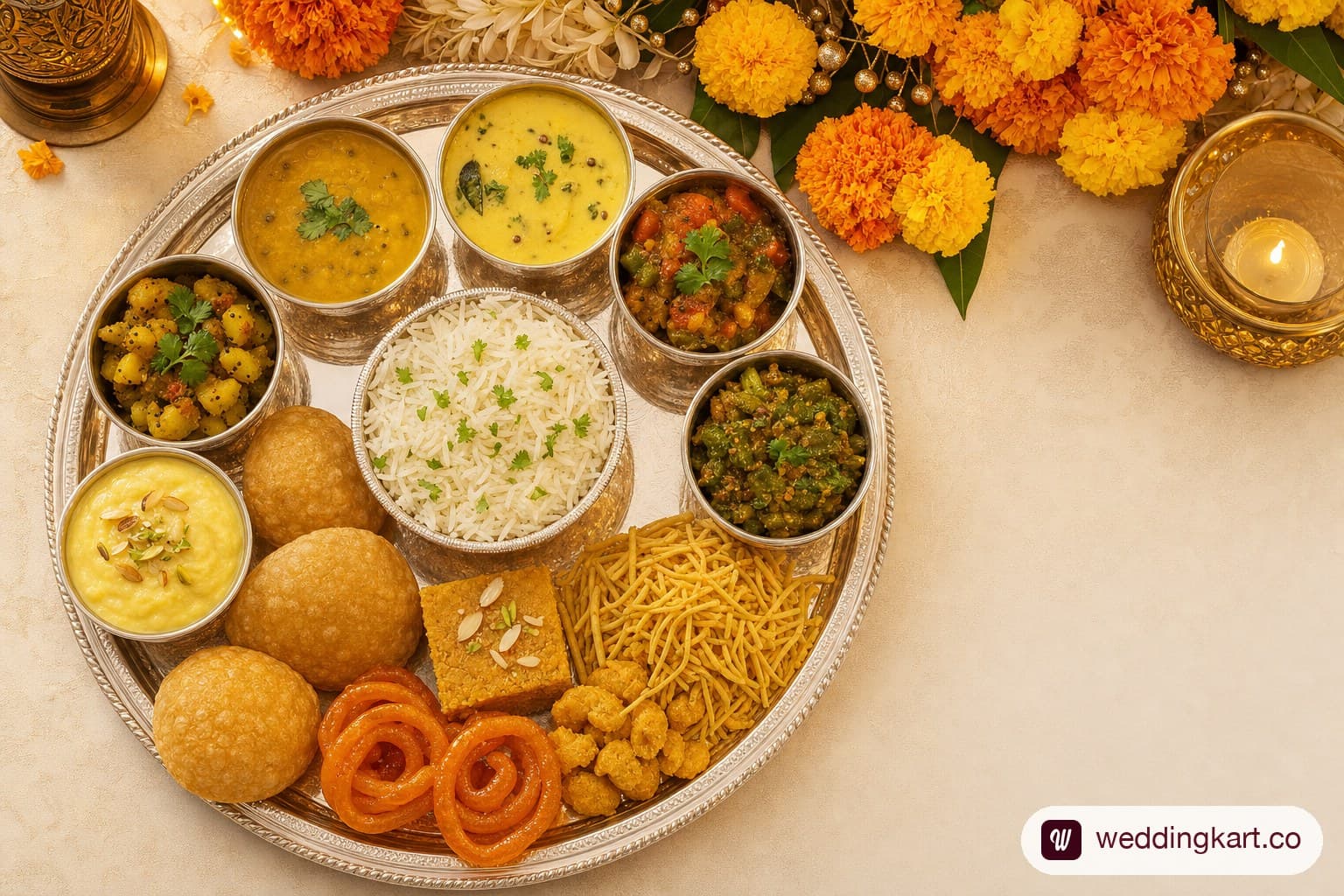
If there is one thing that every Gujarati wedding guest remembers, it is the food. The traditional Gujarati wedding thali is a vegetarian feast of extraordinary variety — and it is considered an expression of hospitality and abundance. A full formal thali at a Gujarati wedding typically includes:
- Starters: Pani puri, dhokla, fafda, jalebi, various chaats
- Dal: Sweet gujarati dal (sometimes served as a standalone course)
- Sabzi: 3–5 vegetable dishes including a dry sabzi, a gravy, and a stuffed item
- Kadhi: The tangy, sweet Gujarati kadhi is non-negotiable at most weddings
- Rice dishes: Plain rice, khichdi, or pulao
- Breads: Bajra rotla, phulka, puri
- Sweets: Mohanthal, ghevar, Basundi, halwa, and at least three to four other mithai
- Cooling items: Chaas (buttermilk), shrikhand, and fresh fruit
Catering costs in Ahmedabad (2026) range from ₹600–₹800 per plate for standard vegetarian service to ₹1,200–₹2,000 per plate for premium catering with live counters and imported ingredients. For a 500-guest wedding across two main events, expect to budget ₹8–₹20 lakh for catering alone.
Key questions to ask your caterer: Do they handle all events or just the main wedding? What is their staffing ratio? Do they provide serving equipment? What is the cancellation policy if the headcount changes by 20%?
Guest List Management for Gujarati Weddings
A Gujarati wedding with 400–600 guests attending multiple events is one of the most complex guest management challenges in Indian weddings. The problem is not just the size — it is the segmentation. Different guests attend different events: your business colleagues may come to the reception but not the Garba night. Your extended family attends everything. Your friends may be invited to three of the eight events.
Managing this manually — through WhatsApp forwards and phone calls — is the traditional approach, and it consistently leads to confusion, duplicate RSVPs, and guests showing up to events they were not invited to.
For a complete tactical guide to managing your Gujarati wedding guest list — including the master spreadsheet structure, per-event sub-lists, and RSVP collection — read: How to Manage Your Gujarati Wedding Guest List Without Losing Your Mind.
Wedding Invitations & Kankotri
The Kankotri is the traditional Gujarati wedding invitation — a printed card that carries the formal details of the wedding, written with religious verses and the family's blessings. In its classic form, the Kankotri is printed on cream or ivory card stock with gold embossing and a red envelope.
In 2026, most Ahmedabad families send a combination: a physical Kankotri for close family and elders, and a digital WhatsApp invitation for the broader guest list. The WhatsApp invitation is typically a PDF or a designed graphic card paired with a personalised message.
For templates, tips on sending to 500+ guests via WhatsApp, and how to personalise every message without doing it manually, see: How to Send Gujarati Wedding Invitations via WhatsApp to 500+ Guests.
Pre-Wedding Photoshoot
The pre-wedding photoshoot has become an essential part of Gujarati wedding planning — both for memories and for the social media announcement. Ahmedabad and its surroundings offer remarkable backdrops: the stepped wells (vavs) of Adalaj and Patan, the ornate architecture of the Sidi Saiyyed Mosque, the Sabarmati Riverfront, and the heritage havelis of the old city.
Budget ₹25,000–₹1.5 lakh for a professional pre-wedding photographer session in Ahmedabad, depending on the photographer, the number of locations, and whether video is included. Book at least three to four months in advance for the best-quality photographers.
Full Gujarati Wedding Budget Breakdown
This is an approximate budget breakdown for a mid-range Gujarati wedding in Ahmedabad in 2026, assuming 500 guests across 6 events with a total budget of ₹50 lakh. Scale proportionally for your actual budget.
| Category | % of Budget | Estimated Amount (₹50L base) |
|---|---|---|
| Venue (all events) | 25–30% | ₹12.5L – ₹15L |
| Catering (all events) | 25–30% | ₹12.5L – ₹15L |
| Photography & Videography | 8–12% | ₹4L – ₹6L |
| Decoration (all events) | 12–18% | ₹6L – ₹9L |
| Bridal Attire & Jewellery | 8–12% | ₹4L – ₹6L |
| Music & Entertainment (Garba DJ/band) | 4–6% | ₹2L – ₹3L |
| Wedding Planner | 8–12% | ₹4L – ₹6L |
| Printing, Invites & Favours | 3–5% | ₹1.5L – ₹2.5L |
| Transportation (cars, Baraat fleet) | 4–6% | ₹2L – ₹3L |
| Contingency (always keep this) | 5% | ₹2.5L |
Use the Weddingkart Wedding Budget Calculator to estimate your specific wedding cost based on city, guest count, and number of events.
Gujarati Wedding Checklist: Month-by-Month Timeline
This is your complete planning timeline. Use it as your master checklist from the moment you set a date.
12 Months Before
- Set your wedding date (check the Hindu calendar for auspicious muhurat)
- Define your guest count and overall budget
- Shortlist and book your primary venue — this goes fast in peak season
- Start researching and meeting wedding planners if you plan to hire one
- Book your photographer and videographer (the best ones book 12–18 months out)
9 Months Before
- Book your caterer for all events
- Shortlist outfits — book your Panetar, lehenga, and chaniya choli
- Research and book bridal jewellery (heirloom sourcing or rental)
- Book your Garba music (live orchestra or DJ band) — demand is high
- Begin your guest list — master list first, then per-event segmentation
6 Months Before
- Finalise decoration concept and book decorator for all events
- Book wedding cars and Baraat transport
- Book makeup artist and bridal hair stylist (book trials)
- Commission Kankotri printing (allow 2–3 months for custom work)
- Book hotel rooms for outstation guests
- Set up your guest communication platform (Weddingkart or similar)
3 Months Before
- Finalise menus for all events with caterer
- Send save-the-date messages to all guests via WhatsApp
- Complete bridal outfit fittings
- Book priest for Mandvo ceremony — confirm muhurat time with family
- Finalise and review vendor contracts one more time
1 Month Before
- Send formal invitations to all guests
- Begin RSVP collection — track per event
- Create vendor contact master sheet with all names and phone numbers
- Brief family members on their roles for each ceremony
1 Week Before
- Confirm final headcounts with caterer and venue
- Send logistics reminders (venue address, parking, dress code) to all guests via WhatsApp
- Collect and pack all items needed for ceremonies: Pithi ingredients, Garba lamps, Mandvo materials
- Confirm arrival times and positions for all vendors
Day Before
- Confirm all vendors are confirmed for the next day (quick WhatsApp check)
- Send 'See you tomorrow' message with last timing reminders to guests
- Rest — the next four days are going to be extraordinary
Day After
- Send thank-you messages to all guests
- Brief photographer on any missed moments or key shots for delivery
- Settle final vendor payments according to contracts
Managing Communication for a Gujarati Wedding
With 400–600 guests across 6–8 events, guest communication is one of the most underestimated operational challenges of a Gujarati wedding. Most families handle it reactively: one WhatsApp forward of the invite, then frantic individual messages the night before.
The smarter approach is a structured communication timeline: Save the Date (12 weeks out) → Formal Invitation (8 weeks) → RSVP collection (6 weeks) → RSVP reminder (3 weeks) → Logistics update (1 week) → Day-of update (morning of each event) → Thank you (day after).
For a complete communication timeline with message templates for each stage, see: Destination Wedding Communication: A Planner's Timeline.
Weddingkart is built for exactly this — manage your complete guest list, send function-specific WhatsApp invitations, collect RSVPs per event, and track attendance for your caterer and venue. Used by top event managers in Ahmedabad.
Start Your Free Trial Today →💌 Built for Gujarati weddings of 400–1,000 guests across 6–8 events
Weddingkart is built for exactly this — manage your complete guest list, send function-specific invitations via WhatsApp, collect RSVPs, and track attendance per event.
Start Free Trial →Frequently Asked Questions
What is the traditional wedding in Gujarat?
A traditional Gujarati wedding is rooted in Vaishnavite Hindu custom and runs as a series of 6–8 separate events over four to five days — Chandlo Matli, Gol Dhana, Mehendi, Garba Night, Pithi, Mandvo (the main Vedic ceremony under the mandap), Jaanmano & Baraat, and the Reception. It centres on bonding the two families, not just the couple: the mama (maternal uncle) has a defined ceremonial role, and Garba night is treated as a community celebration rather than a private party.
What happens in a Gujarati wedding?
Rituals build from family formalisation to celebration to the wedding rites themselves: Chandlo Matli formalises the match between families, Gol Dhana is the engagement, Mehendi and Garba are pre-wedding celebrations, Pithi is a purifying turmeric ritual on the wedding morning, and Mandvo is the core ceremony — Saptapadi (seven vows), Kanyadaan, and Hasta Milap around the sacred fire. The Jaanmano is the groom's processional arrival, and the Reception closes the wedding week.
Do Gujarati brides wear sindoor?
Yes. As in most North and West Indian Hindu wedding traditions, the groom applies sindoor (vermilion) to the bride's hair parting during the wedding rituals as a marker of her married status — the same core custom found in Punjabi and other Hindu weddings, though the styling and accompanying jewellery differ by community.
Is the glass of milk on the wedding night a Gujarati tradition?
Not exclusively — offering the couple a glass of milk on Suhaag Raat (the wedding night) is a custom shared across many Indian Hindu communities, not something unique to Gujarati weddings. What is distinctly Gujarati is the Aeki Beki game, where the couple searches for a ring in a tray of milk and vermilion-tinted water, and the Panchamrut — a mix of milk, yogurt, ghee, honey, and sugar — offered to the groom during the ceremony.
By Mayank JaiswalLast updated
Was this article helpful?
Share