
Last updated:
All PostsWedding Welcome Kit Ideas: What to Include (+ Free Printable Checklist)
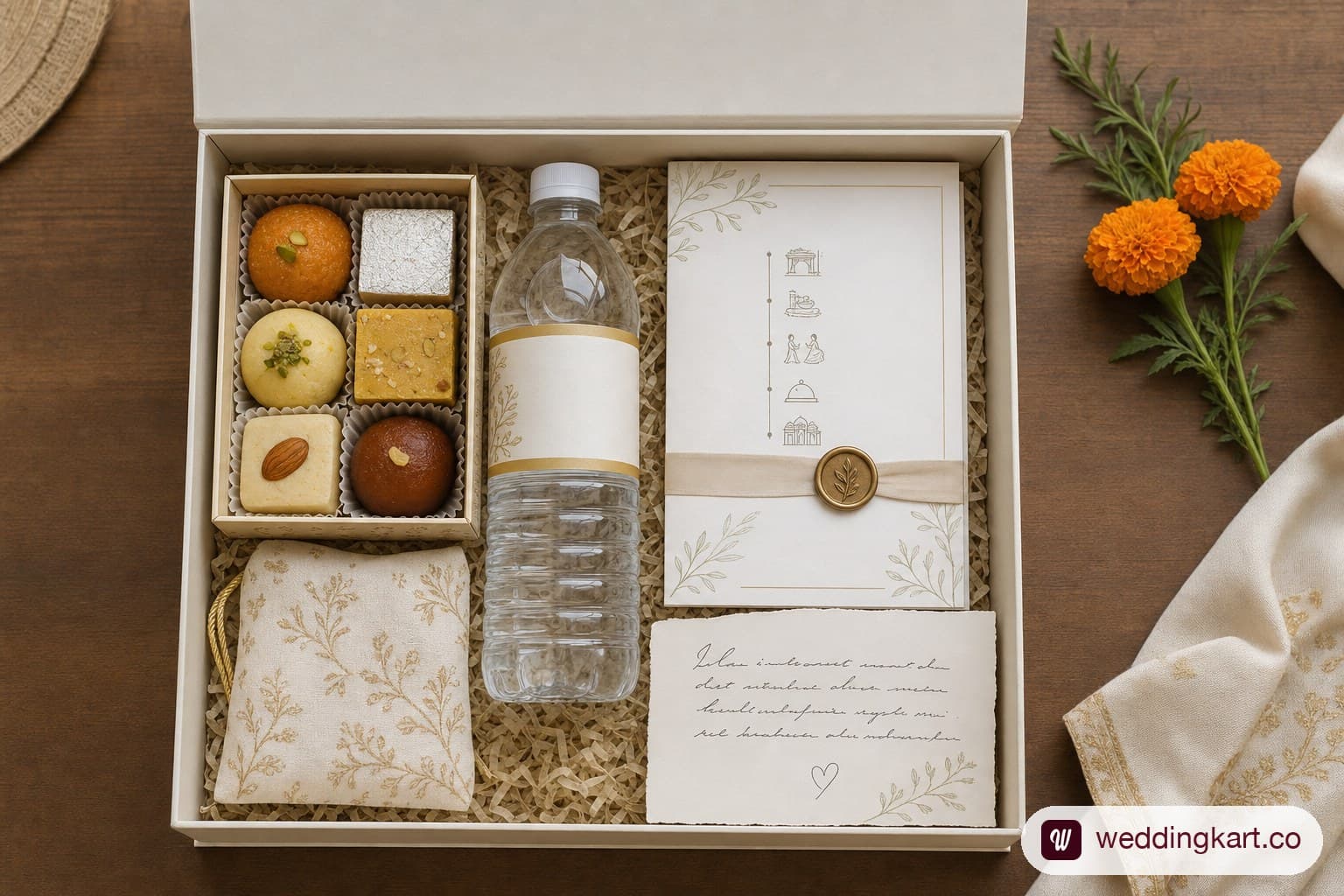
A wedding welcome kit should include a printed itinerary or schedule card, water and a snack, one or two locally sourced treats, and a short handwritten welcome note — packed simply enough to assemble in bulk, and delivered to the guest’s room before they check in. Everything past those basics is a budget decision, not a requirement. The sections below cover exactly what to include, how to pack it efficiently, the India-specific version of this list, and when to deliver it so it actually lands before the guest does.
Why a welcome kit matters more than couples expect
A welcome kit is often the first physical touchpoint a guest has with the wedding after they’ve travelled — before the first ceremony, before they’ve met the couple’s family in person, sometimes before they’ve even left the airport. A kit that’s thoughtful and useful (versus one that’s clearly an afterthought, thrown together in a plastic bag the morning of) sets guests up to feel looked after for the rest of the stay, especially guests travelling alone or from out of town who don’t have a local host checking in on them.
The mistake is treating it purely as a gesture. A good kit does real logistical work — the itinerary card inside answers “what’s happening and when” before a guest has to ask anyone, and often solves the first practical need (water, a snack after a long flight) before the guest thinks to look for a hotel minibar or a nearby shop.
It also sets an expectation for the rest of the stay. A guest who opens a thoughtfully packed kit with a clear schedule inside tends to arrive at the first event already knowing where to be and what to wear — which means fewer questions at the hospitality desk during the busiest arrival hours, not just a nicer welcome. Couples and planners who skip the kit, or treat it as a last-minute add, usually end up fielding the same basic questions (timing, dress code, who to call) individually, guest by guest, that a kit answers once for everyone.
The essentials: what every kit should have
What to put in a wedding welcome kit
Every welcome kit should include four things at minimum: a printed schedule or itinerary card, water, a snack, and a short welcome note — everything else is an enhancement layered on top of that base.
The reliable core list:
- Printed itinerary or schedule card — dates, times, and dress code for each event the guest is invited to. This is the single most useful item in the kit and the one guests reach for most.
- Water — a bottled or boxed water is close to non-negotiable; guests arriving after travel are reliably thirsty, and it signals basic thoughtfulness even in a minimal kit.
- A snack — pre-packaged and shelf-stable (chips, namkeen, biscuits, a small trail mix) rather than anything that needs refrigeration.
- A handwritten or personalised welcome note — even a short one, ideally with the guest’s name rather than a generic printed insert.
- Key contact number — one number for questions, tied to the hospitality desk staff who’ll be handling check-in, not the couple directly.
- Basic comfort items, budget permitting — mints, a sachet of tea or coffee, tissues, a small pain reliever.
How to pack wedding welcome bags
Pack welcome bags in an assembly line, one item per person per station, so each bag gets built consistently rather than one person trying to fill every bag alone. Lay out all items on a large table, build one sample bag first as the reference, then have each helper responsible for adding a single item as bags move down the line — this is faster and produces far more consistent results than each person building a full bag from scratch.
A few packing details that save trouble later:
- Use a bag or box that can survive being carried or placed in a room without crushing contents — a rigid small box works better than a thin paper bag if the kit includes anything breakable.
- Add a layer of tissue paper before sealing — it’s a small touch, but it changes a kit from looking like a leftover assembly into something that reads as a gift.
- Batch-pack in rounds of 20-25 rather than trying to complete 200 kits in one continuous run — it’s easier to spot-check quality and catch a missing item early.
- Keep 10-15% extra kits assembled for late additions, replacements, or a kit that gets damaged in transit to the hotel.
- Spot-check every fifth or tenth bag against the sample as the line runs, rather than only checking at the very end — it’s far easier to catch a missing item midassembly than to open 200 finished kits looking for the one that’s short a note.
Weather and season matter more than most checklists mention. A summer wedding benefits from a small hand fan or a sachet of electrolyte powder alongside the water; a winter or hill-station wedding does better with something warming — a sachet of instant chai or a small pair of socks — than another cold snack. Matching the kit to the actual conditions the guest is about to step into reads as more thoughtful than a fixed list applied regardless of season.
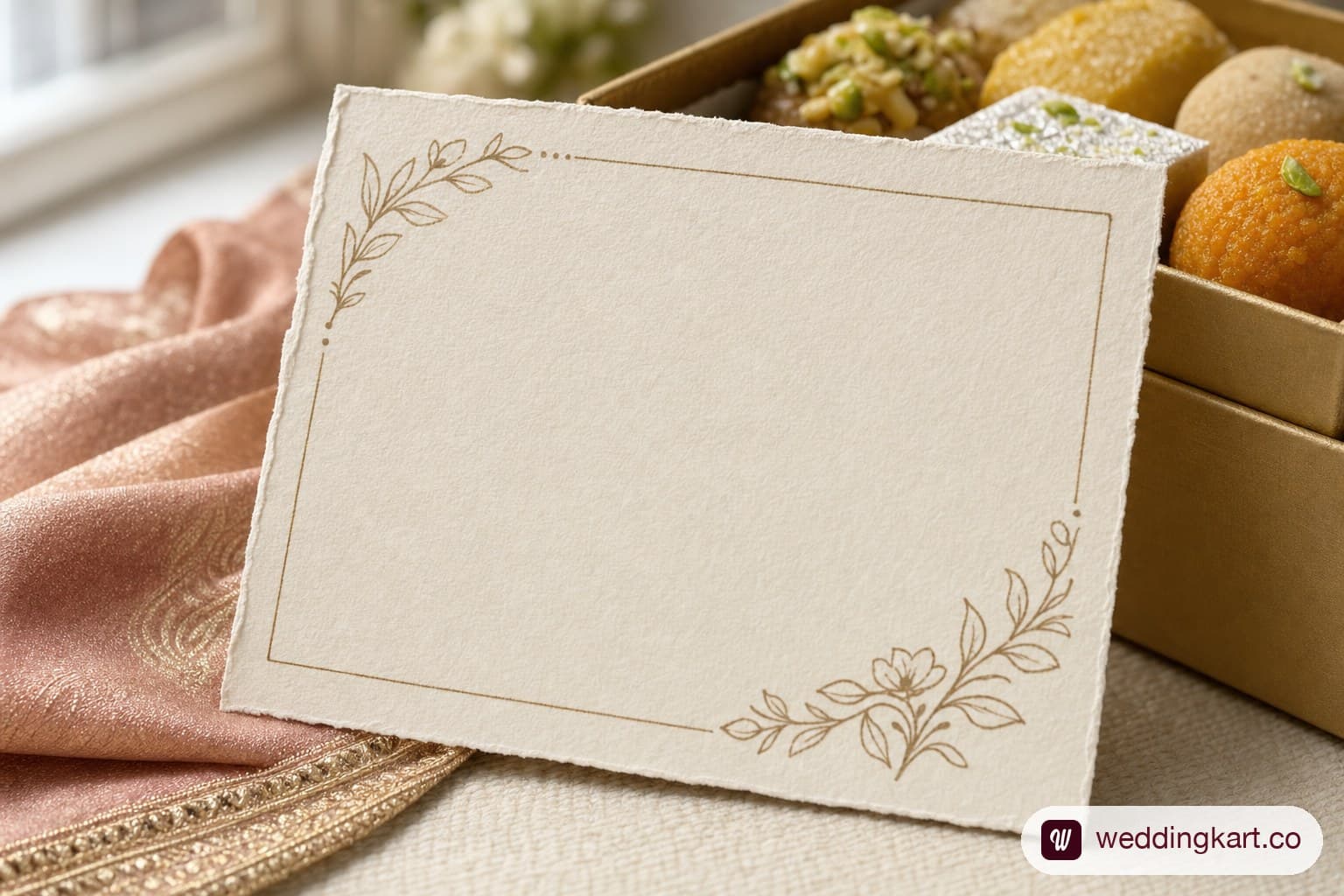

Local-touch ideas (region-specific snacks, notes)
What to put in welcome bags for an Indian wedding
An Indian wedding welcome kit typically adds regional snacks specific to the wedding’s city, a printed welcome note sometimes bilingual in Hindi and English, and occasionally a small ritual item like a diya or a sachet of itr — layered onto the same base kit (itinerary, water, snack, note) described above.
Region-specific additions that work well and are easy to source locally:
- City-specific sweets or snacks — a Rajasthani wedding might include mawa kachori or ghewar; a Gujarati wedding, a small box of mohanthal or fafda; a South Indian wedding, murukku or banana chips. The point isn't the specific item, it's sourcing something the guest wouldn't find at home, which most out-of-town and NRI guests genuinely appreciate.
- A bilingual welcome note — useful specifically for weddings with a mixed guest list of NRI and India-based relatives, where not every guest reads Hindi comfortably, and not every older relative reads English comfortably either.
- A small cultural or ritual touch — a mini diya, a sachet of ittar (traditional perfume oil), or a small piece of fabric in the wedding's colour theme, for weddings leaning into a more traditional presentation.
- A local city guide insert, for destination weddings — a short list of what's nearby (a market, a landmark, a recommended café) for guests who arrive a day early or stay a day after.
This section is the specific gap most existing welcome-kit content misses: general weddingblog guides (built for US weddings) default to Western snacks and skip the regionalspecificity and bilingual-note details that actually matter for an Indian guest list.
Budget tiers: simple vs elaborate kits
A welcome kit doesn't need to be elaborate to work — the itinerary card and a warm note do most of the job. Budget from there based on what the wedding can absorb per guest, not what looks impressive in photos.
| Tier | What's included | Best for |
|---|---|---|
| Simple | Water bottle, one packaged snack, printed welcome note with itinerary | Weddings prioritising budget elsewhere, or a large guest list (200+) where perkit cost adds up fast |
| Mid-tier | Simple tier + a regional snack, mints, a small comfort item (tissues, pain reliever) | Most mid-size Indian weddings — noticeably better than the bare minimum without a large per-guest jump |
| Elaborate | Curated local-specialty box, toiletries (travel-size), printed itinerary card, personalised note, small keepsake favour | Smaller guest lists, VIP subsets of a larger list, or weddings positioning hospitality as a differentiator |
A common and reasonable approach on larger guest lists: run a simple or mid-tier kit for the general guest list and an elaborate kit for a smaller VIP subset (immediate family, outof-town guests staying the full event) rather than trying to give every guest the top tier. For more on drawing that VIP distinction well, see our guide to the full VIP guest experience.
Whichever tier you choose, decide it once, in writing, before packing begins. The most common budget overrun on welcome kits isn’t the per-kit cost itself — it’s scope creep during assembly, where “let’s just add one more thing” gets repeated across 150-300 kits and the elaborate tier’s cost quietly shows up on a mid-tier budget. Setting the tier and the exact contents list before the packing session starts avoids that drift entirely.

How and when to deliver kits (room-drop vs check-in desk)
A welcome kit delivered late is worse than a simple kit delivered on time — the two delivery methods are a room-drop, coordinated with the hotel ahead of a guest’s check-in, or handout at the hospitality desk as guests arrive. Each has a different failure mode to plan around.
Room-drop (kit is already in the room before check-in):
- Requires coordinating directly with hotel housekeeping in advance — some properties charge a per-room distribution fee, and higher-end hotels sometimes require kit contents pre-approved (no alcohol, no open food items) before they’ll place them.
- Works best when arrival times are known in advance, since housekeeping needs a target window, not a guess.
- Feels more polished — the guest experiences the kit as part of the room itself rather than something handed to them.
Hospitality-desk handout (kit given at check-in):
- Simpler to coordinate — no hotel housekeeping dependency, and kits can be handed out by the desk team covered in our hospitality desk setup guide.
- Better for staggered or unpredictable arrivals, since kits don’t need to be pre-placed against a guess at timing.
- Slightly less polished, but far more forgiving when arrival times shift last-minute — which, on any outstation-heavy guest list, they will.
Most multi-day Indian weddings end up using both: a room-drop for guests with confirmed early arrivals, and a desk handout as the fallback for anyone arriving outside the planned window.
Whichever method you use, confirm delivery happened — don’t assume it. A room-drop that housekeeping marks complete but a guest never mentions can mean the kit sat in the wrong room, or checked-in-but-not-yet-arrived guests got skipped in that wave. A quick end-of-day tally (kits packed vs. kits confirmed delivered, cross-checked against the arrivals list) catches the gap before a guest has to ask where theirs went.
Downloadable: Wedding Welcome Kit Checklist
The full contents list above — core essentials, India-specific additions, and budget-tier breakdown — is available as a printable checklist you can hand directly to whoever’s packing kits, with checkboxes for each tier.
Once the kit is placed, the next open question is whether the guest actually made it to their room to find it — a flight delay or a missed pickup can leave a kit sitting in an empty room for hours. WeddingKart’s Guest Arrival Tracker reads a guest’s shared ticket and keeps their arrival status live, and the WhatsApp Concierge is there the moment a guest has a question the kit’s itinerary card didn’t answer — free for every guest, with nothing to install.
Was this article helpful?
Share