
Last updated:
All PostsHow to Welcome Outstation Guests at an Indian Wedding (+ Free Checklist)
For a 500-guest Indian wedding, 100 to 200 of those people are usually not from the city where the wedding is happening. Welcoming them well means four things done in sequence: send a pre-arrival information packet 3–4 weeks out, negotiate and communicate a hotel room block, run a batched airport pickup, and keep a daily WhatsApp cadence going once the functions start. Skip any one of those and the gaps show up as forty individual phone calls during the exact hours the host family should be enjoying their own wedding.
Outstation guest management is not a nice-to-have layer on top of wedding planning. For any wedding where a fifth or more of the guest list is travelling in, it is one of the two or three things that determines whether the wedding feels effortless or chaotic — regardless of how good the decor or catering turns out to be.
Why outstation guest management makes or breaks an Indian wedding
Outstation guests carry a different kind of risk than local guests. A local guest confused about the venue can call a cousin, check a WhatsApp group, or drive to a familiar part of town and ask around. An outstation guest has none of that. They don't know the city, they're staying at an unfamiliar hotel, and they're frequently older relatives who are less comfortable improvising with maps and ride-hailing apps.
The compounding factor is scale. A single confused guest is a five-minute phone call. Fifty confused guests, all landing within the same six-hour window, all calling the same two or three points of contact, is a logistics failure that eats into the host family's ability to actually enjoy their own wedding. The problems that show up most often are entirely preventable: a lost guest at the airport with no working phone number for the pickup driver, a family that shows up at the wrong hotel because room details were shared informally over a phone call nobody wrote down, a shuttle that leaves without half its passengers because nobody confirmed headcount.
None of this requires expensive fixes. It requires a system that starts before anyone boards a flight and runs through the day they leave.
Before they arrive — what to send outstation guests in advance
The pre-arrival information packet
Every outstation guest should receive a single, consolidated packet — either a WhatsApp message with a linked PDF or a structured multi-message sequence — that answers every question they would otherwise call to ask. At minimum, include the hotel name and address, expected check-in time, the nearest metro station or landmark for guests arranging their own transport, the full pickup schedule if one is being arranged, addresses for every function venue, the dress code for each specific event (not just “traditional,” but color themes if the family is using them), and one direct contact number for the host side — ideally not the bride or groom's personal number.
Send this packet once travel dates are locked: 3 to 4 weeks before the wedding for domestic guests, 6 to 8 weeks for anyone flying internationally. Resend a condensed version 3 to 5 days before departure to catch the guests who forgot to save the first message.
Hotel booking block — how to negotiate and communicate room allocation
If the family is blocking rooms at one or two hotels, negotiate the block once the outstation headcount is roughly known — usually 3 to 4 months out for a city wedding, 6 to 9 months for anything at a destination property where availability is tighter. Ask the hotel directly about the attrition clause (the percentage of blocked rooms you're contractually obligated to fill or pay for regardless — negotiate this down from a typical 80% to something closer to 60% where possible), the rate lock, and the cut-off date after which unclaimed rooms release back to general inventory.
Once rooms are allocated to specific guests, share only enough for guests to plan on — confirmed hotel and approximate check-in window — and hold exact room numbers until closer to arrival, since hotels frequently reassign rooms in the final days before a large block checks in. For the full mechanics of building and sharing that room-by-room list, see our companion guide on building a wedding rooming list.
Save the date + function schedule communication
Outstation guests need the full function schedule earlier than local guests, because they're the ones deciding how many days of leave to take and which flights to book. A save-the-date that reaches local guests 6 to 8 weeks ahead should reach outstation and international guests 3 to 4 months ahead, with a follow-up once the final day-by-day schedule is locked.
Arrival day — the hospitality welcome flow
Airport/station pickup coordination
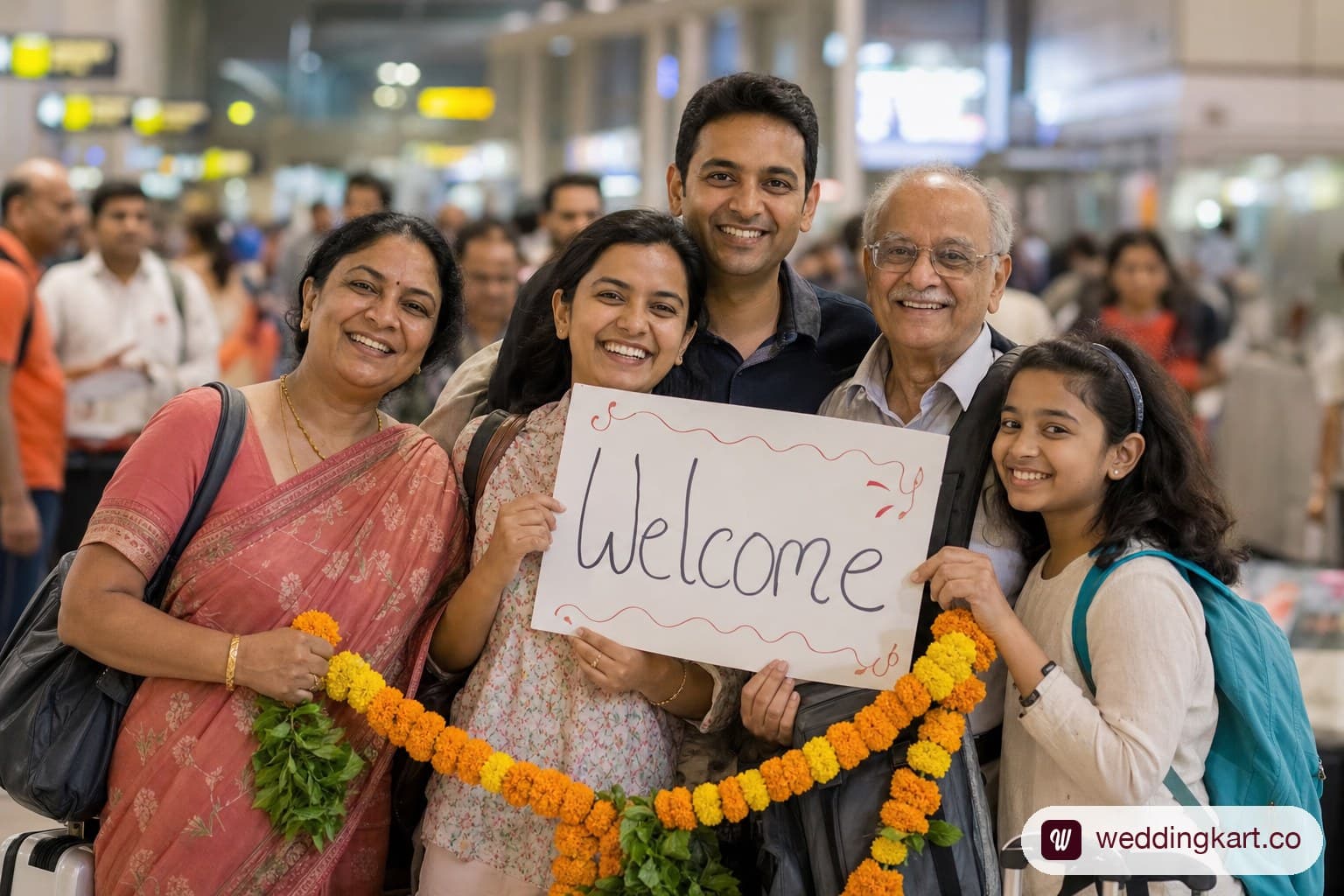
The single highest-risk moment in the entire outstation guest journey is the arrival window — the two to three hours after a guest lands when they're tired, possibly jet-lagged, and entirely dependent on someone showing up as promised. Build a pickup roster from confirmed flight or train details, batch arrivals into time windows so a single car can pick up multiple guests landing close together, and make sure every driver has a printed sheet with passenger names, phone numbers, and the hotel address. For the full mechanics of running this — including the batching rule that prevents drivers from making six separate trips in an afternoon — see our dedicated guide to wedding guest airport pickup planning.
Check-in escort and welcome hamper
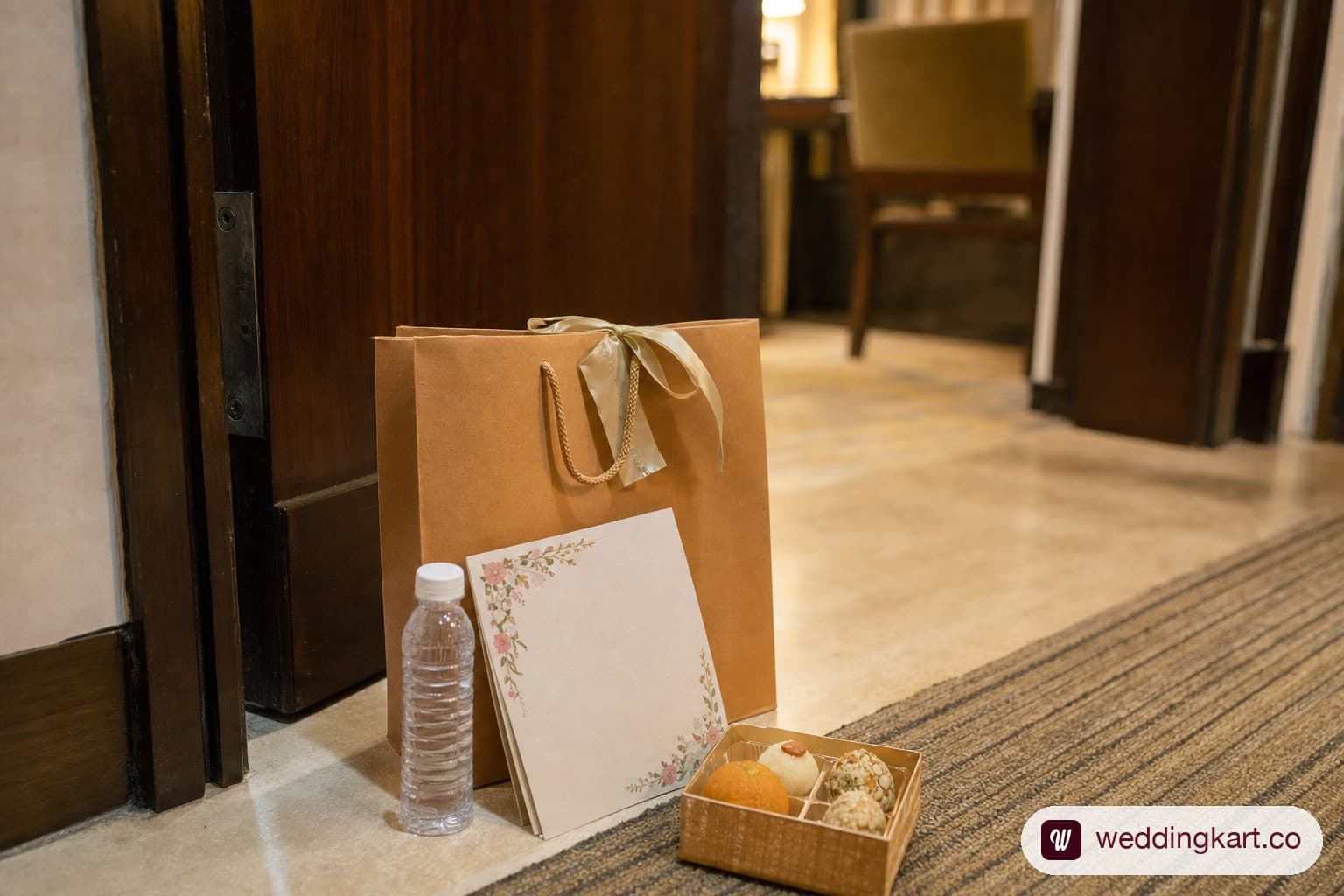
Whoever meets the guest at the hotel should already have their room details confirmed with the front desk, so there's no standing-around-the-lobby moment while paperwork gets sorted. A welcome hamper waiting in the room — local snacks, a printed schedule card, a small branded bag — signals that the family thought about this guest specifically, not just guests in general.
Hospitality desk location and staffing
For weddings with 75 or more outstation guests, station one dedicated person at the hotel lobby for the first full day of arrivals — not a family member who will get pulled into ten other things, but someone whose only job that day is answering guest questions, coordinating late pickups, and being a single reliable point of contact. This person should have a phone that is always answered, a copy of the rooming list, the pickup schedule, and the full function calendar.
During the wedding — keeping outstation guests informed
Day-wise schedule reminders
Once the wedding starts, the information guests need shifts from “how do I get there” to “what's happening today and when.” A short morning message — what's on today, what time it starts, what to wear — solves most of the confusion that otherwise turns into forty individual phone calls to the family.
Shuttle and transport updates
If shuttles run guests between the hotel and function venues, departure times need to go out with enough lead time that people are actually downstairs when the shuttle leaves, and any delay needs to be communicated the moment it's known — not discovered by forty people standing in a lobby wondering where their ride is.
The WhatsApp broadcast strategy for 100+ outstation guests
At this scale, individual texting breaks down fast, and a single unsegmented group chat becomes unusable — every guest sees every message meant for every hotel, every side of the family, every function. The workable pattern is tagging guests by hotel and by which functions they're attending, then sending targeted updates only to the relevant group: a shuttle time only to the guests actually using that shuttle, a venue change only to the guests attending that function. This is precisely the problem WeddingKart's segmented WhatsApp announcements are built to solve — tag every guest by hotel and by function, then send hotel-specific or function-specific updates to exactly the right group instead of one all-guests broadcast that half the recipients ignore.
A sample 5-day outstation guest communication calendar:
| Day | Message |
|---|---|
| Day -1 (arrival day) | Pickup confirmation + hotel welcome details |
| Day 1 (morning) | Today's schedule + dress code + shuttle time |
| Day 2 (morning) | Today's schedule + any venue changes |
| Day 3 (morning) | Final day schedule + checkout reminder |
| Day 3 (evening) | Thank-you message, sent again 48 hours later with photos |
Practical items worth pre-empting
Outstation guests, especially elderly relatives, often silently deal with minor travel-related discomfort rather than ask for help. A small note in the welcome packet about the nearest pharmacy, or including basics like ORS sachets and antacids in the welcome hamper, prevents a guest from quietly struggling through a function because they didn't want to trouble anyone. For weddings hosting 300+ guests across multiple days, our guide to managing 500+ guests across a multi-day wedding covers how this scales without adding headcount to your ground team.
Post-wedding — the graceful send-off
Checkout coordination and drop logistics
Collect departure flight and train times as early as possible — ideally alongside arrival details, since guests rarely think to volunteer this on their own. Organize departure drops with the same batching logic as arrivals, and confirm checkout times with the hotel 48 to 72 hours ahead so there's no last-minute scramble over late checkout fees.
Thank you messages with photos
A short thank-you message sent 48 hours after the wedding, ideally with a handful of photos from the event, closes the loop in a way that guests remember. It costs nothing and takes five minutes to send to a segmented list, but it's the detail that separates a wedding people talk about fondly from one they simply attended.
Outstation guest welcome checklist (printable)
The full sequence above — pre-arrival, arrival day, during the wedding, and post-wedding — is available as a printable checklist, including a starter welcome-hamper contents list.
Quick reference:
- Confirm outstation headcount and negotiate hotel block (3–9 months out)
- Send save-the-date + schedule to outstation guests early (3–4 months domestic, 6–8 international)
- Send pre-arrival information packet (3–4 weeks out)
- Collect flight/train details from every outstation guest (2–3 weeks out)
- Build pickup roster, batch by arrival window (1 week out)
- Confirm room allocation with hotel (72 hours out)
- Assemble and deliver welcome hampers (day before arrivals begin)
- Staff hospitality desk for day 1 of arrivals
- Send daily schedule + shuttle updates (each morning during the wedding)
- Collect departure details, organize drop logistics
- Send thank-you message with photos (48 hours post-wedding)
None of this needs a bigger ground team — it needs one system everyone touches instead of five separate spreadsheets. WeddingKart's guest management dashboard keeps hotel assignments, function attendance, and RSVP status against every outstation guest in one place, so the person staffing your hospitality desk is working from the same data as the person running pickups — not a screenshot that's already out of date.
Was this article helpful?
Share