
When to Send Wedding Invitations (And Save the Dates)
By Weddingkart TeamLast updated
Last updated:
Send wedding invitations six to eight weeks before the wedding for a local event, and three months ahead for a destination wedding. Set the RSVP deadline three to four weeks before the wedding day, not two, because your caterer needs a final count roughly two weeks out and you need the gap to chase the people who never reply.
That gap is the part almost every timeline leaves out, and it is the reason couples end up making phone calls the week before their wedding.
The full timeline, by wedding type
| Wedding type | Save the date | Invitation | RSVP deadline | Final count to caterer |
|---|---|---|---|---|
| Local, most guests nearby | 6–8 months out | 6–8 weeks out | 3–4 weeks out | 10–14 days out |
| Domestic, many travelling | 8 months out | 10–12 weeks out | 5 weeks out | 10–14 days out |
| International guests | 10–12 months out | 3 months out | 6 weeks out | 10–14 days out |
| Destination wedding | 10–12 months out | 3 months out | 6–8 weeks out | 14 days out |
| Holiday weekend | 10–12 months out | 10 weeks out | 5 weeks out | 10–14 days out |
| Peak season (Jun, Sep, Oct) | 9–12 months out | 8–10 weeks out | 4 weeks out | 10–14 days out |
| Short engagement, under 6 months | Skip | As early as possible, minimum 4 weeks | 2–3 weeks out | 7–10 days out |
Two rules underneath the table.
Everyone who gets a save the date must get an invitation. There is no polite way out of this. Send save the dates only to the list you are certain of.
The invitation date is when it lands, not when you post it. Allow a week for domestic post and two to three weeks internationally, and add a week if you are hand-addressing 200 envelopes yourself.
When to send save the dates
Six to eight months before a local wedding. Eight to twelve months if guests are flying, if it is a holiday weekend, or if it is a destination wedding.
Send them as soon as you have the date and venue locked. You do not need the rest of the detail. A save the date carries four things only: both names, the date, the city, and a line saying a formal invitation will follow.
Send earlier than the standard window when:
- Your wedding falls on or near a public holiday, when flights and hotels sell out
- A meaningful share of guests are travelling internationally, since some need visa lead time
- Your wedding is in peak season in a destination city
- Guests will need to book time off work well ahead
Skip save the dates entirely when your engagement is under six months. Send the invitation early instead. Two mailings four weeks apart confuses people.
For what to actually write on one, see our save the date wording guide, which also covers the question of whether you need them at all.
Setting the RSVP deadline (and why three weeks is wrong)
Most templates suggest an RSVP deadline two to three weeks before the wedding. That is too tight, and here is the arithmetic.
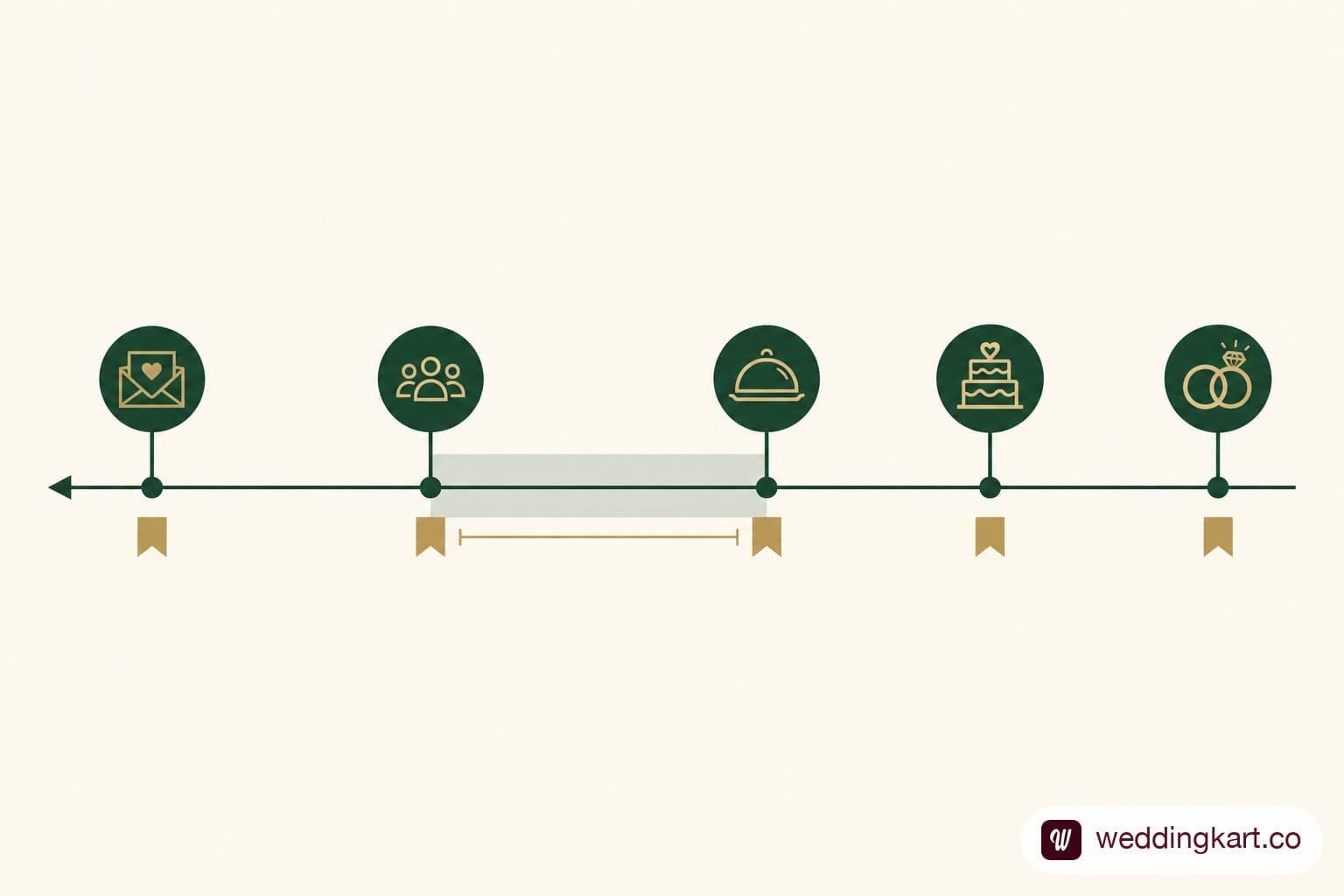
Your caterer needs a final guaranteed count ten to fourteen days before the wedding. Your venue needs the seating plan around the same time. Working backwards:
- Final count due: 14 days before the wedding
- You need the seating plan done: 16 days before
- You need every response in: 21 days before
- You need chase time for non-responders: 10 to 14 days
- So the RSVP deadline should be: 31 to 35 days before the wedding
Four to five weeks, not two to three. Every wedding has a block of guests who do not reply by the deadline, and building the chase window into the schedule is the difference between a calm final fortnight and a frantic one.
Put the deadline on the invitation as a date, not a duration. "RSVP by 1 May" works. "RSVP within four weeks" does not.
Pick a date mid-week, not a weekend. Guests who see a Sunday deadline mentally file it as "sometime that weekend" and then miss it.
Special cases
Out-of-town guests
Send at the ten to twelve week mark rather than six to eight. They are booking flights and hotels, and the room block is almost certainly releasing before your RSVP deadline. Include accommodation detail with the invitation or on the website rather than making them ask.
Overseas guests
Three months minimum. Some need visa appointments, which in several countries run to eight weeks or more on their own. If any guest needs a formal invitation letter for a visa application, send that separately and early, and make it a physical document.
Holiday weekends
Ten weeks for the invitation and save the dates a full year out. Guests planning around a long weekend make other commitments early, and flights are the first thing to go.
Destination weddings
Three months for the invitation, with save the dates ten to twelve months ahead. Your RSVP deadline needs to sit six to eight weeks before the wedding, because guests are buying non-refundable flights and you need to know the real number before your on-site vendors commit.
Digital invitations
The same timeline. Being digital does not mean being late, and sending an emailed invitation three weeks out reads as an afterthought. The one advantage is the send itself is instant, so you can use the full window for responses instead of losing a week to post. Our guide to digital wedding invitations with RSVP covers the delivery risks that come with that.
When you are also ordering paper
Add four to six weeks in front of everything for printing, and another week or two if you want a proof or are doing letterpress. Order at the three to four month mark for a standard timeline.
You are already late. What to do now.
If the wedding is less than six weeks away and invitations are not out, the standard advice stops being useful. This is the practical version.
Between four and six weeks out: send immediately and move to digital. Skip the printed RSVP card, which costs you a week of postal round trip you no longer have. Set the RSVP deadline at two and a half weeks out and say clearly on the invitation that the timeline is short.
Under four weeks: send digitally today and follow every invitation with a phone call or text within 48 hours. At this range you are not waiting for RSVPs to arrive, you are collecting them actively. Budget an evening for calls.
Under two weeks: call everyone. Send the written invitation as a formality afterwards so guests have the details in writing, but the phone call is the invitation. Tell your caterer immediately that your count will firm up late; most will hold a provisional number if you warn them.
In every late case, tell people it is short notice. A guest who receives an invitation three weeks out and is told nothing assumes they were an afterthought or a B-list invite. One honest line removes that entirely.
Chasing non-responders
Expect roughly a third of your list not to reply to the first request. This is normal at every wedding and is not a reflection of your guests.
The sequence that works:
- Invitation lands. Responses arrive in a burst over about ten days, then stop.
- Reminder at the halfway point. A short message, same channel as the invitation.
- Second reminder, one week before the deadline, on a different channel. If the invitation was email, this one is a text. The channel change matters more than the wording.
- The day after the deadline, switch to personal contact. Split the remaining list between you, your partner, and a family member on each side. A message from a known person gets answered when a platform reminder does not.
- Phone calls for whoever is left. Usually 10 to 15 percent of the list, weighted toward older relatives.
Chase households rather than individuals, and keep a record of who you have contacted so two people do not call the same aunt.
This is manageable by hand up to about 150 guests. Past that, or with several events where each guest has a different invitation, the tracking itself becomes the job. WeddingKart's RSVP tracking holds the response state per guest per event and runs the reminder sequence across channels, so the silent households surface weeks before your deadline rather than in the final fortnight. For a straightforward 100-guest wedding you will not need it. For 400 guests across five events you will.
Our full guide on how to track wedding RSVPs covers the guest list structure that makes the chase possible.
Frequently asked questions
How far in advance should wedding invitations be sent? Six to eight weeks for a local wedding, ten to twelve weeks if many guests are travelling, and three months for a destination wedding or international guests.
Is six weeks too late to send wedding invitations? Six weeks is the bottom of the acceptable range, not late. Below four weeks, move to digital and follow up by phone.
When should save the dates go out? Six to eight months before a local wedding, eight to twelve months for destination, holiday weekend, or international guests.
Do I have to invite everyone who got a save the date? Yes. There is no graceful exception. Send save the dates only to guests you are certain about.
What is a reasonable RSVP deadline? Three to four weeks before the wedding for a local event, five to six weeks for destination. Work backwards from your caterer's final count date and add two weeks of chase time.
Can I send save the dates and invitations at the same time? If your engagement is short, skip the save the date and send one invitation early. Two mailings close together confuses guests and wastes money.
What if guests still haven't replied after the deadline? Call them. After a missed deadline, assume non-response means they did not see it rather than that they are undecided, and treat the call as a normal step rather than an imposition.
Sources
- When to Send Wedding Invitations: A Definitive Timeline, The Knot
- When to Send Wedding Invitations: A Complete Timeline, Joy
- When to Send Wedding Invitations, Minted
- When to Send Out Wedding Invitations, Zola