
Quick Answer
How is AI transforming the Indian wedding industry?
AI is reshaping Indian weddings at the operational layer - guest list cleaning, budget and timeline estimation, WhatsApp message drafting, ceremony countdown graphics, FAQ agents, and voice-based guest support - rather than the ceremony itself. Event managers who adopt these tools can run meaningfully more weddings at the same stress level.
Last updated:
Last updated:
60%
Weddings using at least one AI tool in 2026
Source: Weddingkart data
40+
Languages supported by voice AI RSVP, including 12 Indian languages
4×
RSVP completion on WhatsApp buttons vs email forms
0%
AI adoption for rituals & ceremonies (correctly)
How Is AI Being Used in Indian Weddings? The 2026 Guide
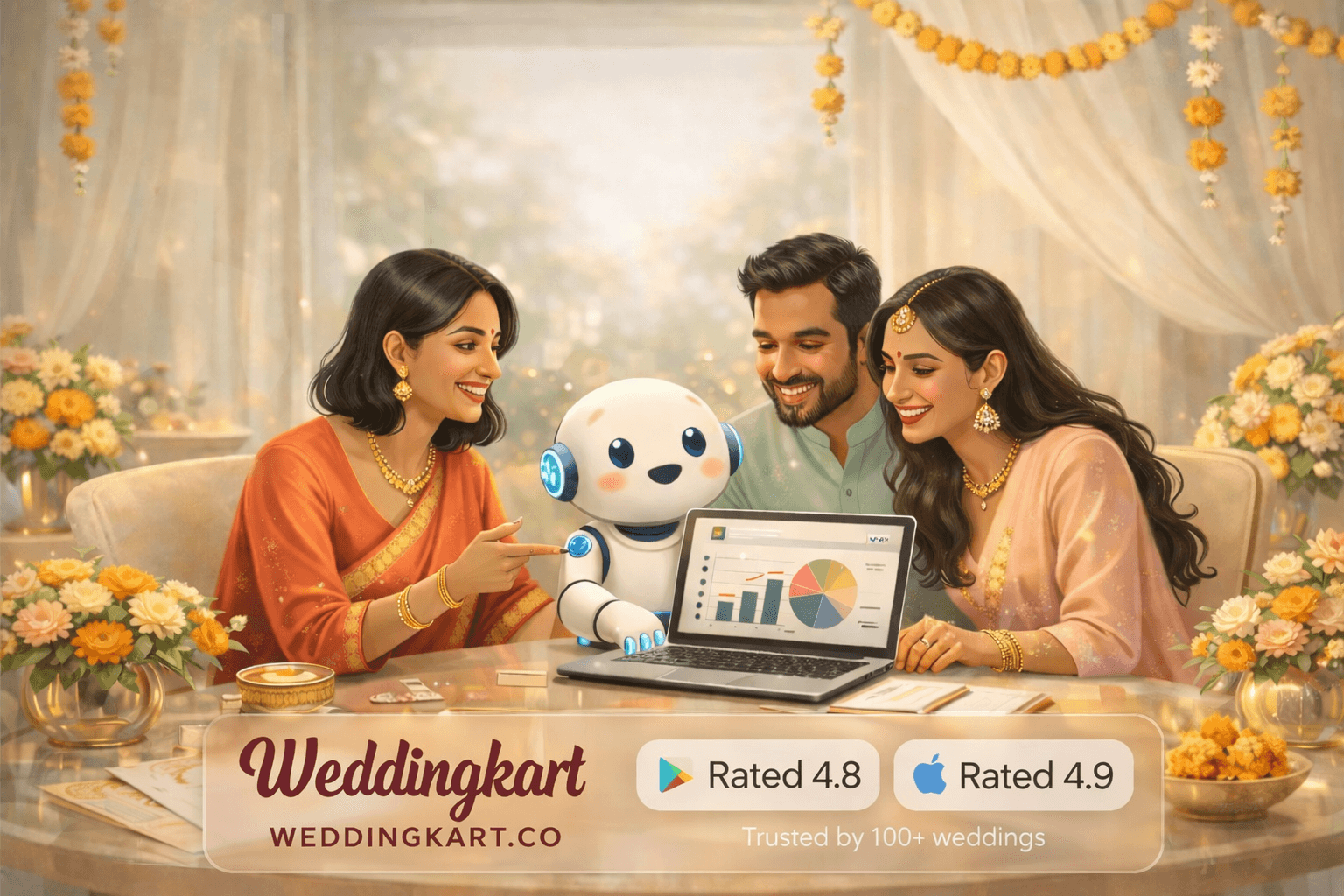
Where AI is taking over, and where it still can't touch. The 2026 Indian wedding AI doesn't run the ceremony. It runs the Monday-morning spreadsheet - 400-name guest lists with mangled Gujarati diacritics, RSVP chases on WhatsApp, ceremony countdown graphics in 12 languages, the Hindi haldi invite your uncle wants re-worded by tonight. What it still can't do: read the silence when a bride's father stops talking mid-venue-discussion, or understand why a mother-in-law is quietly asking if the mandap can face a different direction. The next ten minutes are about that first category - six operational shifts from the last 18 months, the tools Indian event managers actually use (named, ranked), and the two places AI has failed so far.
Quick reference: what AI does across Indian weddings
An honest status by task. "Table stakes" = widely available. "Working" = shipped, works reliably. "Experimental" = new, variable quality. "Not recommended" = AI is weak here.
| Task | What AI does | Maturity | Weddingkart |
|---|---|---|---|
| Guest list cleaning | Normalises names, phone numbers, duplicates | Table stakes | Guest Excel Cleaner |
| Budget estimation | India-specific cost breakdown | Working | Budget Calculator |
| Timeline planning | Adapts to ceremony count and engagement length | Working | Timeline Builder |
| Checklist generation | Personalised to wedding specifics | Working | Checklist Generator |
| Guest FAQ on WhatsApp | Answers repeated questions automatically | Working | In-app feature |
| Message drafting | Multi-language, tone-aware | Table stakes | Message Generators |
| Hashtag generation | Creative direction variants | Table stakes | Hashtag Generator |
| Ceremony countdown graphics | Indian aesthetic tuning | Working | In-app feature |
| Voice AI for guest calls | Inbound + outbound in Indian languages | Experimental | In-app feature |
| AI pre-wedding shoots | Replaces photography | Not recommended | - |
Indian weddings are one of the last great analog holdouts. A single wedding can involve seven ceremonies, four hundred guests, eleven vendors, and thousands of WhatsApp messages between an event manager and a deeply anxious mother-in-law. For years, the industry has run on spreadsheets, printed checklists, and the improvisation of a planner who hasn’t slept since Tuesday.
That’s changing - quietly, and faster than most people realise. AI in the Indian wedding industry has moved past the hype phase and into the operational layer. Not with AI-officiated weddings or viral demos, but in the work underneath: the guest lists, the logistics, the communication, the travel coordination.
At Weddingkart, we’ve been building in this layer for a while now. This post is part industry read, part tour of what we’ve actually shipped - and what we think event managers and couples should know heading into the next two years.
Where AI shows up first: the unglamorous, painful work
The most honest AI wins in the wedding industry are not the flashy ones. They’re the work nobody wanted to do in the first place.
AI guest list cleaning
Every wedding starts with a family elder sharing an Excel sheet that looks like chaos. Names in three different cases, phone numbers formatted as +91-98XXX-XXXXX, 98XXX XXXXX, 0-98XXX-XXXXX, and one mysterious entry that just says “Rohit’s friend.” Before anything else can happen - before a single WhatsApp invite goes out, before RSVPs can be tracked - this sheet needs to be cleaned.
We built an AI Guest List Excel Cleaner specifically for this. Feed it a messy sheet, get back normalised names and international-format phone numbers. What used to take a planner two hours of copy-paste now takes thirty seconds.
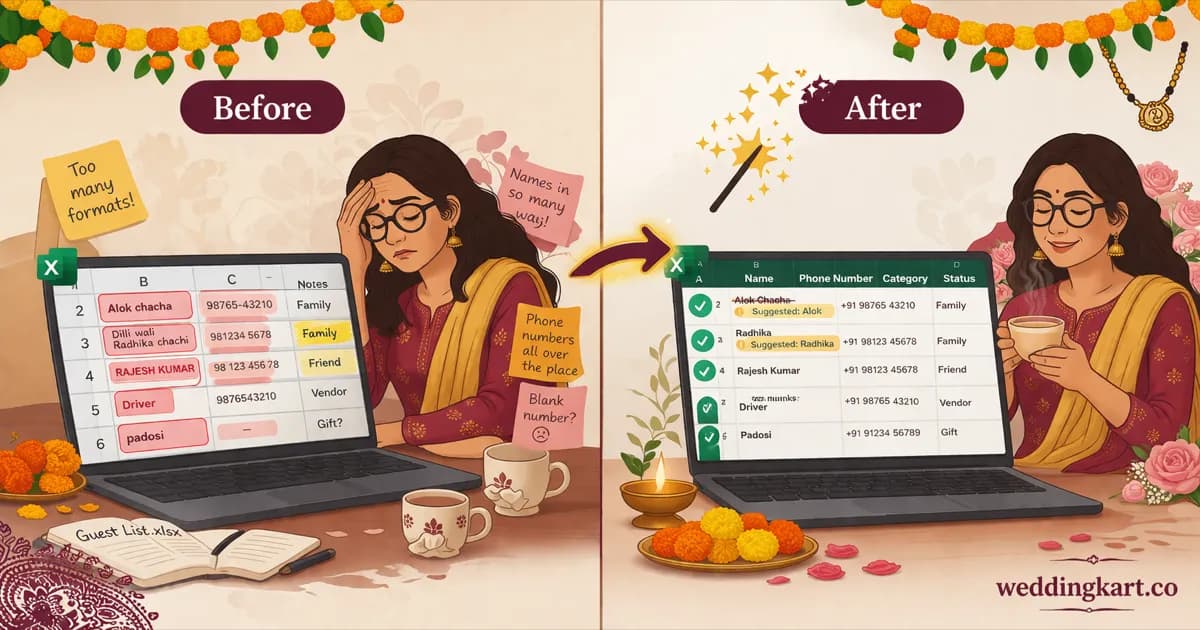
This sounds small. It isn’t. Guest list cleaning is the step where most couples give up and call a manager - which is great for managers, but terrible for couples planning their own wedding.
Handwritten guest lists to digital
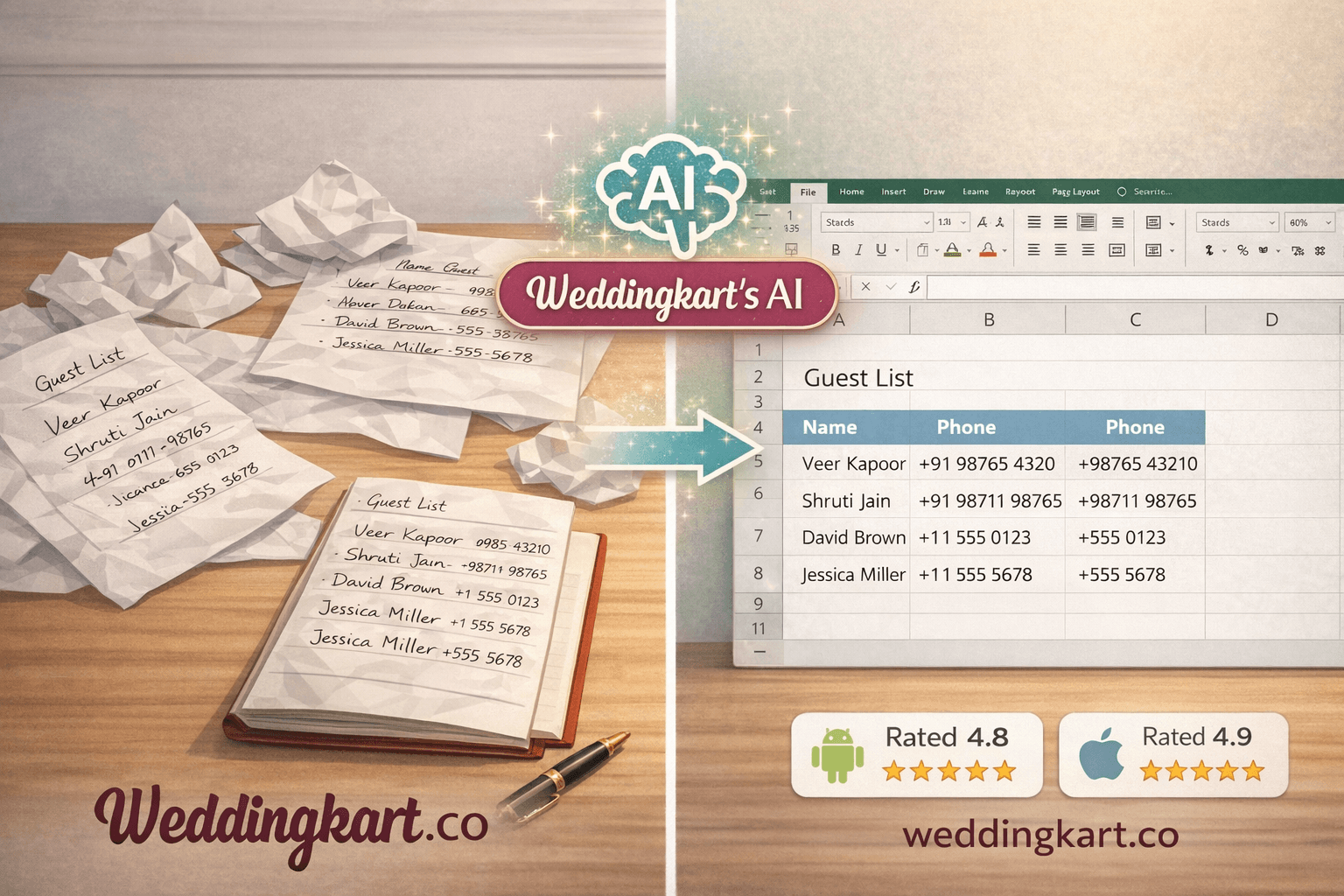
There’s always at least one elder who refuses to type. A grandmother hands over a notebook with 80 names scrawled across four pages. Photographing that and turning it into a clean digital list used to be an intern job.
We handle this through an AI image-to-contacts pipeline inside the Weddingkart app. Point your phone at the notebook, get a clean guest list. Names, numbers, relationships - all extracted and ready to use.
Note: Converting handwritten guest sheets to Excel is a concierge service available only for paid weddings on Weddingkart. Contact support on WhatsApp to enable it for your wedding.
Neither of these is a demo-worthy AI feature. They’re just the things that had to exist before everything else could work.
Where does AI actually help with wedding planning decisions?
The first few weeks after an engagement are a fog of decisions: How much will this cost? When do I need to book the venue? What am I forgetting? Every generic wedding blog answers these with a 12-month “ultimate checklist” that reads the same whether you’re planning a 50-guest court wedding in Pune or a 600-guest destination wedding in Udaipur. That’s where AI earns real value - translating vague questions into plans grounded in the couple’s actual situation.
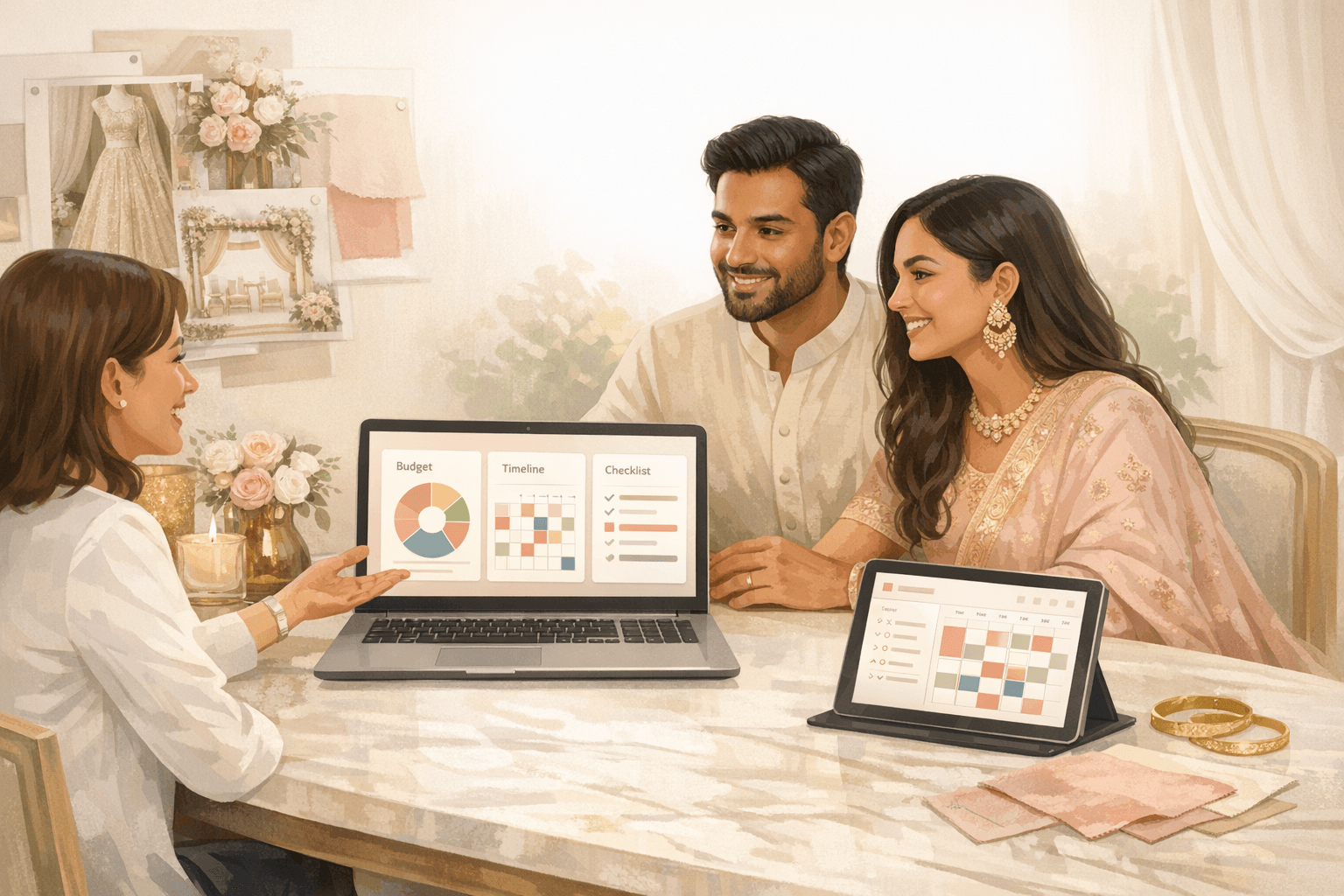
AI wedding budget calculator
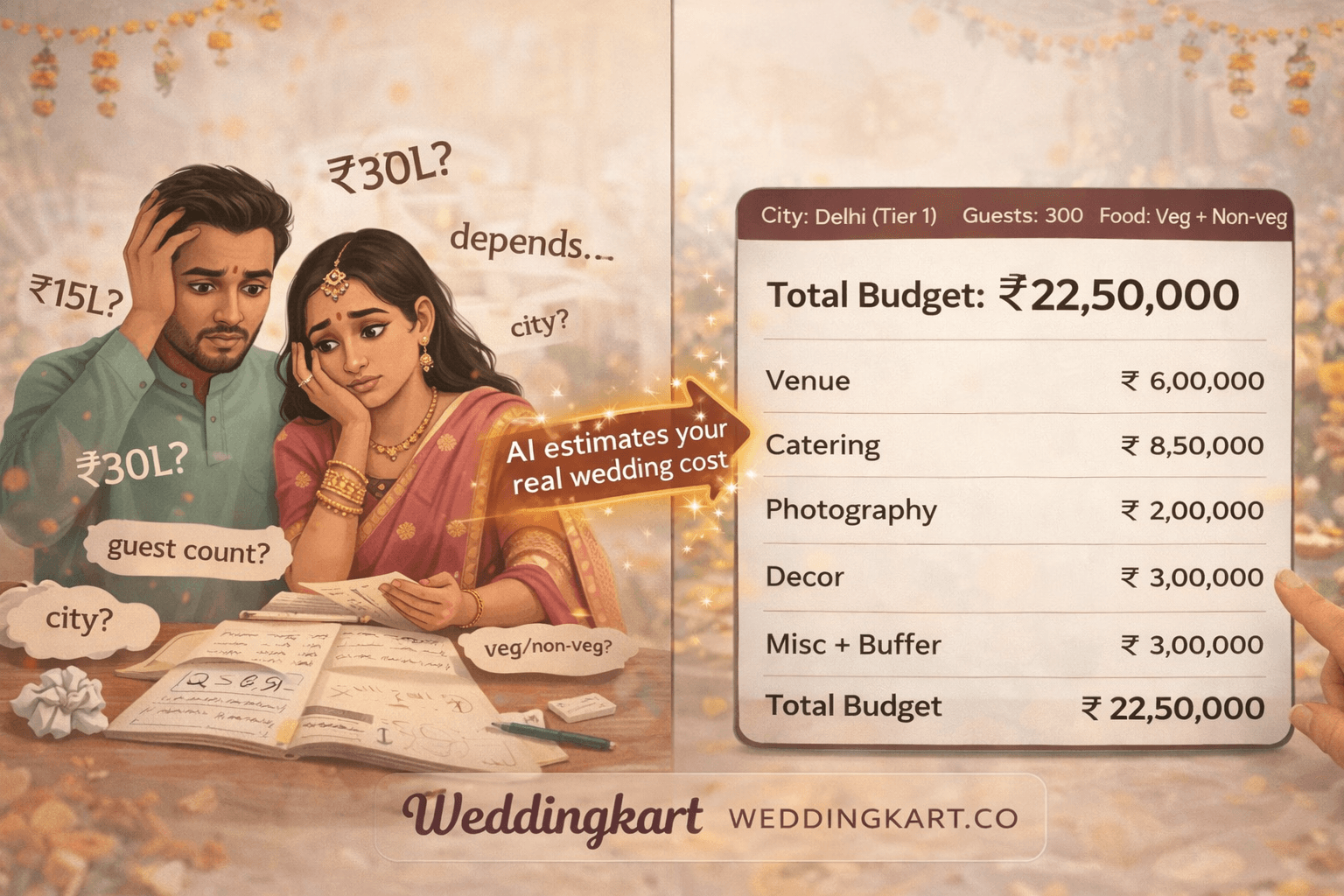
Budgeting is the universal pain point. Every couple starts planning with the same question - how much will this wedding actually cost? - and gets back the same unhelpful answer: “it depends.” The honest answer depends on city tier, guest count, number of ceremonies, vegetarian vs. non-vegetarian catering, venue type, and a dozen other variables that nobody has patience to model.
Our AI Wedding Budget Calculator handles this. It translates a couple’s inputs into a realistic, India-specific cost breakdown - Tier 1 vs Tier 2 vs Tier 3 city pricing, per-plate catering costs, photography tier ranges, mehendi and decor estimates, and a built-in contingency buffer. Instead of a generic spreadsheet, couples get a number grounded in what weddings actually cost in their city in 2026.
AI wedding timeline builder
Once the budget is anchored, the next question is when do we do what? Most online timelines assume a 12-month engagement, a single ceremony, and Western wedding logic. Indian weddings don’t fit this mould - a 3-month engagement with four ceremonies in two cities needs a fundamentally different plan than a 14-month Hindu-Catholic interfaith wedding.
Our AI Wedding Timeline Builder takes the couple’s specifics - wedding date, ceremonies, cities, guest count, vendor status - and generates a timeline that actually reflects their plan. Short engagements get critical-path prioritisation automatically. Multi-ceremony weddings get parallel tracks. The AI decides what’s urgent based on the couple’s reality, not a one-size-fits-all template.
AI wedding checklist generator
The checklist is the third leg of this triangle. Generic wedding checklists are either exhaustive (500 items, 80% irrelevant) or too shallow (30 items, misses half the work). Neither is useful.
Our AI Wedding Checklist Generator builds a checklist from the couple’s situation - ceremonies they’re actually doing, vendors they’ve already booked, guests they’ve already invited - so the output is only the items still relevant to them. For event managers running multiple weddings, it works as a project-management scaffold; for DIY couples, it’s the single source of truth that replaces the WhatsApp notes, Google Keep reminders, and screenshots scattered across three devices.
The broader point these three tools make together: AI’s first value in the wedding industry isn’t generation - it’s estimation. Helping couples understand reality before they spend a rupee, commit to a date, or forget something critical.

weddingkart.co
 Rated 4.8 on Android
 Rated 4.8 on iOS
AI for wedding communication: the biggest unlock
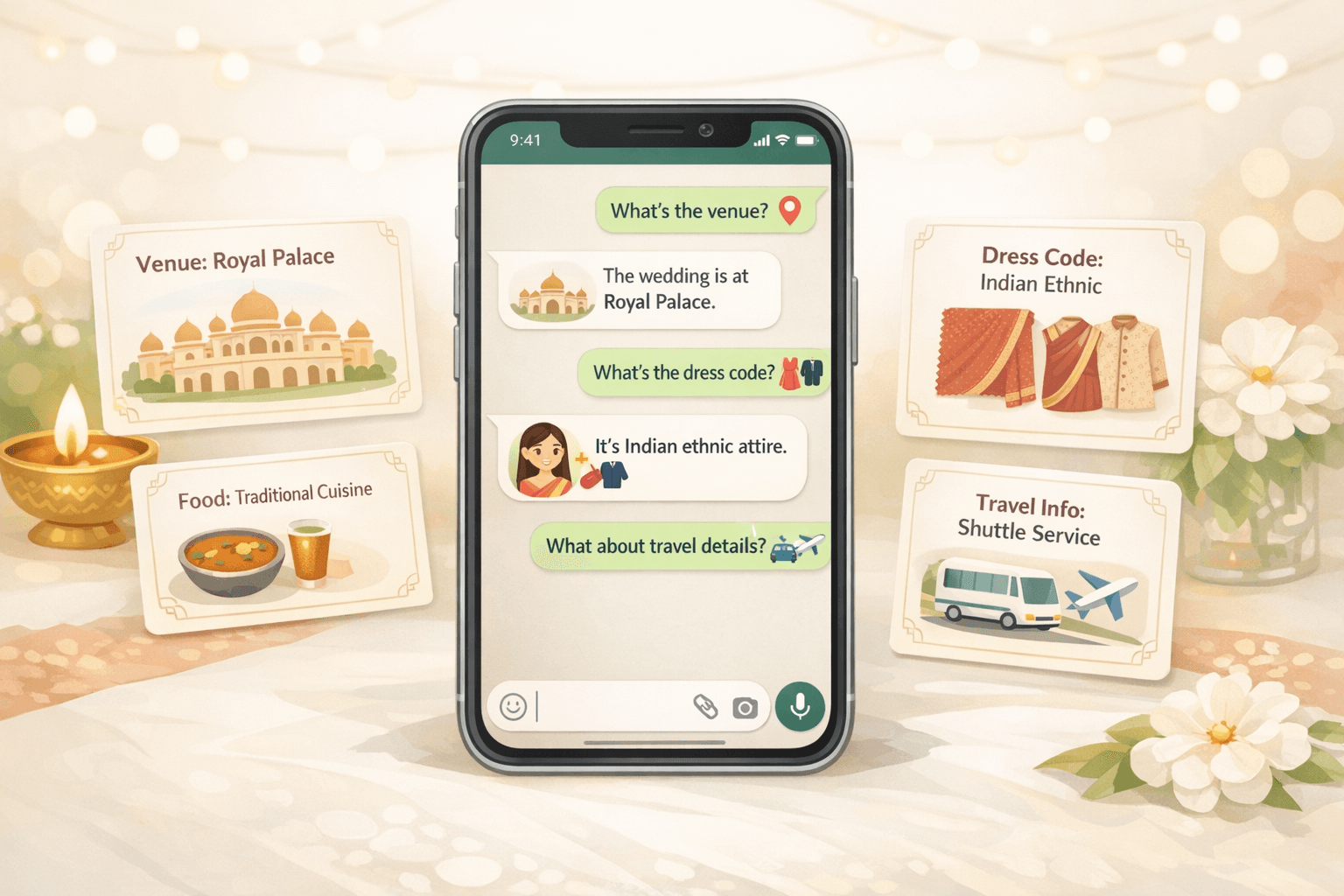
A typical 300-guest Indian wedding generates hundreds to a few thousand inbound questions in the fortnight before the event. Roughly 80% of them are the same six questions worded differently: Where is the venue? Is there vegetarian food? Can I bring my toddler? What’s the dress code for the sangeet?
Taking this off the planner’s plate is the difference between a manager comfortably handling four weddings a month and burning out at two.
AI guest FAQ agent on WhatsApp
We built a guest FAQ agent that sits on WhatsApp and answers these questions directly, using the couple’s actual wedding details. No human gets pinged. Guests get instant answers. Event managers get their evenings back.
This is, by a wide margin, the single highest-impact AI feature we’ve shipped.
AI-generated wedding messages
Couples know what they want to say to their guests - “please share your flight details,” “save the date for the cocktail,” “the mehendi venue has changed” - but writing 400 different WhatsApp messages across five languages and three relationship registers (uncle vs. college friend vs. boss) is not something anyone has time for.
Our Wedding Message Generators handle the drafting. You describe the situation, they write the message.
AI wedding hashtag generator
The same principle applies to wedding hashtags. Our AI Wedding Hashtag Generator takes the couple’s names and vibe, and generates six creative directions instead of the same #RahulWedsPriya energy everyone else has.
AI-generated ceremony countdown images
Every wedding now ships with its own content calendar: “10 days to haldi,” “5 days to mehendi,” “1 day to the pheras.” Couples post these countdowns obsessively. They used to either commission a designer for each one, or settle for the same three Canva templates every other couple used.
We now generate these inside the app as a paid feature, using the latest frontier image models from OpenAI and Google under the hood - tuned for Indian wedding aesthetics (haldi yellows, mehendi greens, the right level of ornamental detail without tipping into wedding-card cliche). Couples get fresh, ceremony-specific visuals in seconds instead of a three-day back-and-forth with a designer.
The deeper shift: the Indian wedding has become a communication product. The ceremony itself is still the ceremony, but the two months leading up to it are essentially a messaging problem - and messaging problems are where LLMs are strongest.
weddingkart.co
Rated 4.8 on AndroidRated 4.8 on iOS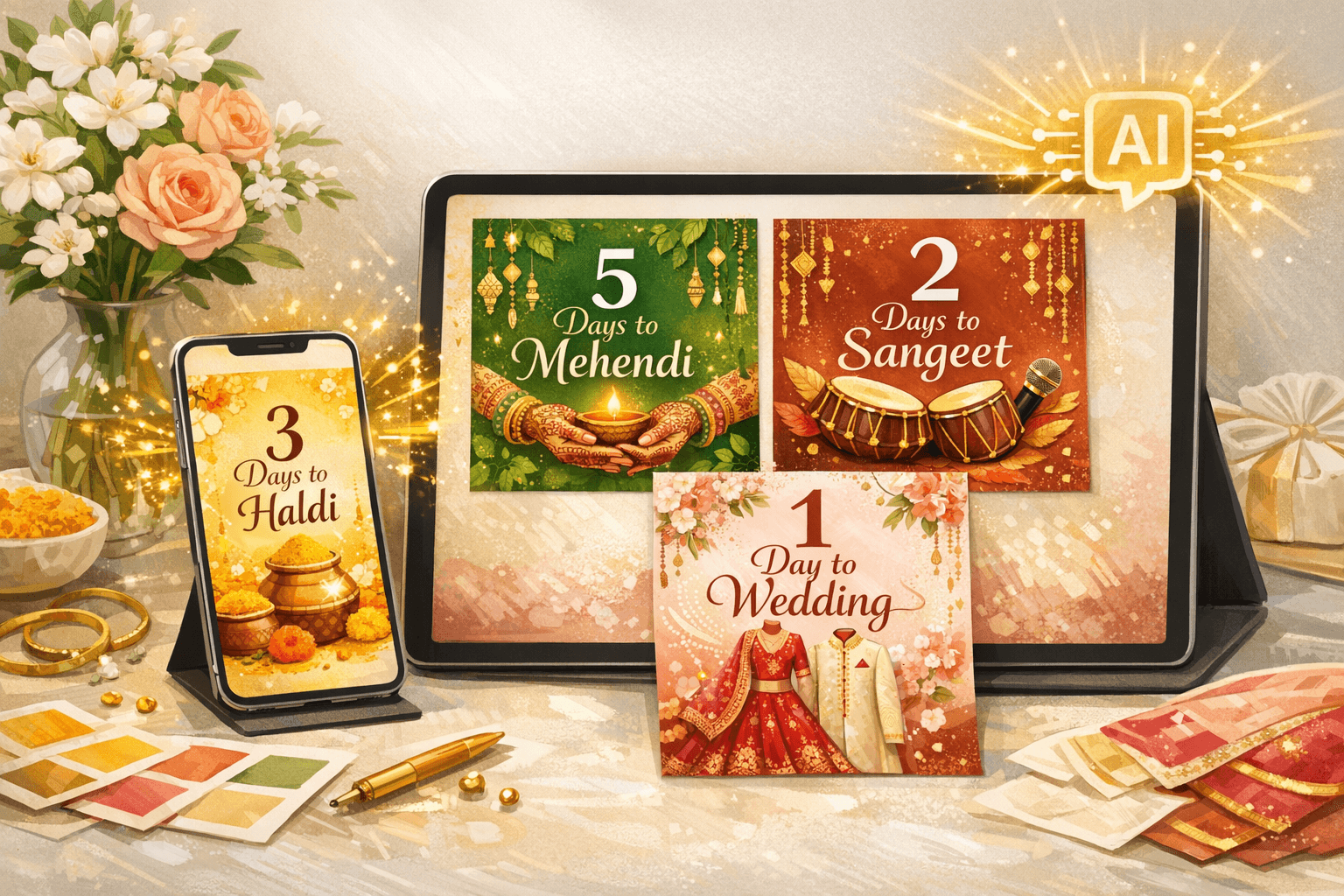
weddingkart.co
Rated 4.8 on AndroidRated 4.8 on iOSVoice AI for weddings: the next 18 months
Text-based AI has obvious ceilings in the Indian wedding context. A significant chunk of guests - especially older relatives - would rather call than type. For a long time, that meant the event manager’s phone rang all day.
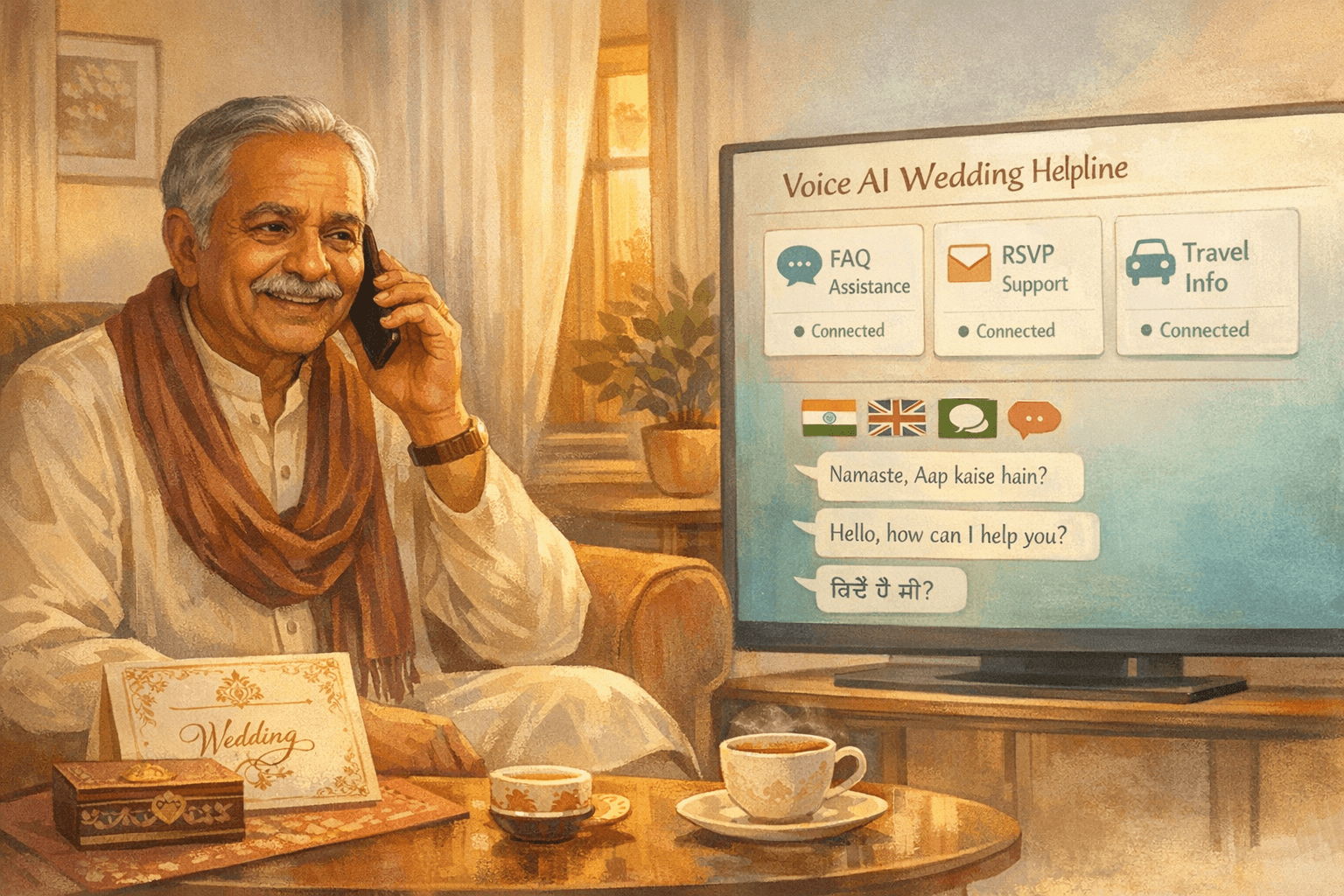
We’re rolling out voice AI agents for two directions of the problem:
- Outbound voice AI. An agent that calls guests who haven’t RSVP’d, confirms their attendance, collects dietary preferences, and notes travel needs - in the guest’s preferred language, at a time they’re actually free.
- Inbound voice AI. An agent that handles guest calls to the wedding helpline, answering the same FAQ-type questions the text agent already handles - but over a voice channel for people who won’t use WhatsApp for anything beyond forwarding good morning messages.
What’s changed recently is the economics. Voice AI in Indian languages has quietly become cost-effective enough to run at scale, which moves it from “expensive premium add-on” to something that can reasonably be a default part of how wedding communication works. The industry is headed toward the latter.
A Tamil-speaking grandmother calling the wedding helpline at 11 PM and getting a real conversation in Tamil - that’s the experience we’re building toward, and it’s where the next 18 months of Indian wedding technology will quietly be decided.
weddingkart.co
Rated 4.8 on AndroidRated 4.8 on iOSHow does AI help diaspora and destination weddings?
The Indian wedding is not only an Indian event any more. A meaningful share of weddings we see today are planned from Dubai, London, Toronto, New Jersey, and San Francisco - with guests spread across three continents, family WhatsApp groups in three time zones, and at least one grandmother who still expects a phone call.
Diaspora weddings are harder. Not because the ceremonies are different - they aren’t - but because the operational layer underneath gets much messier.
- Time zones. The couple is asleep when half their guest list is awake. Every missed message is a 12-hour round trip.
- Multi-country guest lists. Phone number formats span +91, +971, +44, +1, +61. Names span transliterations that don’t match across sheets. Cleaning this manually is a week of work.
- Mixed-language communication. A single WhatsApp broadcast may need to reach a Gujarati uncle in Ahmedabad, a British-born cousin in London, and a Punjabi aunt in Dubai - without sounding wrong to any of them.
- Limited physical presence in India. Destination weddings planned from abroad mean most vendor interactions happen over video calls, and a planner in India is effectively operating with a remote principal.
AI helps in exactly these pain points. Guest list cleaners handle international phone formats automatically. WhatsApp FAQ agents absorb the time-zone gap by answering questions while the couple sleeps. Multilingual message drafters write consistent Hindi/English/Hinglish variants without demanding the couple become copywriters. Voice AI helplines give older relatives a way to call someone in Hindi or Tamil at 11 PM without waking up a human planner.
UAE and Gulf weddings are a rising segment - Indian professionals in Dubai, Abu Dhabi, and Sharjah are increasingly planning weddings either in the Gulf or back in India. UK desi weddings have their own texture, with multi-day events that still reach family in India. Indian American and Canadian weddings push the logistics to the edge: a four-ceremony wedding with half the guest list flying from India needs a communication backbone that simply cannot be run from a spreadsheet.
We cover this in depth across our Dubai and UAE guide, UK desi wedding guide, and North America guide.
What will AI in Indian weddings look like in the next 18–24 months?
A few shifts we are watching, and where we think the industry lands by mid-2027. These are predictions, not facts; treat them as such.
Agentic wedding planners
The next frontier is an AI that doesn’t just answer guest questions - it takes actions. A guest sends a message saying they need a pickup from the airport; the agent adds them to the travel sheet, books a cab with the vendor, sends confirmation both ways, and updates the couple’s dashboard. This is technically within reach. The blocker is trust: couples are not yet comfortable letting AI take actions on their behalf. We expect that to shift as guardrails mature.
Regional-language voice AI
Hindi and English voice AI is already production-grade. Tamil, Telugu, Kannada, Bengali, and Punjabi are close. The next 12 months will push them across the line. After that, a Marathi-speaking dadi calling the wedding helpline gets the same quality as an English-speaking cousin in London. That matters more than most wedding tech people realise.
AI wedding photography
The quality gap between AI-generated faces and real photography is closing fast. Whether it closes enough for wedding albums is a different question - and we think the answer is no. An AI-generated photograph of the grandmother crying during the vidaai is not the same artefact as the real one. Even when the pixels are indistinguishable, the meaning isn’t. We expect AI to stay on the utility side of the image layer: invitations, countdowns, save-the-dates. Not albums.
What we're watching at Weddingkart
Three things specifically. First: the economics of running a voice AI helpline in regional languages for a 300-guest wedding - if that drops further, inbound voice becomes a default, not an add-on. Second: the quality of AI-assisted vendor matching - can an agent recommend a decorator in Udaipur for a Gujarati wedding in April as well as a human planner does? Not yet, but the gap is narrowing. Third: whether couples trust AI with money - the day an AI agent can negotiate with a caterer on a couple’s behalf is the day the planner’s job description changes permanently.
What AI hasn’t touched - and shouldn’t
A few places worth flagging where AI is either overrated or outright unwelcome in weddings.
- The planner as curator. As AI handles more logistics, the event manager’s role shifts toward taste and relationships - the things that don’t generalise. A planner who knows that this particular family’s grandmother will get vertigo on a stage higher than two feet is irreplaceable. No model is going to learn that from training data.
- AI-generated wedding faces. AI-generated pre-wedding shoots are having a moment, and we’re sceptical. A wedding album is a document of real people in a real moment. The uncanniness of generated content sits badly with the emotional register of a wedding, and we’re watching couples quietly sour on it even as some vendors push it harder.
- The ceremony itself. The pheras, the first dance, the grandmother crying during the vidaai - that stays human. That’s the part AI has no business touching, and no wedding tech founder worth their salt wants to touch it anyway.
What this means for event managers and couples
For event managers: The managers who adopt AI wedding planning tools will quietly pull ahead. Not because AI replaces their judgement, but because it removes the logistical drag that limits how many weddings they can run. Running three weddings at the quality level of one is the new competitive frontier. Planners evaluating an integrated stack can start at Weddingkart for wedding planner software in India.
For couples: AI will make the run-up to your wedding less exhausting. Better decisions, faster. Fewer midnight “where is the venue” messages. More time to actually enjoy the weeks before your wedding instead of drowning in Excel. Most couples start with the Weddingkart guest list appand layer WhatsApp communication on top.
For the industry: Weddings are too cultural, too regional, and too stubbornly offline in their most important moments for one platform to swallow the category. There will not be one big winner. But the grain of the industry is changing, and the vendors who treat AI as infrastructure - the way they treat Excel or WhatsApp itself - will pull ahead of the ones who treat it as a gimmick.
At Weddingkart, our bet is that AI’s real job in the wedding industry isn’t to make weddings more impressive. It’s to make them less exhausting. The celebratory moments at the centre are already perfect. Everything around them - the guest lists, the travel pickups, the midnight questions - that’s the work AI was built for.
That’s the work we’re building for.
Try Weddingkart for your wedding
Guest lists, WhatsApp invites, RSVPs, countdowns and more - the AI layer for Indian weddings.
Frequently Asked Questions
How is AI being used in weddings in 2026?
AI is being used across the wedding planning lifecycle in 2026 - cleaning messy guest lists, estimating budgets for Indian and diaspora weddings, generating WhatsApp invitation messages, answering guest FAQs automatically, creating ceremony countdown graphics, and handling voice calls to the wedding helpline in regional Indian languages. The biggest impact is in the operational layer - work that was previously manual and exhausting.
How is AI being used in the Indian wedding industry?
AI is used across the wedding planning lifecycle: cleaning messy guest lists, generating WhatsApp messages, answering guest FAQs automatically, creating ceremony countdown images, and handling voice calls to the wedding helpline. The biggest impact is in the operational layer - work that was previously manual and exhausting.
Is it safe to use AI for wedding planning?
Yes, with caveats. AI tools built for weddings handle guest contact data and personal details, so the standard data-hygiene questions apply: who controls the data, where it is stored, and whether it is sold. A reputable Indian wedding AI platform should store data in India, not train foundation models on your guest list, and give you a way to export or delete everything. Weddingkart does all three. Avoid tools that are vague about data handling.
How much does AI wedding planning cost in India?
Most AI wedding planning tools sit in two buckets. Free tools - like AI budget calculators, hashtag generators, message drafters, and guest Excel cleaners - cost nothing and cover the planning layer. Paid wedding platforms that bundle WhatsApp invites, RSVP tracking, FAQ agents, and voice AI typically cost between ₹2,000 and ₹50,000 per wedding depending on guest count, channels, and ceremony count. Voice AI usually adds a per-minute cost on top. For most Indian weddings, AI tooling is a rounding error on the overall wedding budget.
Can AI help NRI couples plan an Indian wedding from abroad?
Yes. NRI planning is actually where AI has the highest leverage. Time-zone friction, multi-country guest lists, and limited physical presence in India make manual coordination exhausting. AI tools help NRI couples clean guest lists spanning India plus the diaspora, draft multilingual WhatsApp messages for family abroad and in India, auto-answer guest questions in Hindi and English on WhatsApp, and handle inbound helpline calls from older relatives across time zones.
How do event managers use AI to run more weddings?
Event managers adopting AI wedding tools can handle more weddings per season without adding headcount. The highest-leverage features are AI guest FAQ agents on WhatsApp (which absorb 70–80% of repeated guest questions), AI message generators for bulk announcements, voice AI for RSVP collection, and WhatsApp delivery tracking so managers know which guests received which messages. The net effect is freeing a manager from reactive firefighting so they can do the taste and relationship work that actually earns their fee.
Does Weddingkart handle diaspora weddings (UAE, UK, US, Canada)?
Yes. Weddingkart is used by NRI couples planning Indian weddings from the UAE, UK, US, and Canada - both destination weddings in India and diaspora weddings held abroad. The tools work across time zones, handle international phone number formats, and draft WhatsApp messages across English, Hindi, and Hinglish registers.
What AI tools help event managers run more weddings?
The tools with the highest ROI for event managers are AI guest FAQ agents, AI message generators for bulk WhatsApp communication, AI guest list cleaners, and voice AI agents for RSVP collection. Together these let a manager handle meaningfully more weddings at the same effort level.
Can AI plan an Indian wedding end to end?
No - and nobody in the industry is seriously trying. AI handles logistics, communication, and repetitive work very well. It does not handle the taste, relationships, and cultural judgement that make a wedding feel right. The future is AI-assisted human planners, not AI replacing planners.
Is voice AI ready for Indian weddings?
Yes, for specific use cases. Indian-language voice AI has recently become economically viable for production use, and it works well for structured tasks like RSVP collection, FAQ answering, and travel confirmation. It is not ready for open-ended emotional conversations - but it does not need to be.
Does Weddingkart use AI?
Yes, extensively. Weddingkart uses AI for budget estimation, timeline building, checklist generation, guest list cleaning, handwritten-list digitisation, WhatsApp message generation, hashtag generation, ceremony countdown image generation, and voice-based guest interaction.
Is AI-generated wedding content worth using?
AI is excellent for utility content - countdown graphics, save-the-dates, invitation copy, and hashtags. It is weaker for content meant to capture real moments such as pre-wedding shoots or ceremony photography. Rule of thumb: use AI for what you would send to a designer; use humans for what you would send to a photographer.
Was this article helpful?
Share
By Mayank JaiswalLast updated