
Last updated:
All PostsHow to Plan an Indian Wedding on a Budget: A Realistic Guide with Real Numbers
Quick Answer
How much does a budget Indian wedding cost?
A genuinely beautiful, meaningful Indian wedding is achievable for ₹5 to ₹15 lakh with the right choices made early — before vendors are booked, not after. Under ₹5 lakh gets an intimate 50–80 guest wedding; ₹15–30 lakh adds a second function and a dedicated venue for 150–250 guests. The average urban Indian wedding runs ₹20–50 lakh, so the savings come from what you choose to skip, not from a lower-quality version of everything.
Last updated:
This guide walks through where the money actually goes in an Indian wedding, where it can be cut without the wedding feeling cut, and what a real 8-lakh, 150-guest wedding budget looks like line by line.
What does a budget Indian wedding actually cost?
Under ₹5 lakh — intimate & simple
At this level, expect 50 to 80 guests, a community hall or home venue, a simple local caterer rather than a full-service catering company, and in-house or freelance photography rather than an established studio. This tier works best when the family prioritizes intimacy and meaning over scale.
₹5 to ₹15 lakh — mid-range with personality
This is where most budget-conscious urban Indian weddings land: 100 to 150 guests, an affordable banquet hall, typically a single-day celebration rather than a multi-day affair, and a mid-range photographer. There's enough room to add personal touches without every rupee going toward the basics.
₹15 to ₹30 lakh — fuller celebrations with flexibility
At this level, families can typically host 150 to 250 guests, book a proper dedicated venue, run two functions instead of one, and bring in a candid photography team.
The biggest budget drains in Indian weddings (and how to cut them)
Venue (the largest cost — how to save)
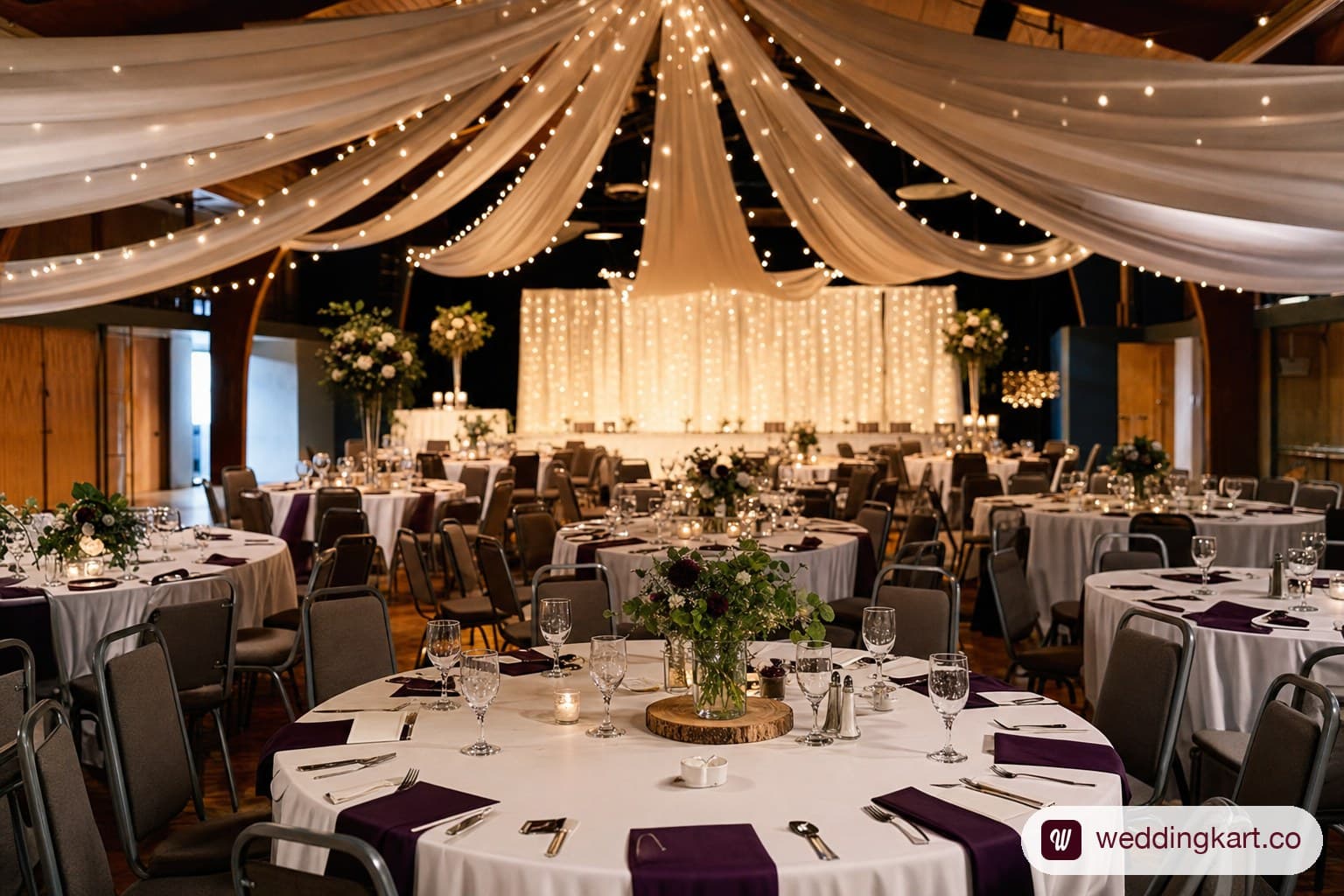
Venue typically eats 25 to 35% of the total wedding budget. Booking during the off-season, April through June in most of North India, can bring rates down 30 to 50% compared to peak wedding season. Community halls run roughly ₹30,000 to ₹80,000 for a full-day booking, against ₹3 to 8 lakh for a comparable banquet hall.
Catering (per-plate vs. buffet, in-house vs. outside)
Negotiate per-plate pricing directly rather than accepting a package rate, and compare the venue's in-house catering against outside caterers, which are often 15 to 20% cheaper for the same menu. Confirm the venue allows outside catering before locking a hall.
Photography (how to find good photographers at lower cost)
Established studios charge upward of ₹1 lakh for a wedding package. Newer photographers building a portfolio frequently charge ₹20,000 to ₹50,000 for comparable quality work.
Decoration (seasonal flowers, DIY, and rental)
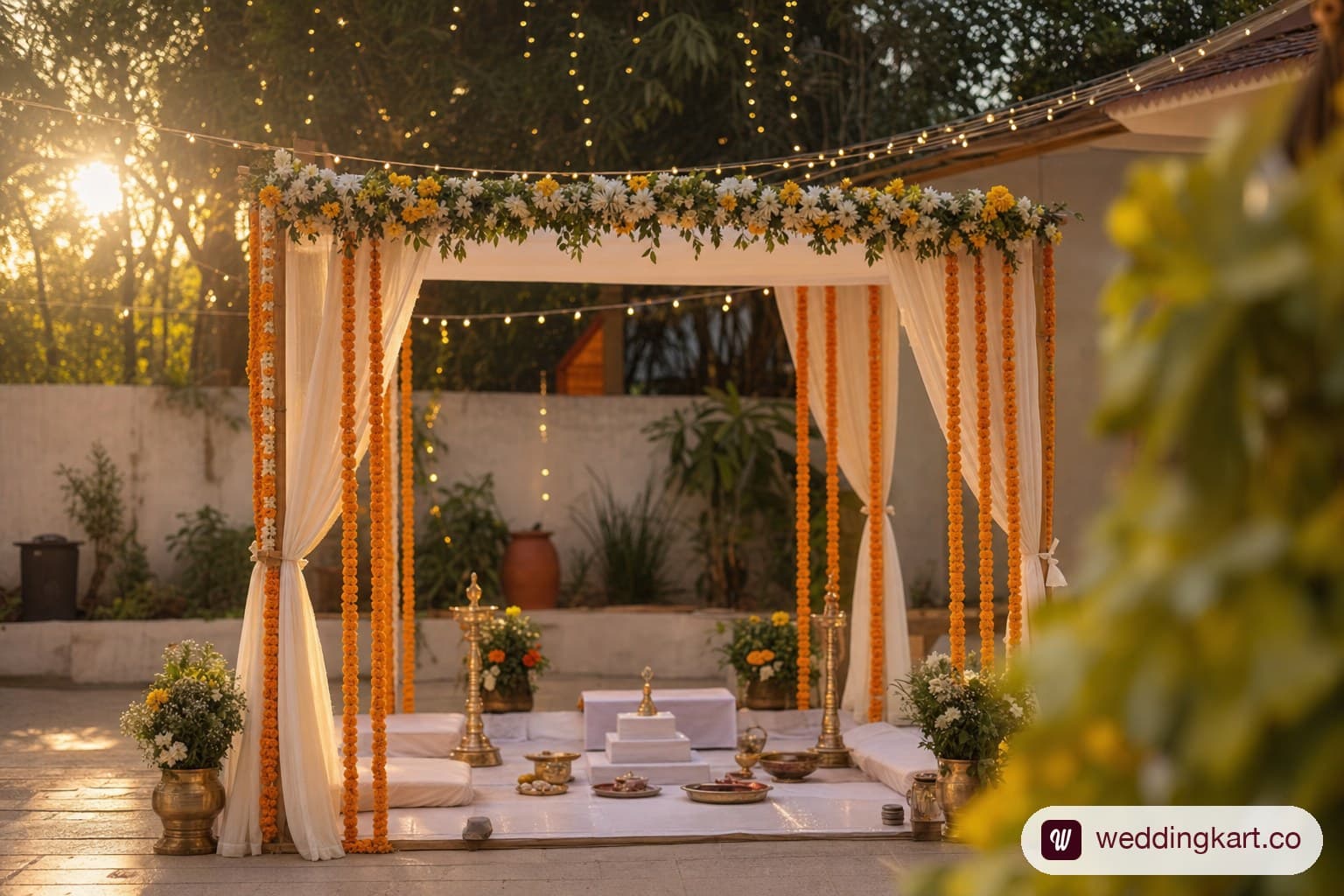
Seasonal, locally sourced flowers — marigolds and jasmine especially — are consistently the most affordable and most visually striking option. A DIY approach for smaller decor elements, combined with rented larger pieces like mandap structures, splits the difference between cost and polish.
Outfits (rent vs. buy, sample sales)
Renting wedding outfits typically saves 60 to 80% compared to buying, and this applies across bridal wear, groom's-side outfits, and guest attire for multi-day events. For readers planning outfit shopping in Ahmedabad specifically, our Ahmedabad wedding clothes rental guide covers where to look and what to expect to pay.
Venue strategies for a budget wedding
Community halls and dharamshalas
Beyond cost savings, community halls and dharamshalas often come with fewer restrictions on outside vendors and catering than commercial banquet halls.
Home and terrace weddings
For smaller guest counts, hosting at home or on a terrace eliminates venue cost almost entirely, though it's worth budgeting for tenting, seating, and possibly a generator.
Off-season bookings (April–June)
Off-season bookings also give more negotiating leverage on caterers, decorators, and photographers, since all are less booked out during slower months.
Budget wedding invitation ideas
Digital invitation cards — zero printing cost
A well-designed digital invitation costs nothing to distribute, compared to printed cards which run ₹15,000 to ₹60,000 for a 500-guest wedding once design, printing, and courier are added up.
WhatsApp invitations with a personal touch
The concern most families have with digital invitations is that they feel impersonal compared to a printed card. Personalization solves this. WeddingKart's personalized WhatsApp wedding invitations merge each guest's name and the correct event details automatically, at no per-message cost, so the money saved on printing can go straight back into catering or decor.
Food & catering on a budget
Beyond negotiating per-plate pricing, the biggest lever in catering cost is menu design rather than menu size. A tightly curated menu with five or six dishes done well typically costs less and is better received than a sprawling twelve-item spread. Buffet-style service is also consistently cheaper than plated service for the same menu.
The budget wedding checklist — what not to cut
Regardless of overall budget, a few things are worth protecting even when cutting elsewhere: food quality, a photographer whose actual portfolio has been reviewed, and enough seating and shade for elderly guests. What guests notice least, in practice, is elaborate stage decor, printed invitation cards versus digital ones, and whether the venue is a name-brand property or a well-run community hall.
Where budget-conscious families overspend without noticing
The single most common budget leak isn't a big-ticket item — it's a package rate accepted without itemization. A venue quoting “₹1,200 per plate, all-inclusive” often bundles décor, DJ, and photography at a markup well above what those same vendors would charge booked separately; the only way to know is asking for the itemized breakdown before signing, not after. The second common leak is guest-count creep between the initial budget and the final headcount — a wedding budgeted for 150 guests that quietly grows to 180 by RSVP deadline adds real cost to catering, seating, and favors that never gets re-budgeted, since the family is still mentally working off the original number. Building a 10% contingency into the catering line specifically, rather than the miscellaneous line, catches this before it becomes a last-week scramble.
Real budget breakdown example (₹8 lakh, 150 guests)
| Category | Approx. cost (INR) | % of budget |
|---|---|---|
| Venue (banquet hall, off-season) | 1,20,000 | 15% |
| Catering (150 guests, outside caterer) | 2,25,000 | 28% |
| Decoration (mandap, seasonal flowers) | 80,000 | 10% |
| Photography (independent photographer) | 40,000 | 5% |
| Outfits (bride + groom, rented + purchased mix) | 1,00,000 | 12.5% |
| Invitations (digital, zero print cost) | 0–5,000 | under 1% |
| DJ / music | 50,000 | 6% |
| Miscellaneous (transport, gifts, contingency) | 1,00,000 | 12.5% |
| Total approx. | 8,00,000 | 100% |
This breakdown is illustrative and will vary by city, guest count, and local vendor rates — use it as a starting framework, not a fixed quote.
For the guest-management side of running a budget wedding without extra staffing costs, our guide to managing 500+ guests across a multi-day wedding covers how to keep coordination simple even at scale, and if you're weighing a destination wedding against a budget city wedding, our destination wedding cost guide breaks down that comparison in detail.
Was this article helpful?
Share