
Zola vs The Knot: Which Wedding Website Wins?
Quick Answer
Zola vs The Knot: which should I actually use?
In our view, pick Zola if you want a bigger design catalogue (600+ templates vs The Knot's 100+, both self-reported) and a simpler registry-first setup. Pick The Knot if you specifically want a vendor directory to start your search from scratch and don't mind that its parent company, The Knot Worldwide, faces a proposed nationwide class action (filed April 2025) alleging it sold vendors fabricated leads - the company calls the claims baseless and disputes them. Both apps rate 4.9/5 on iOS. Neither is built for WhatsApp-based guest communication, which matters if your guest list spans multiple countries.
Last updated:
2013
Zola founded (private, VC-backed)
1996
The Knot founded (now part of TKWW)
600+
Zola website templates (self-reported)
100+
The Knot website templates (self-reported)

Every couple who lands on this comparison is really asking one of two things: which free wedding website looks better, or which one is less likely to embarrass them with their family's gift list. Both questions have real, researchable answers - and the second one has gotten more complicated since a proposed nationwide class action landed on The Knot's parent company in April 2025.
Quick take: who wins for what
- Registry-first couples who want more design variety: Zola.
- Couples starting their vendor search from zero: The Knot - but read the lawsuit section below first.
- Couples who want the simplest possible setup: Zola, marginally - both are free and quick to start.
- Weddings spanning multiple ceremonies, countries, or a WhatsApp-first guest list: neither - see the note near the end.
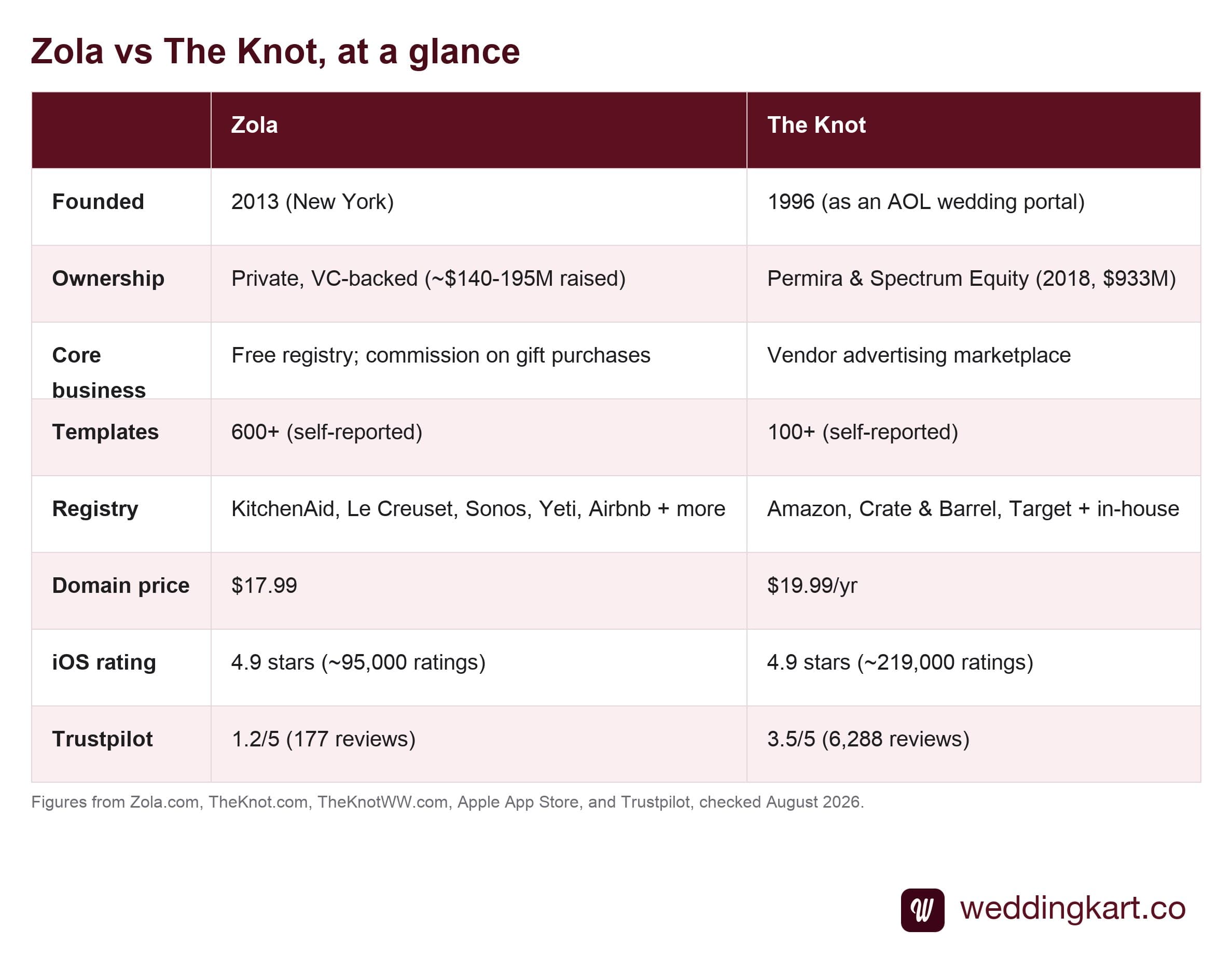
| Zola | The Knot | |
|---|---|---|
| Founded | 2013 (New York) | 1996 (as an AOL wedding portal) |
| Ownership | Private, venture-backed | Permira & Spectrum Equity (2018, $933M) → The Knot Worldwide |
| Core business | Free registry; commission on gift purchases | Vendor advertising marketplace; couple tools are free |
| Website templates | 600+ (self-reported) | 100+ (self-reported) |
| Named registry partners | KitchenAid, Le Creuset, Brooklinen, Sonos, Yeti, Airbnb + more | Amazon, Crate & Barrel, Target + in-house store |
| Custom domain | $17.99 | $19.99/yr |
| iOS app rating | 4.9★ (~95,000 ratings) | 4.9★ (~219,000 ratings) |
| Trustpilot score | 1.2/5 (177 reviews - small, complaint-skewed) | 3.5/5 (6,288 reviews) |
Figures from Zola.com, TheKnot.com, TheKnotWW.com, Apple App Store, and Trustpilot, checked August 2, 2026 - these change over time, so use the source links in this article to verify current numbers.
What is Zola, and how does it make money?
Zola launched in 2013 in New York, founded by Shan-Lyn Ma and Nobu Nakaguchi, pitched as "the first all-in-one wedding registry platform." It has stayed private through several rounds of venture funding, backed by investors including Lightspeed Venture Partners and Thrive Capital. (Wikipedia)
The registry itself is free - Zola's own site advertises zero-fee cash funds - and the company earns money when guests actually buy registry gifts through it. Zola doesn't publish its exact commission rate on its own site, so we're not citing a specific percentage here. (Zola)
What is The Knot, and how does it make money?
The Knot is older by seventeen years - it started in 1996 as an AOL wedding portal, went public in 1999 as XO Group, and was taken private in 2018 when Permira Funds and Spectrum Equity paid $933 million for it and merged it with WeddingWire to form The Knot Worldwide (TKWW). (Wikipedia) TKWW now also owns WeddingPro, Hitched, Bodas.net, The Bump, Simply Eloped, and The Bash.
Where Zola's revenue comes from registry gifts, The Knot Worldwide describes itself as connecting "over 4.5 million annual users with approximately 900,000 global small businesses" - a large vendor-advertising marketplace sitting alongside the free couple-facing website and registry. Its own vendor marketing promises to surface "relevant business profiles across various digital and interactive surfaces at high-impact moments throughout the [couple's] planning journey," meaning vendor recommendations are a designed part of the couple experience, not incidental to it. (The Knot Worldwide)
Website design and templates: how do they actually compare?
Zola advertises 600+ templates across style categories like classic, modern, floral, rustic, and minimal; a custom domain runs $17.99. (Zola) The Knot advertises 100+ templates across categories including Most Popular, Floral, Rustic, Classic, and Modern (yes, including a Bridgerton-themed set); a custom domain costs $19.99/year. (The Knot) Both counts come straight from each company's own marketing pages - neither is independently audited - so read them as directional, not exact. A bigger catalogue mostly buys more niche aesthetic variety; the core building blocks (RSVP page, registry links, event details, photo gallery) are functionally similar on both.
Zola names more registry partners - does that make it better?
Zola names nine specific retail partners on its own registry page - KitchenAid, Le Creuset, Brooklinen, Lenox, Waterford, Sonos, Yeti, Airbnb, and Cuisinart - and layers a "universal registry" browser extension on top that can pull in gifts from almost any online store. It also runs a 20% newlywed discount on unclaimed registry items for six months after the wedding. (Zola)
The Knot names three flagship partners - Amazon, Crate & Barrel, and Target - plus its own in-house store. (The Knot) Nine named partners looks like a clear win on paper, but Amazon's own catalogue is broad enough to cover a lot of the same ground - in our read, the real gap favoring Zola is in specialty and direct-to-consumer brands that Amazon and Target don't carry, not in registry breadth overall.
Which has better guest list and RSVP tools?
Both are free and functionally similar: track RSVPs, meal choices, plus-ones, and export the list as a spreadsheet. Reported complaints differ in kind, though we haven't independently reproduced either: Zola has been reported to support only one primary guest plus a single named plus-one - awkward if you want to track two partners independently, each with their own contact details. The Knot has been reported to occasionally desync its guest list between app and website.
Neither advertises what a dedicated guest-operations tool does for a large or international wedding: no WhatsApp-native messaging, no automatic multi-ceremony segmentation (bride's side vs groom's side, per-event invites), no travel-ticket parsing. That's a genuinely different product category, not a missing feature on either platform.
Which app has better reviews?
Neither wins outright on iOS star rating: both sit at 4.9 out of 5 as of this writing, checked August 2, 2026. The sample sizes differ a lot - Zola's Wedding Planner app has roughly 95,000 ratings, The Knot's roughly 219,000, about 2.3x more. (Zola on the App Store) (The Knot on the App Store) A larger sample makes a 4.9 average a more stable estimate of typical user sentiment, but it doesn't on its own prove one app is better than the other.
Trustpilot tells a rougher story for both, though the sample sizes there are much smaller and skew toward people motivated enough to complain: Zola sits at 1.2 out of 5 across 177 reviews, and The Knot at 3.5 out of 5 across 6,288 reviews. Trustpilot itself notes Zola "has no history of asking for reviews," which is exactly the condition that produces an angry-customer-only sample - treat the 1.2 figure as a complaint magnet, not a verdict on the average user's experience. (Zola on Trustpilot) (The Knot on Trustpilot)
What does the lawsuit against The Knot Worldwide actually allege, and how has the company responded?
More than 20 named vendors allege they paid The Knot Worldwide for leads that never converted into real weddings, according to a 2025 investigation reported by PetaPixel and Newsweek. The Knot Worldwide disputes the allegations, calls them baseless, and says the leads it delivers convert at scale: 9 million leads to 900,000 vendors in 2024, facilitating an estimated $4 billion in vendor-side spend, with flagged-spam messages under 1% of total volume. (PetaPixel) (Newsweek)
The named examples in that reporting: photographer David Sachs says he raised his ad spend to $1,000/month after leads dried up. Elite Casino Events says it landed only 19 total clients over six years on the platform, with just one of eight "leads" ever responding. Morina Photography says it was billed $1,798.80 a month against an agreed $1,648.90. A proposed nationwide class action citing allegations like these was filed against The Knot Worldwide in California on April 30, 2025; separately, Senator Chuck Grassley sent letters to the SEC and FTC in March 2025 citing more than 200 FTC complaints filed against The Knot and WeddingWire since 2018.
This isn't the first time similar allegations have surfaced: a 2023 Forbes investigation cited three named former employees alleging the company sold ad placements to major partners that didn't actually exist, and noted the Better Business Bureau had revoked The Knot's accreditation in 2020. (Forbes) None of this has been adjudicated - the lawsuit is active and unresolved as of this writing, and The Knot Worldwide maintains the disputed cases are a small fraction of an otherwise legitimate, high-volume business. What we can say with confidence: this is a live legal dispute with named plaintiffs and congressional scrutiny from Senator Grassley behind it, not a single disgruntled reviewer - and it's worth knowing about before you build a vendor shortlist inside The Knot's directory specifically. It says nothing about the website builder or registry, which are a separate part of the product.
One clarification: the documented allegations above are about vendors paying for leads, not about couples' personal information being sold. There's long-running, unresolved discussion among users about whether The Knot shares couples' email addresses with advertisers, but we couldn't verify that specific claim against a primary source - treat it as a separate, open question from the vendor-lead allegations above.
So which should you actually use?
If registry variety and a simpler setup matter more to you, Zola is the stronger all-around pick. If you're starting your vendor search from nothing and want one directory to lean on, The Knot has built its whole business around vendor discovery in a way Zola hasn't - you're just choosing it with an active lawsuit over its vendor-leads business in the background, not in spite of zero controversy. Neither is obviously wrong; they optimize for different parts of the planning process.
Neither answer changes much if your actual problem isn't "which website looks nicer" but "how do I get 300 people across four cities to RSVP, tell me their dietary restriction, and show up on time." That's a guest-operations problem, and it's outside what either platform was built to solve.
One aside, disclosed plainly: Weddingkart is our product, and it's built for exactly that guest-operations problem via WhatsApp rather than email - useful mainly for multi-ceremony or international weddings, not a replacement for either platform's registry or design tools. Weddingkart has no US customer base today; mentioning it here is a disclosure, not a claim that it fits every reader. Learn more if that's relevant to your wedding.
Sources
- Zola – Wedding Registry (fees, cash funds, named partners)
- Zola – Wedding Website (template count, domain pricing)
- The Knot – Registry (named retail partners, fees)
- The Knot – Wedding Website (template count, domain pricing)
- The Knot Worldwide – About Us (corporate structure, brand portfolio)
- Wikipedia – Zola (company) (founding, funding history)
- Wikipedia – The Knot Worldwide (founding, 2018 acquisition, merger)
- Forbes (2023) – advertiser fraud allegations, named ex-employees
- PetaPixel (2025) – fake-lead allegations, named vendors
- Newsweek (2025) – proposed class action, Grassley letter, TKWW response
- Apple App Store – Zola Wedding Planner (rating, review count)
- Apple App Store – The Knot Wedding Planner (rating, review count)
- Trustpilot – Zola
- Trustpilot – The Knot
Company figures, pricing, and ratings change - the links above go to each source directly so you can check current numbers yourself. This article does not test hands-on workflows on either platform; feature and complaint descriptions are drawn from each company's own published pages and cited press reporting, not first-party testing. The vendor-fraud allegations against The Knot Worldwide describe an active, unresolved legal matter; nothing in this article should be read as a finding of fact against the company.
Frequently asked questions
Is Zola or The Knot free?+
Both are free for the core product - website, registry, and guest list. Neither charges couples to build a site or open a registry. Each earns money elsewhere: Zola earns a commission when guests buy registry gifts, and The Knot's owner, The Knot Worldwide, runs a large vendor-advertising marketplace alongside the free couple-facing tools.
Which has more wedding website templates, Zola or The Knot?+
Zola advertises over 600 website templates on its own site; The Knot advertises 100+. Both figures are self-reported by each company, not independently audited, so treat them as directional. A bigger catalogue mostly buys more niche aesthetic variety - the core building blocks (RSVP page, registry links, event details, photo gallery) are functionally similar on both.
What stores can I register at on Zola vs The Knot?+
Zola names partners including KitchenAid, Le Creuset, Brooklinen, Lenox, Waterford, Sonos, Yeti, Airbnb, and Cuisinart, plus a browser extension that can add gifts from almost any online store into one universal registry. The Knot names Amazon, Crate & Barrel, and Target as its flagship partners, plus its own in-house store - fewer named partners, but Amazon's own catalogue covers a lot of ground on its own.
Does The Knot really send fake leads to vendors?+
That's the substance of an active, unresolved legal dispute - not a settled fact either way. A 2025 investigation (reported by PetaPixel and Newsweek) surfaced complaints from 20+ named vendors alleging they paid for leads that never converted to real weddings, and a proposed nationwide class action was filed in California in April 2025. The Knot Worldwide calls the allegations baseless, disputes them, and says flagged spam is under 1% of the 9 million leads it says it delivered to 900,000 vendors in 2024. Nothing has been adjudicated either way - read the full context below before drawing a conclusion.
Which is better for tracking RSVPs and guest lists - Zola or The Knot?+
Functionally similar: both track RSVPs, meal choices, plus-ones, and export guest data to a spreadsheet, for free. User-reported complaints diverge - Zola has been reported to support only one primary guest plus a single named plus-one, while The Knot has been reported to occasionally desync its guest list between app and website (we haven't independently reproduced either issue). Neither platform does anything close to per-guest WhatsApp messaging, travel-ticket collection, or multi-ceremony guest segmentation - that's a different category of tool.
Can I use both Zola and The Knot for the same wedding?+
Nothing stops you from creating accounts on both, but most couples pick one as their primary hub - the RSVP link and registry you actually send to guests - and let the other sit unused. Splitting your real guest list and registry across two platforms just means chasing RSVPs and gift-tracking in two places instead of one.
Who owns Zola and The Knot?+
Zola is still privately held and venture-backed, founded in 2013 by Shan-Lyn Ma and Nobu Nakaguchi, with no acquisition to date. The Knot has changed hands more: founded in 1996 as an AOL wedding portal, it went public in 1999 as XO Group, and was taken private in 2018 by Permira Funds and Spectrum Equity for $933 million, then merged with WeddingWire to form The Knot Worldwide - which also owns WeddingPro, Hitched, Bodas.net, The Bump, Simply Eloped, and The Bash.
Do Zola and The Knot work for weddings outside the US?+
Both are built primarily around US wedding conventions and US retail partners. The Knot Worldwide's Bodas.net and Hitched brands serve Spanish-speaking and UK markets respectively, but as separate products, not inside The Knot itself. Neither platform is built around WhatsApp-based guest communication, which matters for international, multi-ceremony, or NRI weddings where guests default to WhatsApp over email.
Which should I actually pick?+
There's no universal winner - it depends what you're optimizing for. Zola tends to fit registry-first couples who want more design variety and a simpler setup. The Knot tends to fit couples who want to start their vendor search from scratch and are comfortable weighing an active, unresolved lawsuit against its parent company. If your real problem is coordinating 300 guests across multiple ceremonies or countries, neither platform was built to solve that - it's a different kind of tool entirely.
By Mayank JaiswalLast updated
Was this article helpful?
Share