
Last updated:
All PostsBest Wedding Venues in New York City: The Complete 2026 Guide
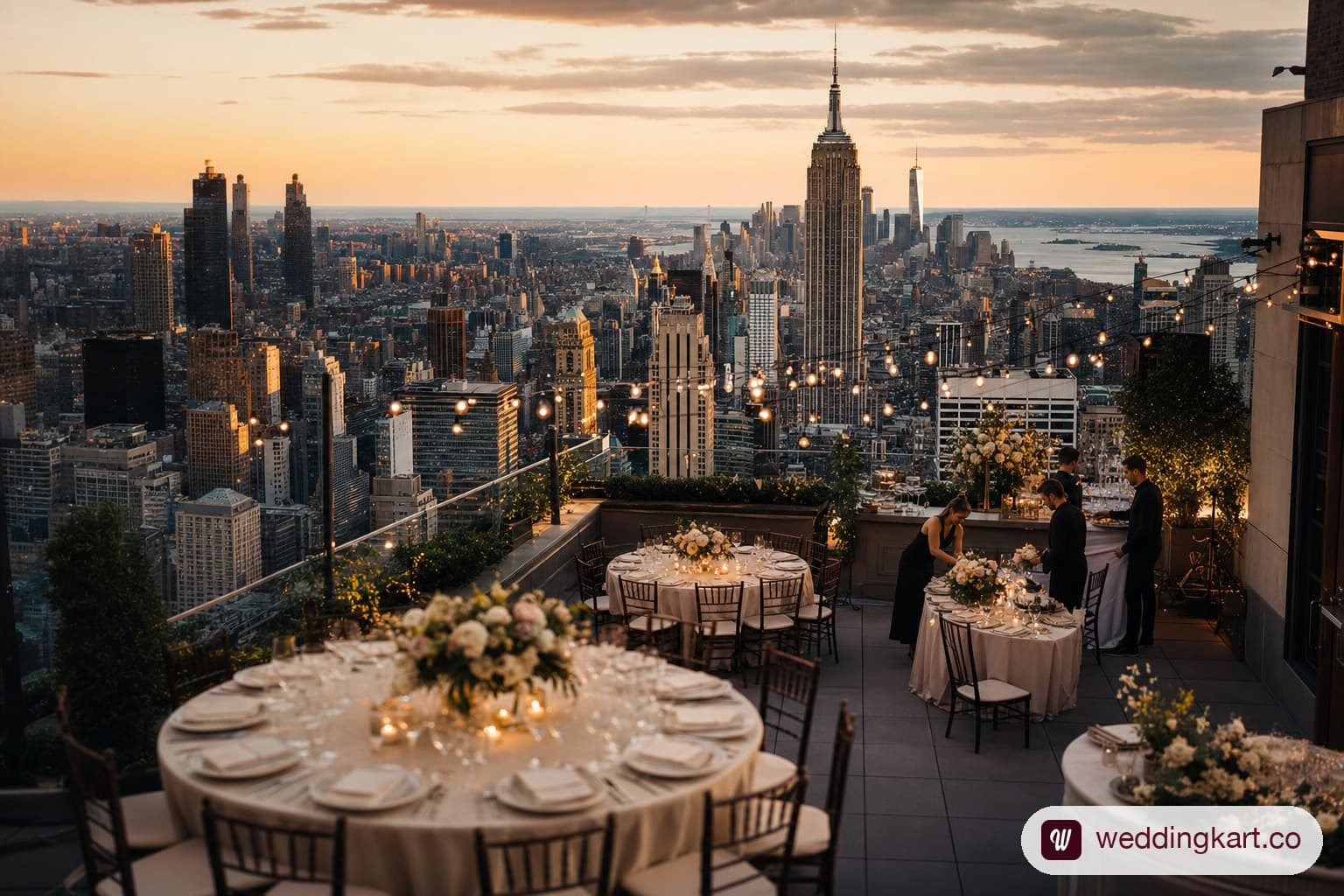
New York City has more wedding venues than almost any other US market, and that abundance is exactly what makes choosing one so hard. Between six boroughs, a dozen distinct venue styles, and booking calendars that fill 12 to 18 months out, most couples start their search with a vague idea ("rooftop, maybe?") and end it overwhelmed by spreadsheets of tour notes. This guide breaks down the real differences between venue types, what each borough actually costs, and the questions that separate a smooth booking from a contract you regret.
Why NYC is one of the most competitive wedding venue markets in the US
Three things make New York different from almost every other city a couple might consider: land is scarce, calendars are dense, and the buildings themselves impose rules other markets don't have to think about.
Usable outdoor space is limited citywide, so the venues that do have it — gardens, rooftops, waterfront piers — carry a premium and get booked out first. Popular venues routinely hold two or three ceremonies in a single Saturday, which means the vendor load-in windows are tight and the venue staff run a more rigid schedule than a suburban property with only one wedding a week. And because so many NYC venues operate inside older or landmarked buildings, they often carry building-specific constraints — freight elevator hours, noise curfews tied to residential zoning, union labor requirements for load-in — that don't show up on a typical venue-shopping checklist built for other cities.
None of that means NYC weddings are harder to plan well. It means the standard advice ("book a venue you love and figure out logistics later") doesn't hold up here. The logistics are part of the decision.
There's also a pricing reality worth naming upfront: NYC wedding venues run higher than the national average across every category, not just the obvious luxury tier. A "budget" venue in Queens can still cost more than a mid-tier venue in a smaller city, because the floor for commercial event space in New York is simply higher than almost anywhere else in the country. That's not a reason to avoid the city for your wedding — it's a reason to shop by category and borough rather than by a national price benchmark that doesn't apply here.
Types of NYC wedding venues
Before touring anything, it helps to know which category you're actually choosing between. Each comes with a different cost structure, a different degree of control over vendors, and a different risk profile if weather or scheduling doesn't cooperate.
Hotel ballrooms
Ballrooms remain the default for a reason: full climate control, a single point of contact for catering and rentals, and — for out-of-town guests — a room block one elevator ride from the reception. The tradeoff is flexibility. Most hotels require in-house catering and have fixed vendor lists for AV and sometimes florals, so the "blank canvas" feeling of a loft isn't available here.
Rooftop & skyline venues
The draw is obvious in photos. The operational reality is a shorter list of usable dates than couples expect, because rooftop bookings depend on weather contingency space being available too — and because most rooftop venues in NYC operate under building noise curfews that end music by 10 or 11 p.m., regardless of your contract's stated end time. If a rooftop or waterfront venue is genuinely on your shortlist, our dedicated rooftop and waterfront venue guide covers weight limits, curfews, and rain-backup planning in more depth than fits here.
Waterfront venues
East River and Hudson River venues both trade on open sightlines, but they photograph differently — East River venues typically face the Brooklyn/Queens skyline, Hudson River venues face New Jersey and tend to get better sunset light. Both come with the same wind-exposure and tenting considerations as rooftops.
Gardens & outdoor spaces
The smallest category by supply, and the first to book out for May–October Saturdays. A garden venue without a fully enclosed indoor backup space (not just a tent) is a genuine risk in a city where afternoon thunderstorms are common from June through August.
Lofts & industrial venues
Popular in Brooklyn and increasingly in Long Island City, these spaces typically come "unstyled" — you're renting square footage and high ceilings, then bringing in your own catering, rentals, and decor. That flexibility is also the cost driver: what looks cheaper on the venue rental line often evens out once furniture, linens, and a full kitchen buildout are added.
Museums & cultural institutions
A smaller, higher-price-point category, but one where the venue itself does most of the visual work — couples often spend less on decor because the space doesn't need it. Availability is usually limited to specific evening hours after public hours end, which narrows the ceremony-start-time conversation more than couples expect.
Across all six types, the same rule holds: the venue rental fee is the starting number, not the total. Every category has its own hidden add-on — service staff and union labor fees for museums, a generator and additional insurance for outdoor spaces, catering minimums for hotels — and none of those show up until you ask for the full proposal, not just the rental quote.
Best venues by borough (Manhattan, Brooklyn, Queens)
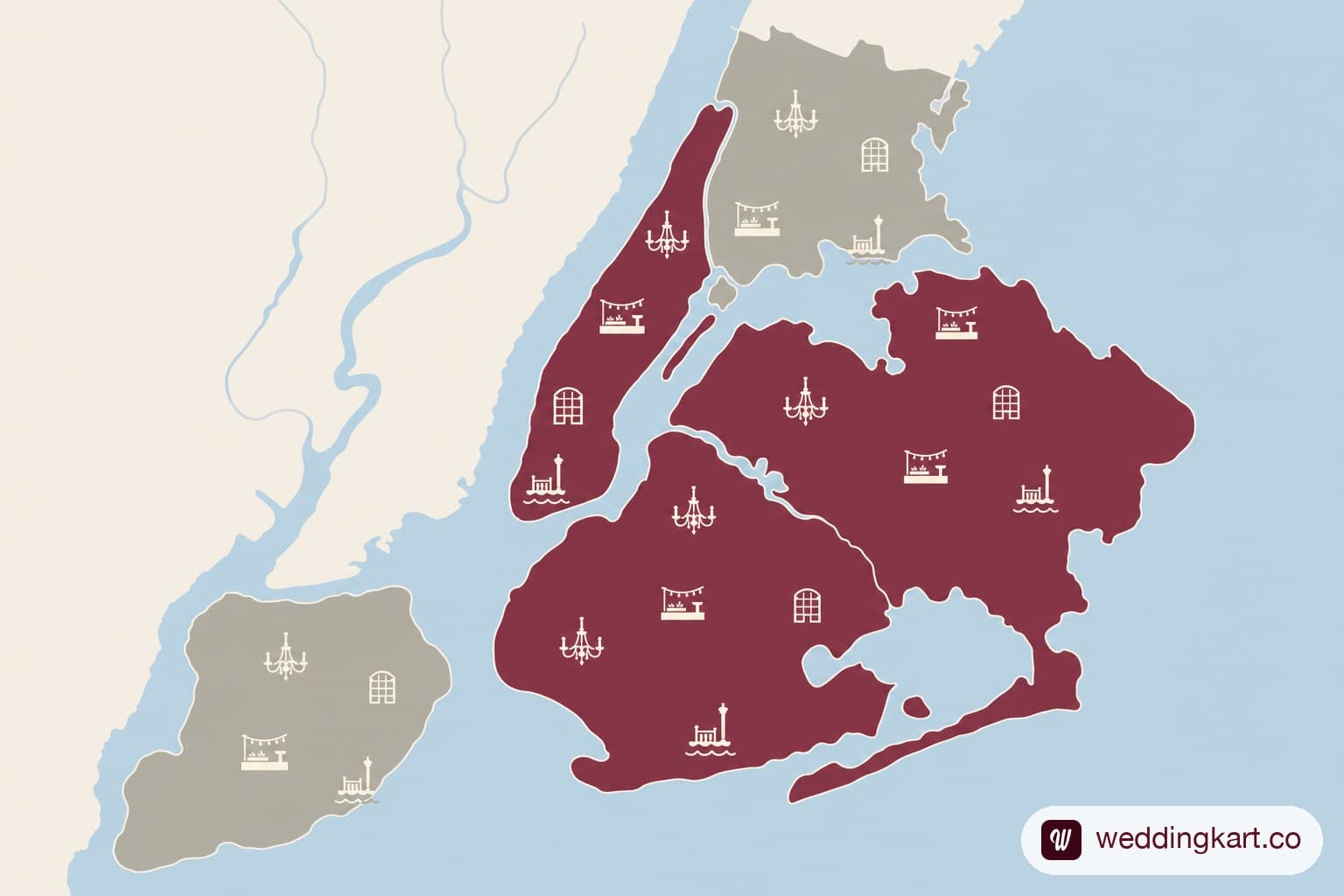
Borough matters more for a NYC wedding than city choice matters almost anywhere else, because it changes price, aesthetic, and how easy the day is for your guests to reach.
Manhattan gets you the easiest logistics for your guest list — most of your guests can reach the venue without a car — but you pay for that convenience, and the highest-demand venues are the hardest to book on a Saturday in peak season. Brooklyn has closed most of the price gap with Manhattan for its most in-demand loft and waterfront venues, but still offers meaningfully more square footage per dollar than a comparable Manhattan ballroom. Queens remains the best value of the three, particularly in Long Island City, where waterfront and event-hall venues sit a single subway stop from Manhattan.
A practical way to decide: map your guest list by home borough or state before you tour a single venue. If most of your guests already live in or near Manhattan, a Brooklyn or Queens venue isn't a hardship — it's one subway ride. But if a large share of your list is flying in or driving from outside the city, weigh venue choice against hotel density: Manhattan has, by a wide margin, the most hotel rooms within walking distance of any venue, which simplifies your room-block conversation considerably. Brooklyn's hotel inventory has grown but is still concentrated in a few neighborhoods (Williamsburg, Downtown Brooklyn), and Queens has the thinnest hotel density of the three outside of Long Island City.
It's also worth touring at least one venue in a borough you didn't expect to like. Couples who start their search assuming "Manhattan or nothing" are often surprised by what a Long Island City waterfront venue or a Bushwick loft offers for the same budget that gets a much smaller Manhattan space.
What to look for when choosing a venue
Guest count and budget narrow the list first, but four other factors decide whether the venue actually works for your specific wedding:
1. Indoor/outdoor risk tolerance. If any part of your day happens outdoors, ask what "backup" means at that specific venue — a tent isn't the same as a fully enclosed indoor room, and some contracts only guarantee the tent option.
2. In-house vs. outside catering. Hotels and some event spaces require their own kitchen; lofts and galleries usually let you bring in any licensed caterer. This single policy affects your budget more than almost any other line item.
3. Guest transit and parking access. For a NYC wedding, assume most guests won't have a car. Ask how far the venue is from the nearest subway stop and whether there's a drop-off zone for older guests or anyone using a car service. If a meaningful share of your list is coming from outside the city, our destination wedding guest management guide covers the broader logistics of coordinating a guest list that isn't local.
4. Accommodation blocks for out-of-town guests. If more than a handful of guests are traveling in, ask whether the venue has a hotel partnership or block rate nearby — negotiating this after you've already signed the venue contract gives you far less leverage.
Two more factors matter specifically in a dense city market. First, ask how many events the venue will host on your date — a venue running back-to-back weddings needs a hard stop time for your vendor breakdown, which can compress your reception more than you'd expect. Second, ask what happens if your event runs long: some NYC venues have a strict cutoff tied to a residential building's noise ordinance, not just a contract clause, which means no amount of extra payment buys you extra time.
A practical tour approach: book no more than three or four venue tours per day. NYC venues often run 45–60 minutes apart by subway or car even within the same borough, and rushing between tours makes it harder to remember which space had which tradeoff. Bring the booking checklist below to every tour and take photos of the ceiling height, backup indoor space, and load-in area — details that blur together after the third or fourth venue.
Once the venue's locked, the harder part starts. A signed contract doesn't tell you who's actually coming — that's a guest-list and RSVP problem, and it only gets more complicated when your guest list is scattered across boroughs, states, and time zones. WeddingKart lets you send personalized invitations by WhatsApp, SMS, and email, and track RSVPs in real time from one dashboard, so you're planning against confirmed numbers instead of a guess.
Venue booking checklist — questions to ask before you sign
Bring this list to every tour. A venue coordinator who can answer all of it clearly, without hedging, is usually a good operational sign.
Cancellation & weather: What's the cancellation policy and refund timeline? If part of the day is outdoors, what exactly does the indoor backup space look like, and is it guaranteed or "subject to availability"?
Vendor restrictions: Is catering in-house or open? Is there a preferred/required vendor list for florals, AV, or rentals? Are outside vendors required to carry insurance?
Noise & curfews: Is there a music end-time curfew, and does it apply to amplified sound only or all music? Are there restrictions tied to a residential building next door?
Load-in & access: What are the vendor load-in hours, and is there a freight elevator or loading dock? Is there a coordinator on-site during load-in, or is that the couple's responsibility?
Guest logistics: Is there ADA-accessible entry and restrooms? How far is the nearest subway stop, and is there a drop-off area for cars and rideshares?
Contract terms: What's included in the rental fee vs. billed separately (tables, chairs, linens, security, cleanup)? What's the overtime rate if the event runs past the contracted end time?
We've turned this into a printable one-page checklist you can bring to venue tours — download it below. For a broader planning checklist that covers the rest of your timeline beyond the venue, our wedding checklist tool is a useful next step.
How far in advance to book (NYC-specific scarcity)
Most national wedding-planning guides suggest booking a venue 9–12 months out. In NYC, that timeline is too short for anything in high demand. Popular Saturday dates at well-reviewed venues — particularly in the May–October peak season — are typically booked 12 to 18 months ahead, and the most in-demand rooftop and waterfront venues can sell out even further out for a specific date.
May–June and September–October (peak season, best weather): book 14–18 months out if you have a specific venue and Saturday in mind.
July–August (still popular, slightly more availability): 12–15 months out is usually workable.
November–April (off-peak, better pricing and availability): 8–12 months out is often enough, though venues with a strong reputation still fill their best dates early.
Friday and Sunday dates, any season, generally have more availability and lower pricing than a Saturday at the same venue — worth asking about directly if your date is flexible.
Average venue cost in NYC
Venue rental alone in NYC typically runs from the mid four figures for a loft or garden space on an off-peak date, up to $20,000–$40,000+ for a full-service hotel ballroom or high-demand rooftop on a peak Saturday. Where a venue is quoting "all-inclusive" pricing that bundles catering, rentals, and service, per-guest costs commonly range from roughly $250 to $500+ depending on the venue tier and catering minimum.
The single biggest driver of total cost isn't the venue category — it's the catering minimum, which scales directly with guest count. A venue that looks affordable on the rental-fee line can still be the most expensive option once a 150-guest catering minimum is applied. Ask for the all-in number, not just the room rental, before comparing venues against each other.
A few other line items couples consistently underestimate when budgeting a NYC venue specifically: overtime fees for running past your contracted end time (often $500–$1,500 per additional hour), mandatory security staff for venues over a certain guest count, and — for any venue without an in-house sound system — a separate AV rental. None of these are unique to New York, but the dollar amounts attached to them tend to run higher here than in most other markets. Our wedding budget calculator is a straightforward way to model these line items against your total budget before you start comparing venue proposals.
Bringing it back to the guest list
Whichever venue type or borough you land on, the venue decision is really the first of several logistics decisions — who's coming, how they're getting there, and how you'll keep 150+ RSVPs organized without a shared spreadsheet everyone edits differently. Choosing a smaller venue category? Our micro-wedding and intimate venue guide covers the specific venue types that work well under 50 guests. Considering leaving the five boroughs entirely? Our barn and rustic venue guide covers the Hudson Valley and Long Island alternative.
The venue is the first big decision, not the last one. Once it's booked, the harder work — building an accurate guest list, sending invitations that reach people across time zones, and tracking who's actually confirmed — is what determines whether the day you planned on paper matches the day you get.
By Mayank JaiswalLast updated
Was this article helpful?
Share