
Quick Answer
What are all the functions in a Gujarati wedding and how do you plan each one?
A full Gujarati wedding programme has 6 to 8 functions: Chandlo Matli, Gol Dhana (engagement), Mehendi Night, Garba Night (Sanji), Pithi, Mandvo (main ceremony), Jaanmano & Baraat, and the Reception. Each has a different guest count (20 for Chandlo Matli vs. 700+ for Garba and Mandvo), venue requirement (home settings for intimate rituals, large open floors for Garba), and dress code. Plan each function with its own guest sub-list, assign a coordinator per major event, and use a platform that tracks per-event RSVPs rather than one combined list.
Last updated:
6–8
distinct ceremonies across four to five days
300–700+
guests at Garba Night and Mandvo
2,500–3,000 sq ft
minimum open floor needed for 500 Garba dancers
3–6 hrs
bridal Mehendi application time
Last updated:
All PostsHow to Plan All Gujarati Wedding Functions: Garba, Pithi, Mehendi & More
A function-by-function planning manual — timing, guest lists, venue logistics, and communication for every Gujarati wedding ceremony
A Gujarati wedding in Ahmedabad is not one event. It is a series of six to eight distinct ceremonies spread across four to five days, each with its own rituals, guest list, dress code, venue requirements, and logistics. Planning all of them simultaneously — while managing vendors, a budget, and 400–600 guests — is one of the most complex multi-event coordination challenges in Indian wedding culture.
This guide breaks down every major Gujarati wedding function — what happens, when it happens, who attends, what you need to arrange, and the specific communication and logistics challenges for each. Whether you are planning your own wedding or coordinating as a professional event manager, this is your function-by-function planning manual.
The Complete List of Gujarati Wedding Functions
A full Gujarati wedding programme in Ahmedabad typically includes these events, in rough chronological order:
| Function | Timing | Location | Guest Count (typical) | Duration |
|---|---|---|---|---|
| Chandlo Matli | 2–3 weeks before wedding | Bride's home | 20–40 (immediate family) | 2–3 hours |
| Gol Dhana (Engagement) | 1–3 months before wedding | Venue / family home | 100–250 | 3–5 hours |
| Mehendi Night | 2 nights before wedding | Home / small venue | 80–200 (women) | 4–6 hours |
| Garba Night (Sanji) | 1 night before wedding | Large hall / open lawn | 300–700+ (all guests) | 5–7 hours |
| Pithi Ceremony | Morning of wedding day | Bride's & groom's home (simultaneous) | 20–50 (close family) | 2–3 hours |
| Mandvo (Main Ceremony) | Wedding day | Wedding venue | 400–700+ (all guests) | 6–10 hours |
| Jaanmano & Baraat | Wedding day afternoon/evening | Venue entrance / street | All guests | 2–3 hours |
| Reception Dinner | Evening of wedding day or next day | Hotel / banquet | 400–700+ | 4–5 hours |
Note: The number and sequence of events varies between Patel, Brahmin, and other Gujarati sub-communities. Some families observe additional rituals such as Mameru, Sagai, or Haldi separately. This guide covers the core programme common to most Ahmedabad Gujarati weddings.
Planning Each Function
Chandlo Matli — The First Formal Ritual
The Chandlo Matli is the official start of the wedding process. The groom's family visits the bride's home; the groom's mother applies a red chandlo (tilak) to the bride's forehead, symbolising her formal acceptance into the family. The bride's family reciprocates with gifts.
What to arrange: Intimate home setting (no external venue needed), a pooja thali with turmeric, kumkum, and sweets, light refreshments for the groom's family. No professional photography is typically hired for this — a family member with a good phone is sufficient.
Guest list: Immediate family on both sides only. 20–40 people maximum. This is not a social event — it is a family ritual.
Communication: Personal phone calls only — no formal invitation needed. Confirm with both families a week before.
Gol Dhana — The Engagement
The Gol Dhana is a joyful, formal ceremony that makes the engagement official. Gol (jaggery) and Dhana (coriander seeds) are distributed to guests as symbols of sweetness and fertility. Both families gather; there is music, food, and the exchange of rings.
What to arrange: Venue or a large family home, a priest for the pooja portion, catering for 100–250 guests (lighter than a full wedding meal — snacks and a main course), music (live dhol or a Bluetooth speaker setup).
Guest list: Both extended families, close friends of both families. Unlike the Chandlo Matli, this is a social event — your professional contacts may be included.
Timing tip: Book the Gol Dhana venue separately from your wedding venue — avoid the same space to give each event its own distinct atmosphere.
Mehendi Night
The Mehendi ceremony is primarily for the bride and her female guests. A professional Mehendi artist applies bridal Mehendi to the bride's hands and feet — a process that takes three to six hours for a full bridal design. Guest Mehendi is simpler and faster.
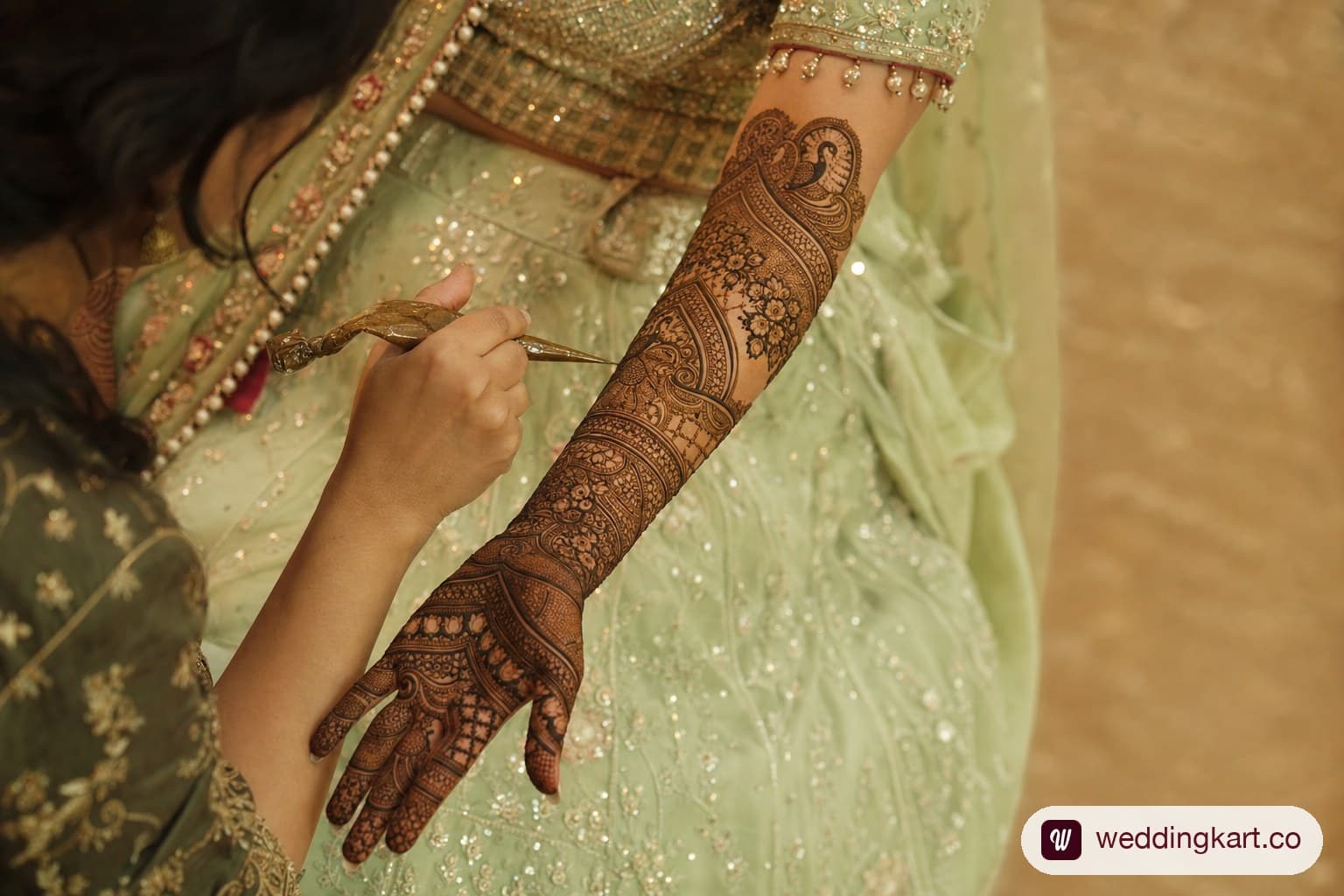
What to arrange: A professional Mehendi artist (book 3–4 months in advance for good artists; bridal sessions cost ₹5,000–₹25,000), comfortable seating (the bride will be seated for hours), a Bluetooth speaker with curated playlist or a small DJ setup, light food and chai.
Guest list: Female guests — family and friends. Close male family members may attend the early portion. The bride's female friends and cousins are the core attendees.
Dress code guidance: Casual to semi-formal. Greens, yellows, and pastels are traditional choices. Guests should avoid white sarees and black outfits.
Garba Night (Sanji / Sangeet)
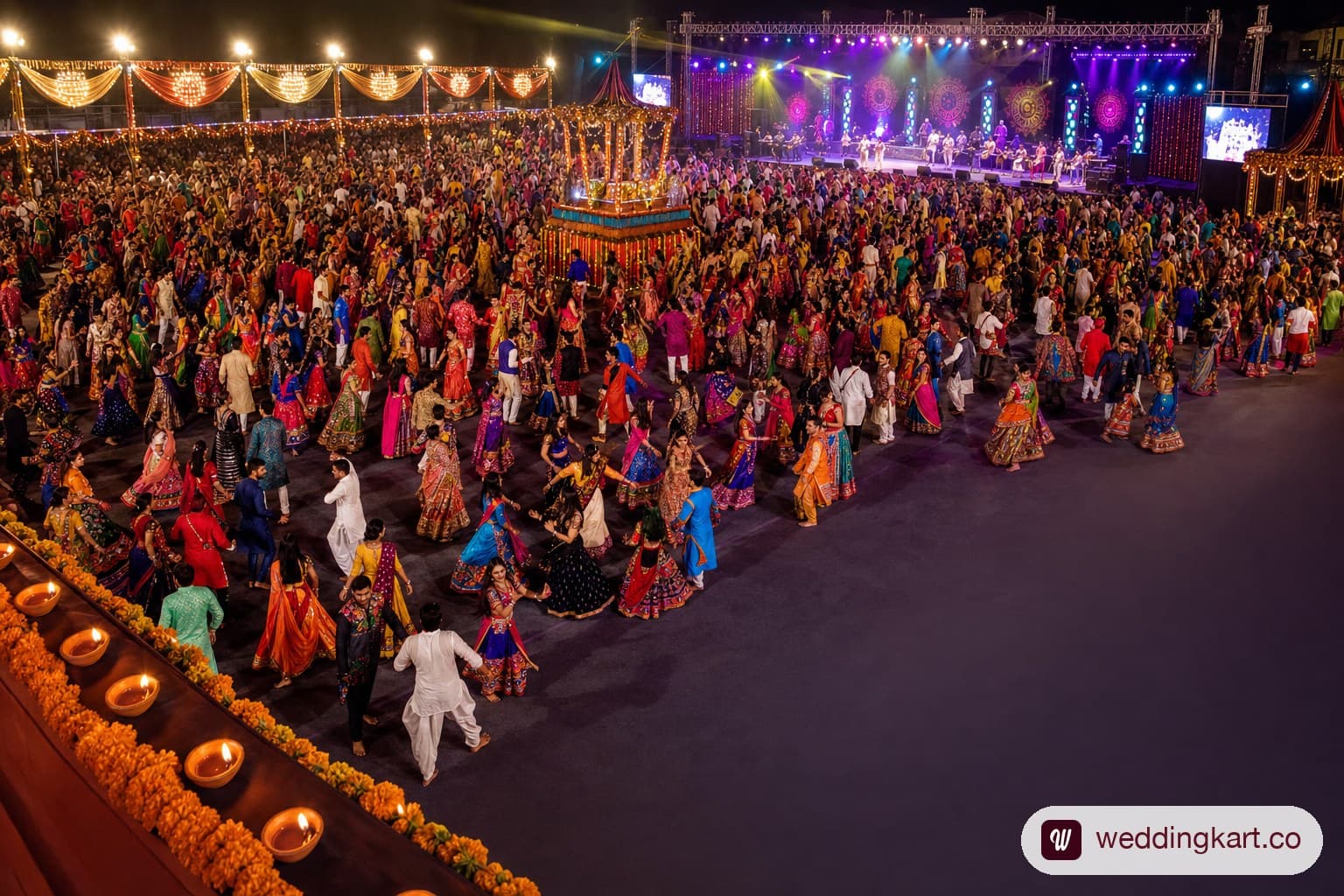
Garba Night is the most anticipated event of the entire Gujarati wedding week. It is the community celebration — open to all guests — and it is the event where Gujarati cultural identity is most vividly expressed.
Venue: Large open lawns and community halls are the traditional choice. The venue needs a sufficiently large open floor for concentric Garba circles — allow at least 5–6 sq ft per guest. For 500 dancers, you need 2,500–3,000 sq ft minimum of open floor space.
Music: The choice between a traditional live Garba orchestra (live singers, tabla, dhol, harmonium) and a modern DJ set significantly affects the atmosphere. Traditional orchestras create the authentic folk Garba feeling; DJs with amplified remix tracks create a more high-energy Bollywood party. Many families opt for a combination: traditional performance in the first half, DJ in the second.
Dress code: Chaniya choli for women, kediyu for men. The more traditional and embroidered, the better. Brief guests explicitly — some first-time attendees at Garba nights arrive in casual Western clothes.
Food: Garba Nights typically serve light snacks, chaats, and beverages rather than a full meal. Avoid heavy food that slows down dancing. Budget ₹300–₹600 per head for Garba food.
Timing: Garba typically starts at 7:30–8 PM and runs until midnight or later. Book venues that have late-night permission (noise ordinance compliance varies by area in Ahmedabad).
Pithi Ceremony
The Pithi is the turmeric ritual — held simultaneously at the bride's and groom's homes on the morning of the wedding. Family members apply a paste of turmeric, sandalwood, and rosewater to the couple's skin. It is intimate, joyful, and messy.
What to arrange: Home setting (no venue), a large tray of Pithi paste (typically prepared by the family), old clothing for the bride and groom (the turmeric stains everything), folk music (live or from a speaker), light refreshments.
Guest list: Close family and the couple's closest friends. 20–60 people. This is an intimate ritual, not a social event.
Photography note: Despite its intimacy, the Pithi is one of the most photogenic ceremonies in a Gujarati wedding. The golden turmeric, the joyful expressions, and the casual setting make for beautiful candid shots. Brief your photographer to be present.
Mandvo — The Main Wedding Ceremony
The Mandvo is the centrepiece of the entire wedding. Under the mandap (a ceremonially constructed canopy, traditionally of bamboo decorated with mango leaves, flowers, and cloth), the priest guides the couple through Vedic rituals that formalise their union.
Key rituals during the Mandvo include:
- Kanyadaan: The gift of the bride by her father — one of the most emotionally significant moments of the ceremony.
- Hasta Milap: The joining of hands — the groom's right hand is tied to the bride's right hand with a sacred thread.
- Saptapadi (Sat Fera): The seven vows — the couple walks seven circles around the sacred fire, each circle representing a specific vow and blessing.
- Mangalsutra: The groom ties the sacred thread around the bride's neck, completing the marriage.
Timing: The Mandvo ceremony is scheduled based on the muhurat (auspicious time determined by the priest). In Ahmedabad, main wedding ceremonies often start between 7 AM and 11 AM. The Mandvo can last 4–6 hours depending on the scope of rituals.
Mandap decoration: The mandap is the centrepiece of all wedding photography. Invest appropriately — fresh flowers (marigold, roses, lotus) or premium artificial setups both work well. Budget ₹1.5–₹8 lakh for mandap decoration depending on your overall budget.
Jaanmano & Baraat
The Jaanmano is the groom's processional arrival at the wedding venue — a procession that is part celebration, part spectacle.
In Ahmedabad: The standard Baraat includes the groom on a decorated horse (or in a luxury car for modern families), accompanied by dancing relatives, a brass band or DJ truck, and family members showering flower petals. The procession moves from the groom's gathering point to the wedding venue entrance.
What to arrange: Decorated horse or premium car, brass band or DJ truck, rose petal supply, family coordination for who walks where in the procession, civic permissions if the procession will involve road closures.
Logistics note: Baraat processions in Ahmedabad require coordination with local traffic authorities if they involve any road occupancy. Your event manager should handle this. Start the Baraat at least 30 minutes before the ceremony muhurat time to account for the procession pace.
Reception Dinner
The Reception is the final major event — a celebratory dinner that formally introduces the couple as a married pair. It is typically more formal than any preceding event and often held at a hotel or premium banquet hall.
What to arrange: Venue with stage and seating, catering for full dinner service (3–5 course), entertainment (DJ, live singer, or a performance), couple's entry choreography, photo booths, and professional photography for guest portraits.
Guest list: All wedding guests plus business contacts and acquaintances who were invited to the Reception only. This is typically the largest event in terms of guest diversity — mixing family, friends, and professional relationships.
Dress code: Festive formal — the most dressed-up event after the main wedding. Men in sherwanis or suits; women in sarees, lehengas, or formal gowns.
Guest Lists — Who Attends Which Function?
One of the most delicate decisions in Gujarati wedding planning is determining which guests attend which functions. Here is a practical allocation framework:
| Guest Category | Chandlo | Gol Dhana | Mehendi | Garba | Pithi | Mandvo | Reception |
|---|---|---|---|---|---|---|---|
| Immediate family (both) | ✓ | ✓ | ✓ | ✓ | ✓ | ✓ | ✓ |
| Extended family | — | ✓ | ✓ | ✓ | Selected | ✓ | ✓ |
| Close friends | — | Selected | ✓ | ✓ | — | ✓ | ✓ |
| College / workplace friends | — | — | Selected | ✓ | — | ✓ | ✓ |
| Business contacts / clients | — | — | — | Selected | — | Selected | ✓ |
| Outstation family | — | Selected | ✓ | ✓ | Selected | ✓ | ✓ |
This matrix should be treated as a starting point — every family's specific relationships and hierarchies will require adjustments. The critical rule: be explicit and consistent. If a business contact is not invited to the Mandvo, do not accidentally include them in your Mandvo invitation send.
Venue Logistics for Each Function
Different functions have fundamentally different venue requirements:
- Chandlo Matli & Pithi: Home settings. No venue needed. Ensure the space can comfortably accommodate 20–60 people with seating.
- Mehendi Night: Home or a small decorated venue. The key requirement is comfortable low seating (floor mattresses or cushion seating work best for long Mehendi sessions), good lighting for the artists, and easy parking access.
- Garba Night: Large open floor. Community halls, open lawns, and hotel banquet spaces with movable furniture all work. The floor must be smooth and non-slippery for dance safety. Acoustics matter enormously — a hall that echoes badly will ruin the musical experience.
- Mandvo: The main wedding hall needs adequate mandap space, seating for all guests, a separate area for the kitchen/catering setup, and good ventilation (the sacred fire generates heat and smoke).
- Reception: Hotel banquet halls or premium standalone venues. Requires a stage, a raised area for the couple's seating, full dining service, and a dance floor area.
The Multi-Function Communication Challenge
With six to eight events, different guest lists per event, and different invitations needed for each, the communication challenge in a Gujarati wedding is enormous. The most common mistakes:
- Sending all invitations at once (overwhelming guests and creating confusion about which events apply to them)
- Sending the same invitation to all guests regardless of which events they are attending
- No RSVP tracking per event (leading to inaccurate catering headcounts)
- Forgetting to send morning-of reminders for each event (guests arrive late or go to the wrong gate)
For the complete communication strategy and templates for each of these stages, see: Complete Wedding Communication Timeline: What to Send Guests & When.
How to Manage 7 Events Without Getting Overwhelmed
The answer is: start early, build a structured plan, and use tools that handle the operational complexity for you.
At the planning level: assign a coordinator to each major event. Your wedding planner handles the Mandvo; a trusted family member manages the Garba Night logistics; another family member owns the Mehendi coordination. Diffuse the responsibility.
At the communication level: use a platform that lets you manage per-event guest lists, send targeted WhatsApp invitations, and track RSVPs per event. Doing this manually across 500 guests and 7 events is practically impossible without errors.
💌 Managing 7 events with different guest lists and separate venues?
Weddingkart lets your event manager build per-function guest lists, send dedicated invitations, and collect RSVPs for each event independently.
See How Weddingkart Works →By Mayank JaiswalLast updated
Was this article helpful?
Share