
Last updated:
All PostsMulti-Event Wedding RSVP Tracking: Mehndi, Sangeet, Wedding & Reception in One Place
Send a standard 'Will you attend?' RSVP form to an Indian wedding guest list and you will get back a pile of answers to the wrong question. Your caterer does not need to know whether Priya's family is 'attending the wedding' in some general sense — they need to know that four of them are coming to the Mehndi for light snacks, all six are coming to the Sangeet for dinner, four are coming to the Wedding ceremony for a full meal, and all six are coming to the Reception. A single yes/no answer collapses four different planning numbers into one, and by the time anyone notices, the caterer has already been given the wrong headcount for three of the four events.
This is not a hypothetical edge case — it is the default shape of almost every Indian wedding with more than 200 guests, and it is precisely the gap that generic RSVP tools, wedding websites, and even most wedding planners' own spreadsheets fail to close.
Why a Single RSVP Form Fails for Indian Multi-Event Weddings
Western wedding planning tools are built around one ceremony and one reception — a single day, a single headcount, a single RSVP question. An Indian wedding routinely runs 3–5 separate functions across as many days, and critically, different guests attend different subsets of those functions. A colleague might come only to the Reception. A childhood friend might come to the Sangeet and Wedding but skip the Mehndi, which is traditionally smaller and more family-focused. Immediate family attends everything. Treating this entire structure as one RSVP question is the single biggest reason Indian wedding catering orders come in wrong.
The stakes are real: a caterer planning light snacks for a 50-person Mehndi, a seated dinner for 200 at the Sangeet, a full multi-course meal for 500 at the Wedding, and another spread for 600 at the Reception needs four separate, accurate numbers — not four guesses derived from one blended RSVP.
This is also why a generic wedding RSVP tool — built for a single Western-style ceremony and reception — cannot simply be repurposed for an Indian wedding by adding a few extra date fields. The entire data model of a single-event tool assumes one guest list, one attendance status, and one headcount. Bolting per-event tracking onto that after the fact tends to produce a clunky workaround rather than a system that was actually designed for the way Indian weddings work.
The Four Tiers of Indian Wedding Guests
Tier 1: All-Events Guests (Immediate Family)
Parents, siblings, grandparents, and the closest relatives on both sides. This tier attends every function, from the Mehndi through the Reception, and is usually the smallest but most logistically important group — they often also have specific roles (rituals, hosting duties) at each event.
Tier 2: Wedding + Reception Only (Extended Family)
Aunts, uncles, cousins, and close family friends typically attend the two largest events — the Wedding ceremony and the Reception — but may skip the smaller, more intimate Mehndi and Sangeet unless specifically invited to those as well.
Tier 3: Reception Only (Colleagues, Acquaintances)
Professional contacts, distant acquaintances, and broader social circles are frequently invited only to the Reception — the most public-facing, party-style event, and the one with the largest and most flexible guest capacity.
Tier 4: International NRI Guests (All Events If Possible, Else Main Day)
Overseas guests who have taken the time and expense to fly in are often invited to every event they can attend during their trip — but practically, many can only make the Wedding ceremony and Reception if their visit is short. Treat this tier as its own category precisely because their attendance pattern does not cleanly match either Tier 2 or Tier 3.
Assigning every guest to one of these four tiers before you send a single invitation does two things at once: it tells you exactly which events each guest should even be asked about (so a colleague never receives a confusing invite to your family's private Mehndi), and it gives you a rough early estimate of each event's headcount well before RSVPs start coming in — useful for early conversations with your venue and caterer about capacity.
What You Need to Track for Each Event
Beyond a simple yes/no, each event has its own planning variables that a good tracking system should capture alongside attendance — not as an afterthought, but as part of the same per-event record.
Mehndi Night
Typically the smallest event by headcount, informal, women- and family-focused, with light snacks rather than a full meal. Even a small headcount error here matters less financially than at larger events, but an accurate number still helps with seating and mehndi-artist planning — a mehndi artist booked for 50 hands needs a very different setup than one booked for 150.
Sangeet / Garba
A mid-sized, high-energy event with music, dance, and a full dinner service for most attendees — this is where an inaccurate headcount most directly translates into wasted or insufficient catering, since portions are typically generous and per-plate costs add up fast. This is also often the event with the widest gap between 'invited' and 'actually attends,' since some Tier 2 guests treat it as optional in a way they would never treat the Wedding ceremony itself.
Wedding Ceremony
Usually the largest formal event, with a full ceremonial meal and the most rigid seating and ritual logistics — this headcount also drives your mandap and hall capacity planning, not just catering. Because this event often has assigned or structured seating near the mandap for close family, an accurate Tier 1 and Tier 2 count matters even more here than the raw total.
Reception Dinner
Often the single largest headcount of all four events, since it is the most socially inclusive function — plan for your Reception number to genuinely be the ceiling your venue and caterer need to design around. This is also the event most likely to include last-minute plus-ones and colleague-of-a-colleague attendees, so build in a small buffer here specifically.
The Real Cost of Getting Per-Event Headcounts Wrong
It is worth being concrete about why this matters financially, not just logistically. Indian catering is typically priced per plate, per event. If your blended RSVP tells you '450 people are coming' without breaking that down per function, a caterer working off that single number has to guess how to distribute it across four very different meal types — and will almost always guess conservatively high across the board to avoid running short, which means you pay for portions that were never going to be eaten at your smaller events. Conversely, under-ordering for your largest event (usually the Reception) because the blended number felt 'roughly right' is the scenario that ends with guests visibly not getting a full plate — the single worst guest-experience failure at an Indian wedding, and one that is entirely preventable with accurate per-event data.
The same logic applies to seating, hotel shuttle scheduling, and even bar/beverage ordering for events that have one — every one of these vendor conversations gets easier and cheaper with a real per-event number instead of an estimate derived from a single blended RSVP.
How to Collect Per-Event RSVPs via WhatsApp
The most reliable format keeps the ask simple while still capturing per-event detail. A message structured like this works well:
"Hi [Name]! We'd love to have you celebrate with us. Please let us know which events you'll join: Reply 1 for Mehndi, 2 for Sangeet, 3 for Wedding, 4 for Reception — or just list the ones you'll attend (e.g. '2, 3, 4'). And how many in your party for each?"
This single message replaces what would otherwise be four separate RSVP requests, while still giving you the per-event granularity your vendors actually need. For guests you already know will attend everything (Tier 1) or only the Reception (Tier 3), you can simplify further and just confirm headcount rather than asking them to select events they were never going to be invited to.
See also: RSVP by WhatsApp: Why One-Tap Buttons Get 3x More Responses Than Forms
Build in a way for guests to update their answer, too — plans change, flights get delayed, and a guest who confirmed the Mehndi in month one may need to drop it in month three. A simple standing instruction ('reply anytime to update your RSVP') costs nothing to include and saves you from working off stale data later.
Tracking in a Spreadsheet: What It Looks Like
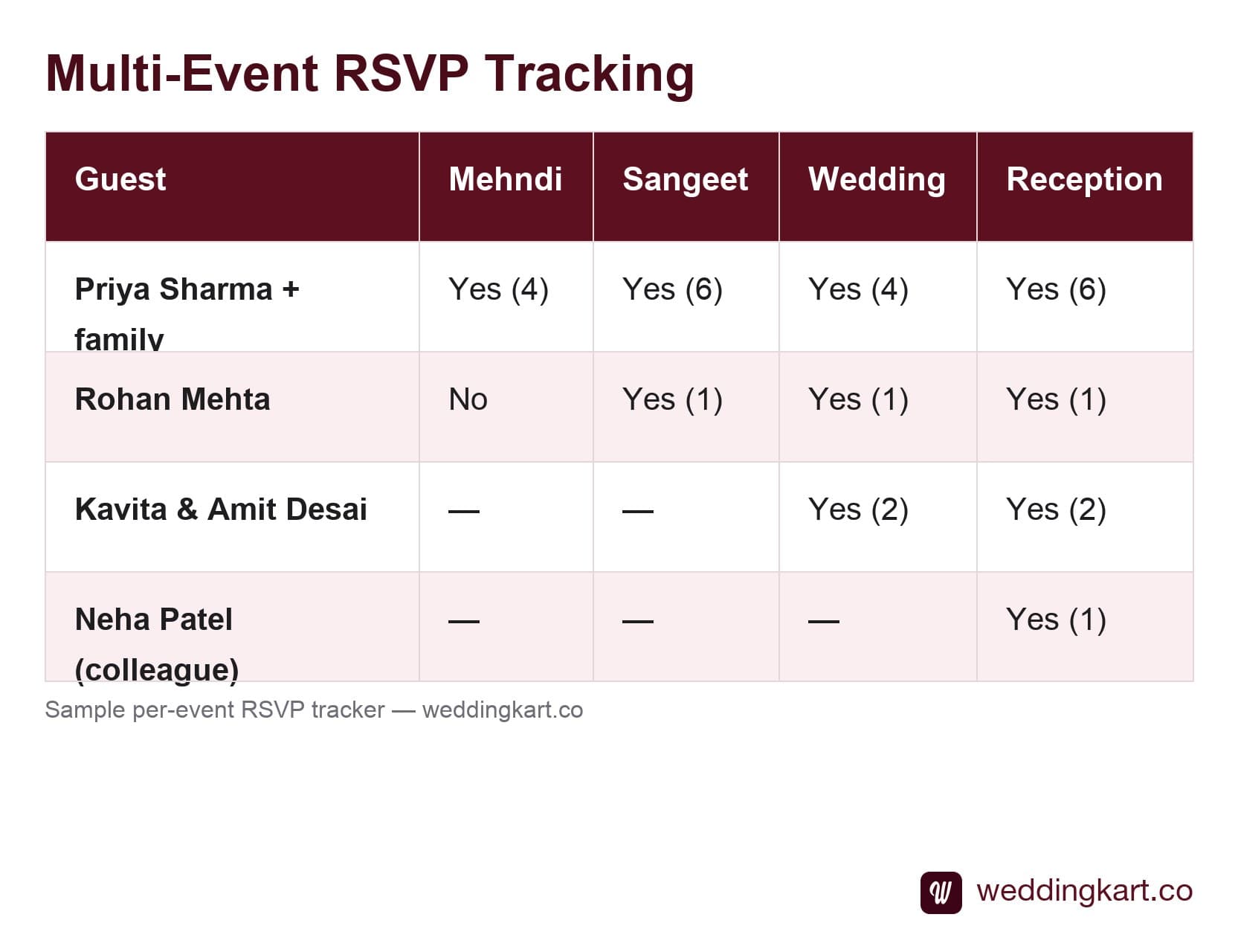
A workable manual version needs one row per guest and one column per event, not a single blended status column:
| Guest Name | Mehndi | Sangeet | Wedding | Reception |
|---|---|---|---|---|
| Priya Sharma + family | Yes (4) | Yes (6) | Yes (4) | Yes (6) |
| Rohan Mehta | No | Yes (1) | Yes (1) | Yes (1) |
| Kavita & Amit Desai | — | — | Yes (2) | Yes (2) |
| Neha Patel (colleague) | — | — | — | Yes (1) |
With this structure, a simple column total at the bottom of each event column gives you your caterer-ready headcount for that function, updated in real time as responses come in. Notice too how the dashes matter as much as the yeses — a colleague with no entry under Mehndi or Sangeet is not a missing response, it is correctly reflecting that they were never invited to those events in the first place, which is exactly the distinction a single blended RSVP column cannot make.
Why Spreadsheets Break at Scale
This structure works cleanly for 50 guests and starts to strain past 150–200. Four RSVP replies per guest, arriving across WhatsApp, email, and phone calls at different times over several weeks, all need to be manually entered into the correct cell by someone paying close attention. Miscounts creep in easily — a 'yes' recorded in the wrong column, a headcount update that never gets reflected, a guest who replies twice with conflicting numbers. By the time 400–600 guests are involved, this reconciliation work becomes close to a part-time job in the final month before the wedding, at exactly the point you have the least spare time to do it.
There is also a data-freshness problem unique to multi-event tracking: a guest who confirms all four events in week one might message again in week six to say they can no longer make the Mehndi due to a delayed flight. If that update does not immediately propagate to the Mehndi column — and in a manually maintained sheet, it frequently does not, because nobody remembers to go back and edit an old row — your headcount silently drifts out of date without anyone noticing until the caterer asks for final numbers.
How WeddingKart Manages Multi-Event RSVPs Automatically
This is the exact problem WeddingKart was built to solve, and it remains one of the few tools built specifically around it — most generic RSVP and wedding-website tools are still designed for a single-event Western wedding and simply do not have a native concept of 'four events, four different guest lists.' WeddingKart sends the per-event RSVP request over WhatsApp, captures the reply against the correct event automatically, and rolls every response up into a live, caterer-ready headcount for each function — Mehndi, Sangeet, Wedding, and Reception — updated the moment a guest replies, with no manual spreadsheet entry.
See also: Multi-Event Support · The Indian Wedding Guest List & RSVP Playbook
Reports are generated in the format your vendors actually use — a clean per-event headcount you can forward directly to your caterer or venue coordinator, rather than a raw export they have to interpret themselves. For couples juggling four events, a family POC, and a guest list across multiple countries, this is often the single planning task that benefits most from automation, precisely because it is repetitive, detail-sensitive, and directly tied to real money spent per plate.
💌 WeddingKart is the only guest management tool built specifically for Indian multi-event weddings. Collect RSVPs per event, track headcounts for Mehndi, Sangeet, Wedding, and Reception separately, and give your caterer real-time numbers — without a single manual spreadsheet update.
Start Free Trial →By Mayank JaiswalLast updated
Was this article helpful?
Share