
Quick Answer
How do you collect wedding RSVPs from guests across different time zones?
Send and set deadlines around each guest region's local morning, not India time — an 8pm IST message lands at 2:30am on the US East Coast and is buried by the time guests wake up. Use one-tap WhatsApp replies for India-based guests, email for corporate contacts, and phone calls for elderly relatives, and give overseas guests 10-12 weeks of notice versus 4 weeks for local guests.
Last updated:
13.5 hrs
Widest time zone spread across an NRI guest list
10-12 wks
Recommended RSVP notice for NRI/overseas guests
10-15%
Overseas guests who won't give a firm answer until the final weeks
2
Reminders is the ceiling before it reads as a broadcast
Last updated:
All PostsHow to Collect Wedding RSVPs From Guests in Different Time Zones: The NRI Guide
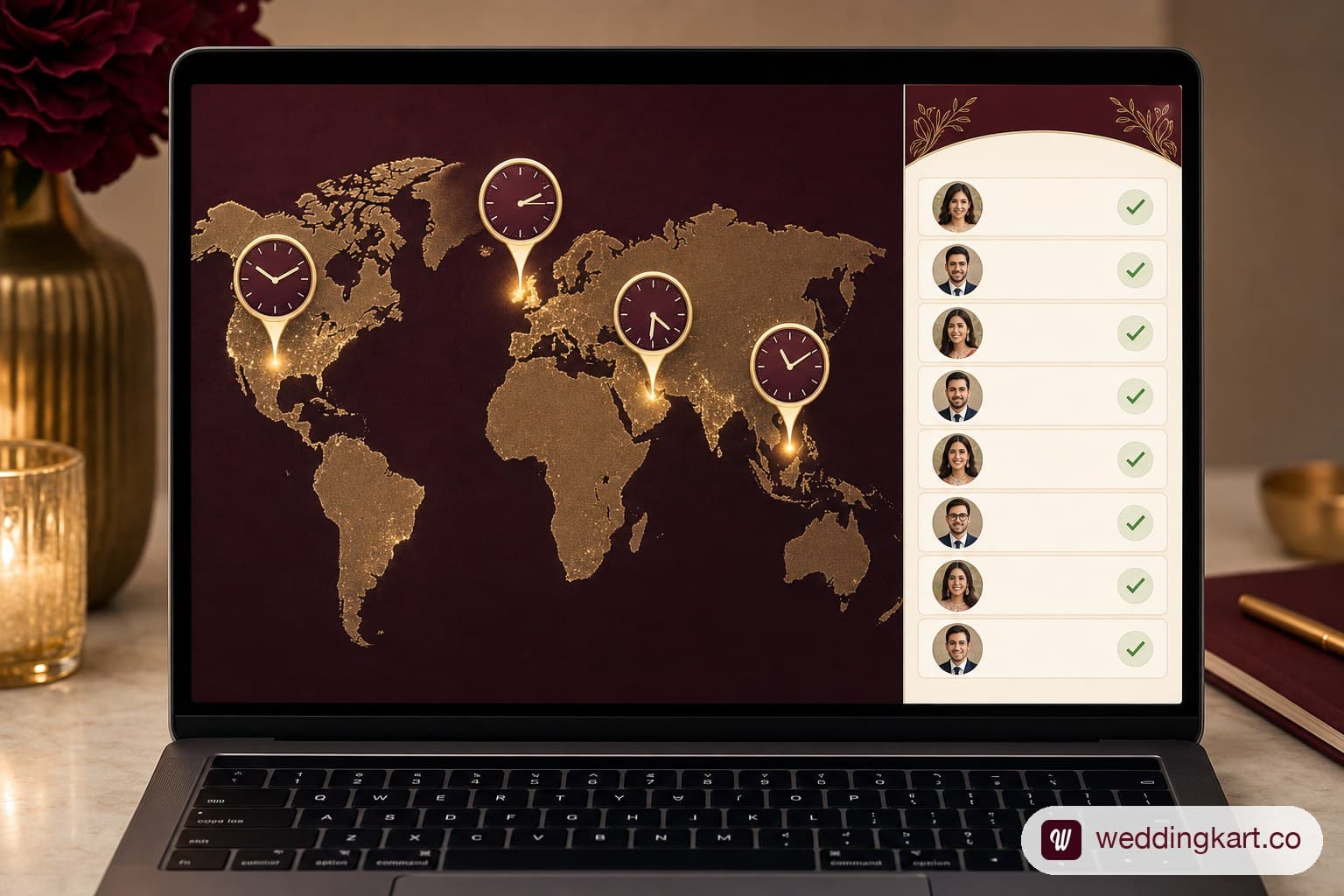
Set your RSVP deadline for 8pm IST and you have, without realising it, set it for 2:30am on the US East Coast, 11:30pm the previous night on the West Coast, and 6:30am in the UK the next morning. Your India-based guests will see the reminder in their evening scroll and reply within the hour. Your guests in Houston and London will be asleep, and by the time they wake up, the message has been buried under two days of other WhatsApp chats. This is the quiet way NRI weddings lose real RSVPs — not because guests do not want to come, but because the deadline landed while they were unconscious.
Why RSVP Collection Is Uniquely Hard for NRI Weddings
A single-city Indian wedding can get away with a WhatsApp message and a rough headcount a week later — everyone is in the same time zone, reachable on the same schedule, and culturally primed to reply on WhatsApp. An NRI wedding breaks every one of those assumptions at once. Your guest list spans up to a 13.5-hour spread, three or four different comfort levels with WhatsApp versus email versus a phone call, and — critically — a caterer back in India who needs a firm number per event weeks before you'll have full clarity on who is actually flying in.
Chasing 500 people for a response by messaging them individually from your personal number compounds the problem twice over: it is slow, and it is exactly the kind of bulk one-to-one messaging pattern that risks a spam flag on your own WhatsApp account.
See also: The Dangers of Using Personal Numbers for Bulk WhatsApp Messages in Indian Weddings
There is also a downstream cost to getting this wrong that couples underestimate: your caterer, decorator, and venue all need a firm per-event headcount weeks before the wedding, and every one of those numbers is built on top of your RSVP data. A caterer planning a Mehndi for 60 people and a Reception for 600 needs those two figures to be genuinely accurate, not a guess padded 'just in case' — padding costs real money per plate, and under-counting means guests without a seat. An RSVP process that quietly loses responses because of time zones does not just create an awkward guest experience; it distorts every vendor order placed against that number.
What Information to Collect in Your RSVP
Keep the actual ask simple — a long RSVP form gets abandoned halfway. Collect only what you genuinely need to plan:
- Attendance per event (not a single yes/no — Mehndi, Sangeet, Wedding, and Reception each need their own answer, since very few guests attend all four).
- Headcount in their party, including children.
- Dietary requirements (vegetarian, vegan, allergies) — ask this separately from the initial RSVP, not bundled into the first message.
- Travel arrival details for out-of-town and overseas guests, collected once flights are actually booked, not at the RSVP stage.
RSVP Collection Methods That Work Across Time Zones
WhatsApp — The Most Frictionless Method for Indian Guests
A one-tap reply — 'Yes / No / Maybe' inside the same message — removes every point of friction between receiving an invite and confirming attendance. No link to click, no form to load, no app to switch to. For your India-based family and friends, this is close to a guaranteed response method. A simple message structure works well here:
"Hi [Name]! Excited to have you at [Event Name] on [Date]. Can you confirm you'll be joining us? Reply 1 for Yes, 2 for No, 3 for Maybe. If yes, how many in your party (including you)?"
Keep the ask to one question per message where possible. A guest who has to answer attendance, headcount, and dietary preference in a single reply is more likely to answer only the first and skip the rest — which is exactly the incomplete data that causes headaches later.
Online RSVP Forms (Google Forms / Wedding Website)
A simple form works well for guests who are used to it — corporate contacts, non-Indian friends, and anyone who would rather fill out details at their own pace than reply in a chat. The trade-off is a real drop in response rate compared to an in-chat reply, since it asks the guest to leave WhatsApp entirely.
Email RSVP — For Corporate Contacts and Older Guests
Some overseas guests — particularly professional contacts of the couple's parents — genuinely prefer email, and a formal RSVP email reads as more appropriate for that relationship than a WhatsApp message. Keep this as a secondary channel for the segment that expects it, not your default.
Phone Calls — For Elderly Relatives Who Prefer Them
Grandparents and elderly relatives, in India or abroad, often will not respond to a text-based RSVP at all — not from reluctance, but because a written reply simply is not their habit. A short phone call from a family member remains the most reliable way to get a firm answer from this segment, and no automated tool should try to replace it.
Best Time to Send RSVP Requests for Each Time Zone
India Standard Time (IST) sits 5.5 hours ahead of the UK (4.5 hours during British Summer Time), 10.5 hours ahead of the US East Coast, 13.5 hours ahead of the US West Coast, and only 1.5 hours ahead of the UAE. Sending — and setting deadlines — around these gaps is the difference between a message a guest sees within the hour and one that is buried by the time they wake up.
Sending to the US (EST / PST)
To land in a US East Coast guest's morning (around 8–9am EST), send between 6:00–7:30pm IST. For the West Coast (8–9am PST), send between 8:30–10:00pm IST.
Sending to the UK (GMT / BST)
To land around 8–9am UK time, send between 1:30–3:00pm IST (adjust an hour earlier during BST, roughly late March to late October).
Sending to UAE / Gulf
With only a 1.5-hour gap, this is the easiest segment — send between 10:30am–1:00pm IST to reach guests during their late morning to early afternoon.
If your list also includes Australia (roughly 4.5 hours ahead of IST) or Canada (functionally the same time zones as the US), apply the same logic: work out your guest's local morning window, then count backwards to find the matching IST send time. The goal in every case is the same — land while the guest is awake and likely to be checking their phone, not at 3am buried under a night's worth of other notifications.
Email RSVP — For Corporate Contacts and Older Guests (continued)
If you do use email for this segment, keep the subject line specific ('RSVP: [Names] Wedding, [City], [Date]') rather than something generic that gets lost in a work inbox, and repeat the same core details you'd put in a WhatsApp message — event, date, time, venue, dress code, deadline. Do not assume a formal contact will follow a link to a wedding website with the same willingness as a close friend; the shorter and more self-contained the email, the higher the reply rate.
Setting a Realistic RSVP Deadline for International Guests
Give overseas guests at least 10 weeks' notice before your RSVP deadline — many NRI couples set it closer to 10–12 weeks out, since flight prices for Indian weddings climb fast once a guest waits too long to book. India-based guests can work with a much tighter window — 4 weeks is typically enough, since local travel decisions do not carry the same cost or lead-time pressure.
- NRI / overseas guests: set the deadline 10–12 weeks before the earliest event they are invited to.
- Outstation India guests: 6–8 weeks is usually sufficient.
- Local guests: 4 weeks is enough — they are not making a travel decision.
How to Send RSVP Reminders Without Annoying Guests
Two reminders is the ceiling. Send the first about two weeks after the initial invitation, and the second about a week before the deadline itself — both personalised with the guest's name rather than a generic blast ('Priyanka, we'd love to know if you can make it to the Sangeet!'). A personalised nudge reads as thoughtful; an identical mass message to 400 people at once reads as a broadcast, and is more likely to be ignored — or reported.
Handling Non-Responders and "Maybe" Replies
Even with well-timed reminders, expect 10–15% of overseas guests to never give you a firm answer until the final weeks — some genuinely are waiting on flight prices or leave approval from work, and chasing them harder rarely speeds that up. After your second reminder, set a hard cut-off: guests who have not responded by 5–7 days before your final headcount deadline to the caterer get moved to a 'no' for planning purposes, with a warm note that they are still welcome if their plans change. This protects your catering and seating numbers from being held hostage by a handful of undecided replies, without actually turning anyone away.
Tracking RSVPs in a Spreadsheet vs. a Dedicated Tool
A Google Sheet works for the first fifty responses. Past that, most couples hit the same wall: replies arrive across four channels — WhatsApp, a form, email, and a phone call from an aunt — and someone has to manually reconcile all four into one row per guest. Miss an update and you are recounting the guest list the week of the wedding, at the exact moment you have the least time to do it.
The other failure mode is subtler: a spreadsheet has no concept of time zones or send schedules. It can hold the data once someone has typed it in, but it cannot decide that a reminder should go out to your US guests at 6:30pm IST and your UAE guests at 11:00am IST on the same day. That scheduling logic either lives in your head — which does not scale past a hundred guests — or it lives in a tool built to handle it.
| Spreadsheet | Dedicated RSVP tool | |
|---|---|---|
| Setup effort | Low — but grows over time | Low — guest list upload, then automated |
| Multi-channel replies | Manual reconciliation | Consolidated automatically |
| Per-event tracking | Possible, but manual | Native |
| Reminders | Manual, easy to forget | Scheduled automatically |
| Real-time headcount for caterer | Requires manual export | Live, always current |
How WeddingKart Collects RSVPs Across Time Zones Automatically
WeddingKart sends RSVP requests via WhatsApp scheduled for the right local time for each guest — so your UAE relatives, your US cousins, and your India-based family each receive it during their own morning, not whatever hour happens to be convenient in India. Responses come back as one-tap replies, are tracked per event, and roll up into a live headcount you (and your caterer) can check at any time, with zero manual chasing.
Because every reply is logged the moment it comes in, there is no window where a response exists in someone's WhatsApp chat but not in your master guest sheet — the two are the same system. That single change is often what turns RSVP season from the most stressful few weeks of planning into a task that mostly runs itself in the background.
See also: RSVP by WhatsApp: Why One-Tap Buttons Get 3x More Responses Than Forms
💌 WeddingKart sends RSVP requests via WhatsApp at the right local time for each guest, collects responses automatically, and lets you track real-time headcounts per event — with zero manual chasing.
Try WeddingKart Free →By Mayank JaiswalLast updated
Was this article helpful?
Share