
Last updated:
All PostsIndian Wedding Timeline: A Day-by-Day Guide for NRI Guests
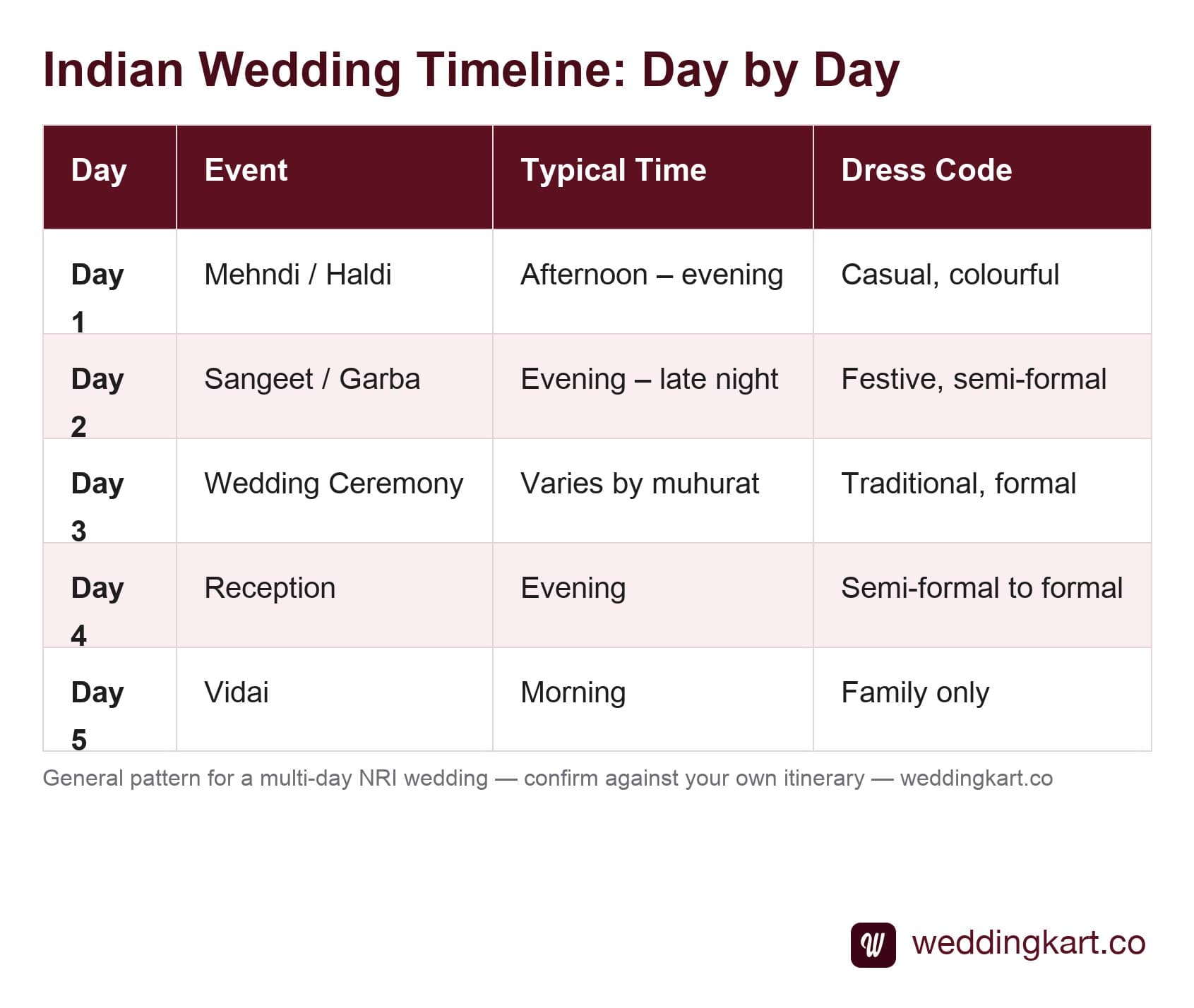
A friend from London gets an invitation to an Indian wedding for the first time and books three nights, assuming it is a single ceremony with a reception afterward — the way weddings work everywhere else they've been. They land to discover the wedding is actually four distinct events across five days, each with a different dress code, a different crowd, and a different start time that rarely matches what was printed on the invitation. This guide is the itinerary that invitation should have included: what actually happens, on which day, at what time, and which events matter most if your visit is short.
This confusion is common enough that it is worth stating plainly upfront: nobody expects you, as an overseas or first-time guest, to already know this structure. Indian families are generally delighted to explain it, and the couple's own wedding website or WhatsApp updates should ideally spell it out well before you travel. This guide exists so you can arrive already knowing the shape of the week, rather than piecing it together in real time between events.
How Long Does an Indian Wedding Last?
Most Indian weddings — particularly the larger, multi-family celebrations common among NRI couples — run 4 to 5 days from the first pre-wedding event to the final send-off. This surprises almost every first-time non-Indian or NRI guest, since a Western wedding is typically a single afternoon and evening. The extended format exists because an Indian wedding is not one ceremony but a sequence of distinct rituals and celebrations, each with its own cultural purpose, guest list, and mood — from an intimate, playful Mehndi night to a large, formal Reception that can include guests the couple has never personally met.
The exact number of events and their order varies meaningfully by region, religion, and family preference — a Gujarati wedding's Garba night looks different from a Punjabi Sangeet, and a South Indian wedding often places more emphasis on specific ceremony-day rituals over a separate pre-wedding music night. What stays consistent across almost all Indian weddings, and especially NRI weddings that tend to consolidate events for a compact overseas guest trip, is the basic four-function shape this guide walks through: a pre-wedding celebration, a music-and-dance night, the ceremony itself, and a reception.
The Standard Indian Wedding Timeline: 4–5 Days
Day 1 — Mehndi / Haldi Ceremony
The celebrations typically open with the Mehndi (henna application) and, often on the same day or the day before, the Haldi (a turmeric paste ceremony applied to the bride and groom, separately, for good luck and glowing skin). Both are informal, daytime-to-early-evening events, traditionally more intimate and family-focused than what follows. As a guest, this is the event where you're most likely to see close female relatives and friends sitting for hours while intricate henna patterns are applied, alongside music, dancing, and a generally relaxed, low-pressure atmosphere.
Day 2 — Sangeet / Garba Night
The Sangeet is the music-and-dance night — family and friends perform choreographed dances, DJs and live musicians keep the energy high, and it is generally the most purely fun, least ritual-bound event of the whole wedding. In Gujarati weddings specifically, this may take the form of a Garba or Raas night with traditional circular dancing that guests are actively encouraged to join, regardless of experience. Expect this to be the event where the two families' personalities show most clearly, through performances, speeches, and often good-natured competitive dance routines between the bride's and groom's sides.
Day 3 — Wedding Ceremony (The Main Event)
The wedding ceremony itself — the Hindu rites, or the equivalent ceremony for the couple's specific faith and community — is the ritual and spiritual heart of the whole event, typically running several hours and often scheduled around an astrologically auspicious time (muhurat) that can fall at an unusual hour, including early morning. This is the event with the most structure and the least flexibility in timing, since the couple's families may have chosen the date and hour specifically for astrological reasons that cannot simply be moved for guest convenience.
Day 4 — Reception Dinner
The Reception is the most broadly inclusive, semi-formal-to-formal evening event — a large dinner and party where the couple is formally presented as newlyweds to the widest circle of family, friends, and professional contacts, many of whom may not have attended the earlier, more intimate functions. If you can only attend one event as an outside acquaintance or professional contact, this is almost always the one you'll be invited to.
Day 5 — Vidai and Post-Wedding
The Vidai (the bride's formal, often emotional farewell from her family home) and any post-wedding rituals typically close out the celebrations. Most non-family guests do not attend this stage — it is usually reserved for immediate family, and is often the most emotionally significant moment of the entire event for the bride's side specifically.
What Actually Happens at Each Event
Beyond the broad strokes of timing and mood, each event also has its own food style, dress expectations, and general atmosphere worth knowing in advance — particularly for a guest deciding what to pack for a multi-day trip that swings from casual daytime events to a formal evening reception.
Mehndi: Timings, Activities, Food
Usually held in the afternoon or early evening, indoors or in a decorated outdoor setting. Expect henna artists working on the bride and close female family and friends, music, and a relaxed, colourful atmosphere. Food is typically a casual spread — chaat, snacks, and light bites rather than a formal seated meal.
Sangeet: Timings, Activities, Food, Dress Code
Typically an evening event, running late — choreographed family performances, open dance floors, and a full dinner service, often buffet-style. Dress code is festive and semi-formal: think vibrant colours, statement outfits, and comfortable footwear for dancing over strict formality.
Wedding Ceremony: Timings, Rituals, Food
Can run at almost any hour depending on the muhurat — some ceremonies begin in the early morning, others in the evening. Expect several hours of rituals (varmala, kanyadaan, the saptapadi/seven vows around the sacred fire, among others depending on community and region), often conducted partly in Sanskrit or a regional language, followed by a full traditional meal. Dress code is the most traditional and elegant of the four events.
See also: Hindu Wedding Rituals Explained, Ceremony by Ceremony
Reception: Timings, Activities, Food, Dress Code
An evening event, usually the most formal in dress code (though this varies by family — some receptions lean cocktail-party casual, others black-tie equivalent), with a stage for photographs, speeches, and a large seated or buffet dinner. This is typically the event with the largest and broadest guest list of the four.
See also: What to Wear to an Indian Wedding: A Guest's Guide
| Event | Typical time | Duration |
|---|---|---|
| Mehndi | Early afternoon – evening | 3–5 hours |
| Sangeet | Evening – late night | 4–6 hours |
| Wedding ceremony | Varies by muhurat (can be morning or evening) | 3–6 hours |
| Reception | Evening | 3–5 hours |
Treat every one of these as a guideline, not a guarantee — actual start times shift constantly around the couple's specific muhurat, venue availability, and family preference. If in doubt, always confirm against the specific itinerary the couple shares, rather than assuming these general patterns apply exactly to the wedding you're attending.
What to Expect as an NRI or International Guest
Indian Wedding Timing Culture (IST = Everything Runs Late)
The printed start time on an invitation and the actual start time of an event are, by long-standing informal convention, not the same thing. A card that says '7pm' often means the actual proceedings begin around 8:30–9pm, and dinner service may not start until well after that. This is not disorganisation — it is a widely understood cultural norm on both sides, and Indian guests typically plan their arrival accordingly. As a first-time or overseas guest, arriving exactly on the printed time is safe (you will not be first, but you also will not miss anything), while arriving early mostly just means extra waiting.
The one exception worth knowing: the wedding ceremony itself, when timed to a specific muhurat, genuinely does need to start at or near its stated time for the ritual portions that must occur within the auspicious window — even if the broader event around it (guest arrival, photos, the reception that follows) still runs on the more relaxed general schedule. If your invitation specifies a precise muhurat time for a particular ritual, treat that specific moment as fixed, even while treating the overall event start time more loosely.
Which Events Can You Miss If You Have Limited Time?
If your trip is short — common for NRI guests taking limited leave from work — the two non-negotiable events are the Wedding ceremony itself and the Reception, since these are the events where your absence would be most noticed and where the couple is most likely to specifically want you present. The Mehndi is the most skippable for guests outside the innermost family circle, since it is smaller and more private by design. The Sangeet is the most fun to attend if you can only add one extra day, but it is genuinely optional for guests who are not close family or friends.
- Only 1 day available: attend the Wedding ceremony.
- 2 days available: add the Reception.
- 3 days available: add the Sangeet.
- 4+ days available: you can experience the full event, including the Mehndi.
If you genuinely cannot decide, ask the couple directly rather than guessing — most couples would rather tell a guest exactly which event matters most to them than have that guest quietly skip the one they most wanted them at. This is especially worth asking if you are close family or a close friend, since the couple's own priorities may not match the general guidance above.
It is also worth building in a buffer day on either end of the trip if your schedule allows — Indian wedding timings shift more than Western guests expect, and a flight booked for the morning immediately after the Reception risks a genuinely stressful dash from a late-finishing event straight to the airport.
How to Share the Wedding Itinerary With Your Guests
Once your schedule is finalised, share it with every guest well before travel — ideally 4–6 weeks out for overseas guests, so they can plan flights, work leave, and packing around the actual day-by-day structure rather than guessing. The clearest format is a simple day-by-day breakdown: event name, date, start time, venue, and dress code, sent as a WhatsApp message or a linked one-page itinerary rather than buried inside a long invitation card. A simple template works well:
"Hi [Name]! Here's our full wedding schedule so you can plan your trip: Thu [date] — Mehndi, [time], [venue], casual/colourful. Fri [date] — Sangeet, [time], [venue], festive wear. Sat [date] — Wedding Ceremony, [time], [venue], traditional/formal. Sun [date] — Reception, [time], [venue], formal. Let us know if you have any questions!"
Sending this as one consolidated message, rather than four separate ones spread over weeks, gives guests — especially those booking flights around it — the full picture at once, which they can then refer back to as the actual dates approach.
🗓️ Make sharing the wedding itinerary easy — WeddingKart lets you send event-specific information, timings, and venue details to each guest segment via WhatsApp, automatically timed so they receive the right update at the right moment.
See How WeddingKart Works →See also: How NRIs Plan an Indian Wedding from Abroad: A Remote Checklist
For couples managing a guest list across several countries, this scheduling task is also where a lot of last-minute WhatsApp confusion originates — guests messaging individually to ask what time the Sangeet actually starts, or whether the Reception dress code is the same as the Wedding day. Sending the full schedule once, clearly, well ahead of travel dates removes most of that back-and-forth before it starts.
✈️ Whether you're the couple building the schedule or a guest trying to make sense of one, WeddingKart keeps every event, timing, and dress code detail in one place — shared with the right guests at the right time.
Try WeddingKart Free →By Mayank JaiswalLast updated
Was this article helpful?
Share