
Last updated:
All PostsNRI Wedding Budget: What an Indian Wedding From Abroad Really Costs
A couple in Austin sees a quote for a 500-guest, three-day wedding in Udaipur and does the mental math against a US wedding: $80,000 for 500 people sounds, on its face, like an extraordinary bargain compared to what the same headcount would cost at home. Then the actual invoices start arriving — international wire fees, a currency that moved against them by the time the final vendor payment was due, flights and hotel rooms for forty relatives they're personally hosting, and a handful of last-minute additions nobody had budgeted for. The wedding itself was never the expensive part. The 'from abroad' part is where an NRI wedding budget actually gets complicated.
Why NRI Weddings Cost More Than Local Indian Weddings
Rupee-for-rupee, an Indian wedding is genuinely inexpensive relative to a comparable Western wedding — a fact NRI couples often quote to their overseas friends. A $80,000 wedding in the US might comfortably seat 120 guests for one evening; the same budget converted to India, at a mid-2026 rate of roughly ₹96 to the dollar, is close to ₹77 lakhs — enough for a genuinely large, multi-day, 400–600 guest celebration across four separate events. On a pure cost-per-guest-per-event basis, India remains one of the most value-dense places in the world to host a large wedding.
But that comparison only holds for the base wedding cost: venue, catering, decor, and vendors priced in INR. Layer an NRI dimension on top and several categories of cost appear that a locally-planned Indian wedding simply does not carry: accommodation for dozens of overseas guests the couple feels obligated to house, subsidised or fully-covered flights for close family who could not otherwise attend, pre-wedding scouting trips home, currency conversion losses on every payment sent from abroad, and international wire fees that add up across dozens of vendor transactions over a year of planning. None of these show up in a typical India-market wedding cost article, because they simply don't apply to a couple who already lives in the same city as their wedding.
Total Budget Ranges for NRI Weddings in India
Exchange rates move constantly, so treat the USD figures below as directional rather than exact — at the time of writing (mid-2026), 1 USD is trading at roughly ₹96–97, 1 GBP at roughly ₹129, and 1 AED at roughly ₹26. All conversions below use approximately ₹96 to the dollar; recalculate against the live rate when you actually book.
Budget Tier: ₹20–40 Lakhs (~$21,000–$42,000)
A well-run wedding at this tier typically means a mid-size Tier 2 city or a straightforward Tier 1 city venue, a guest list under 300, and a leaner 2–3 event structure (often combining Mehndi and Sangeet, or skipping a separate Reception). This tier rewards careful vendor negotiation and a realistic, not-too-ambitious guest list far more than any other.
Mid-Range Tier: ₹40–80 Lakhs (~$42,000–$83,000)
The most common range for a 400–600 guest, three-to-four-event NRI wedding in a Tier 1 city (Mumbai, Delhi NCR, Jaipur, Ahmedabad, Bengaluru, Hyderabad). This tier typically includes a professional decorator, a full photography and videography team, live entertainment, and a dedicated hotel room block for overseas guests.
Premium Tier: ₹80 Lakhs – ₹2 Crore+ (~$83,000–$208,000+)
Heritage palace venues, destination cities like Udaipur or Jaipur at peak season, celebrity vendors, multi-day guest hospitality programs, and larger guest counts (600+) push into this range. Couples at this tier are often effectively running a small hospitality operation for their overseas guests — welcome dinners, sightseeing add-ons, and multiple hotel properties — on top of the core wedding budget.
Where a couple lands within these ranges usually comes down to three decisions made early: the city (a heritage Rajasthan venue costs meaningfully more than a Tier 1 city hotel banquet hall of similar capacity), the guest count (each additional 50 guests adds a real, compounding cost across every per-head category), and the number of distinct events (three events is materially cheaper than five, since almost every vendor category — catering, decor, entertainment — scales with event count as much as guest count).
Budget Breakdown by Category
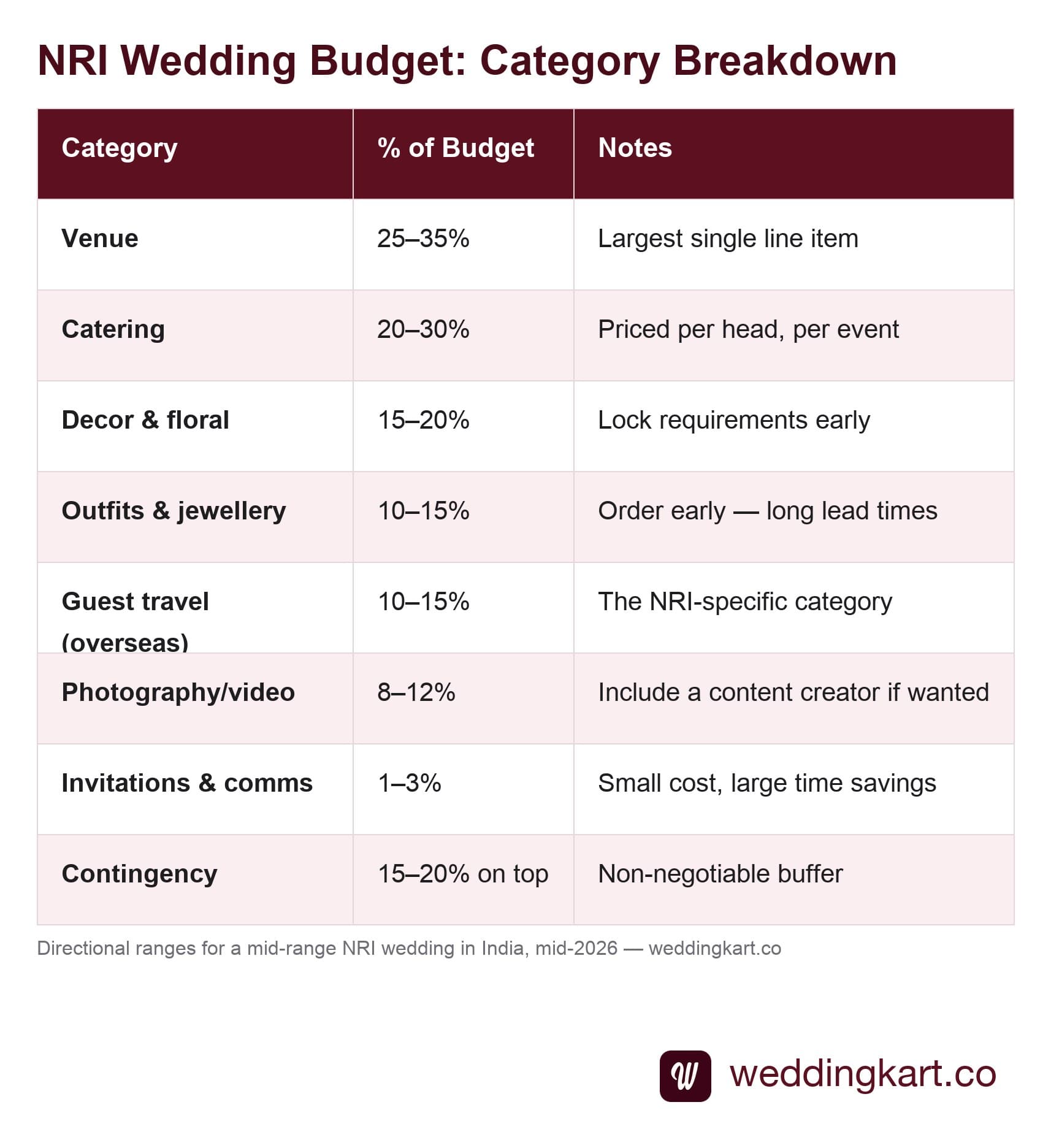
As a starting allocation for a mid-range NRI wedding, most planners work from roughly these proportions — adjust based on your own priorities, since every couple over-indexes somewhere. A useful way to sense-check your own allocation is a rough cost-per-guest, per-event figure, since Indian wedding pricing is overwhelmingly per-head rather than a flat package price:
| Event | Typical cost per guest (catering + basic decor) |
|---|---|
| Mehndi | ₹800–1,500 (~$8–16) |
| Sangeet | ₹1,500–3,000 (~$16–31) |
| Wedding ceremony | ₹2,000–4,500 (~$21–47) |
| Reception | ₹1,800–4,000 (~$19–42) |
Multiply your expected per-event headcount against these ranges and you get a fast sanity check against any vendor quote — a useful exercise before signing a catering contract, and another reason accurate per-event RSVP numbers matter well before you finalise vendor budgets.
Venue: 25–35% of Budget
Almost always the single largest line item, and the one with the widest price range by city and property type — a hotel banquet hall, a heritage property, and a farmhouse venue can differ by several multiples for a similar guest capacity.
Catering: 20–30%
Priced per head, per meal — and with 3–5 events each carrying their own meal service, this adds up faster for an Indian wedding than for a single-day Western one. See our companion guide on multi-event RSVP tracking for why accurate per-event headcounts directly control this cost.
See also: Multi-Event Wedding RSVP Tracking: Mehndi, Sangeet, Wedding & Reception in One Place
Decor and Floral: 15–20%
Mandap design, floral installations, and lighting across every event — this is also one of the categories where costs escalate fastest if requirements aren't locked in early with the decorator.
Photography and Videography: 8–12%
A full team covering all events, including a lead photographer, a second shooter, and a videographer, plus editing and delivery — increasingly, a dedicated reels/social content creator as well.
Outfits and Jewellery: 10–15%
Bridal and groom outfits across multiple events, plus family outfits — remember that delivery lead times for made-to-order Indian outfits can run months, which matters more for overseas couples than local ones.
Guest Travel & Accommodation (Overseas Guests): 10–15%
This is the category with no equivalent in a purely local wedding, and the one NRI couples most often underestimate at the planning stage — covered in more detail below.
Invitations and Communication: 1–3%
The smallest line item by percentage, but disproportionately time-consuming if handled manually — guest communication and RSVP management is one of the most affordable parts of the entire budget relative to the hours it saves managing 500+ guests across multiple countries.
💌 Guest communication and RSVP management is one of the smallest line items in your wedding budget — and one of the biggest time savers. WeddingKart's cost against the hours saved managing 500+ guests manually makes it an easy addition to your invitations and communication budget.
See How WeddingKart Works →The Hidden NRI Wedding Costs Most Couples Don't Budget For
Currency Exchange Losses
Every payment converted from USD, GBP, or AED into INR carries a spread against the interbank rate — and across a year of vendor deposits and final payments, that spread compounds. A currency that moves 3–5% against you between your first venue deposit and your final catering payment can, on a mid-range budget, represent a real five- or six-figure-rupee swing that most couples never explicitly plan for.
Bank Wire Fees to India
Traditional international bank wires typically charge a flat fee per transaction plus an unfavourable exchange margin, and with a wedding requiring dozens of separate vendor payments over a year, these fees accumulate. Dedicated remittance services generally offer meaningfully better rates than a standard bank wire for sending money to India, which is why many NRI couples set up an account with one specifically for wedding payments rather than using their everyday bank.
Guest Travel Subsidies for Close Family
Many NRI couples partially or fully cover flights and accommodation for parents, grandparents, or siblings who could not otherwise attend — a generous and common gesture, but one that is easy to underestimate until multiple international flights for close family are added up against the base wedding budget.
Last-Minute Additions and Vendor Overruns
Extra floral requests, an additional welcome dinner added once overseas guests are confirmed, a vendor's final invoice that runs higher than the initial quote — build a genuine buffer into your budget from day one rather than treating overruns as an exception. A 15–20% contingency on top of your planned budget is a realistic minimum for an NRI wedding specifically, given the extra moving parts.
A concrete illustration of how quickly these hidden costs stack up: a couple with a ₹60 lakh core wedding budget who host 15 close family members (covering roughly $1,200 in flights and 4 nights of hotel each), lose an average 3% to currency spread across the year's vendor payments, and pay standard bank wire fees on eight separate transfers, can easily add ₹8–12 lakhs on top of their 'wedding' budget — 15–20% extra that was never in the original venue-and-catering quote they were comparing to a US wedding.
Currency and Remittance: How to Send Money to India for Your Wedding
Most NRI couples send wedding funds into an NRE (Non-Resident External) or NRO (Non-Resident Ordinary) account in India, either their own or a trusted family member's, and pay vendors from there in INR. A few practical points worth knowing:
- Dedicated remittance services vs. bank wire: services like Wise generally offer rates closer to the interbank mid-market rate than a traditional bank wire, and are worth setting up (with verification completed) well before your first large vendor payment is due.
- A common point of confusion — the Liberalised Remittance Scheme (LRS): LRS governs how much a resident Indian can send abroad each financial year; it does not apply to an NRI sending money into India. If you are an NRI transferring your own funds to India for your wedding, LRS limits are not the relevant constraint — normal international transfer and your receiving bank's standard KYC checks are.
- Large transfers may prompt routine documentation requests: banks in India are required to verify the source and purpose of large inbound transfers as standard anti-money-laundering practice — keep simple records (a note that funds are for wedding expenses, your relationship to the account holder) so you can respond quickly if asked, rather than treating this as an unusual red flag.
- Plan transfers around vendor payment schedules, not the other way around — most vendor contracts specify a deposit and milestone payment structure, and timing your currency conversion to match (rather than converting everything at once, or scrambling at the last minute) reduces both fees and exchange-rate risk.
This is general information, not financial or legal advice — for a wedding budget of any real size, it is worth a short conversation with your bank or a financial advisor familiar with NRI remittances before you commit to a specific transfer plan.
Beyond the mechanics of the transfer itself, timing matters more than most couples initially assume. Vendor contracts in India typically follow a milestone structure — a booking deposit, a mid-way payment, and a final balance closer to the event — and each of those is a separate currency conversion decision. Converting a large lump sum a year out exposes you to a full year of currency movement risk on money you don't need yet; converting piecemeal, matched to each milestone as it comes due, is the more common approach among NRI couples who have been through this before, since it spreads the currency risk across the year rather than betting it all on a single day's rate.
See also: How NRIs Plan an Indian Wedding from Abroad: A Remote Checklist
Five Practical Ways to Control an NRI Wedding Budget
- Fix your guest count before you fix your venue, not after — a venue chosen for a headcount that later grows by 100 guests is the single most common source of mid-planning budget blowouts.
- Negotiate a milestone payment schedule with every major vendor (deposit, mid-way, final balance) rather than a large upfront lump sum — this also gives you natural checkpoints to reassess your budget as the wedding date approaches.
- Get three quotes for every major category, even if a family referral feels like the obvious choice — Indian wedding vendor pricing varies widely and is rarely fixed, especially for NRI clients who vendors may (fairly or not) assume have a larger budget.
- Separate "must-have" from "nice-to-have" early, as a family, before vendor conversations begin — it is far easier to agree on priorities in a calm planning conversation than to renegotiate them under pressure once a vendor has already quoted a number.
- Track actuals against your budget monthly, not just at the start and end of planning — catching a category running 20% over in month four is a minor correction; catching it in month eleven is a crisis.
NRI Wedding Budget Template (Downloadable)
A workable NRI wedding budget tracker needs, at minimum, a running total in both INR and your home currency, a percentage-of-total column per category so you can see at a glance if any one area is running over your planned allocation, and a separate contingency line rather than folding your buffer invisibly into other categories. Update it after every vendor payment, not just at the planning stage — a budget tracker that was accurate in month two and never touched again is not doing its job by month ten.
| Category | % of budget | Notes |
|---|---|---|
| Venue | 25–35% | Largest single line item |
| Catering | 20–30% | Priced per head, per event |
| Decor & floral | 15–20% | Lock requirements early |
| Photography/video | 8–12% | Include a content creator if wanted |
| Outfits & jewellery | 10–15% | Order early — long lead times |
| Guest travel (overseas) | 10–15% | The NRI-specific category |
| Invitations & comms | 1–3% | Small cost, large time savings |
| Contingency | 15–20% on top | Non-negotiable buffer |
📊 Use the WeddingKart Wedding Budget Calculator to estimate your Indian wedding cost by city, guest count, and event structure — and get a starting allocation across every category above.
Try the Wedding Budget Calculator →None of these numbers will match your wedding exactly — city, season, guest count, and personal taste all move the final figure meaningfully in either direction. What should transfer directly, regardless of your specific budget, is the underlying structure: know your category percentages before you start negotiating with vendors, budget explicitly for the NRI-specific costs a local wedding never carries, build in a real contingency rather than an aspirational one, and treat currency and remittance planning as its own task rather than an afterthought handled the week a payment is due.
By Mayank JaiswalLast updated
Was this article helpful?
Share