
Quick Answer
What is WhatsApp Coexistence?
Coexistence lets one phone number run on the WhatsApp Business app and the Cloud API at the same time. Before Meta shipped it in May 2025, connecting a number to the API meant deleting the Business app account on it - you lost the app, and the owner lost the ability to just pick up their phone and reply. With Coexistence the app keeps working, chat history is preserved, and both surfaces see the same conversations. The main constraints: it works only with the WhatsApp Business app and not consumer WhatsApp, one number per Business app account, and someone must open the app at least once every 13 days to keep it active.
Last updated:
WhatsApp Coexistence, Explained
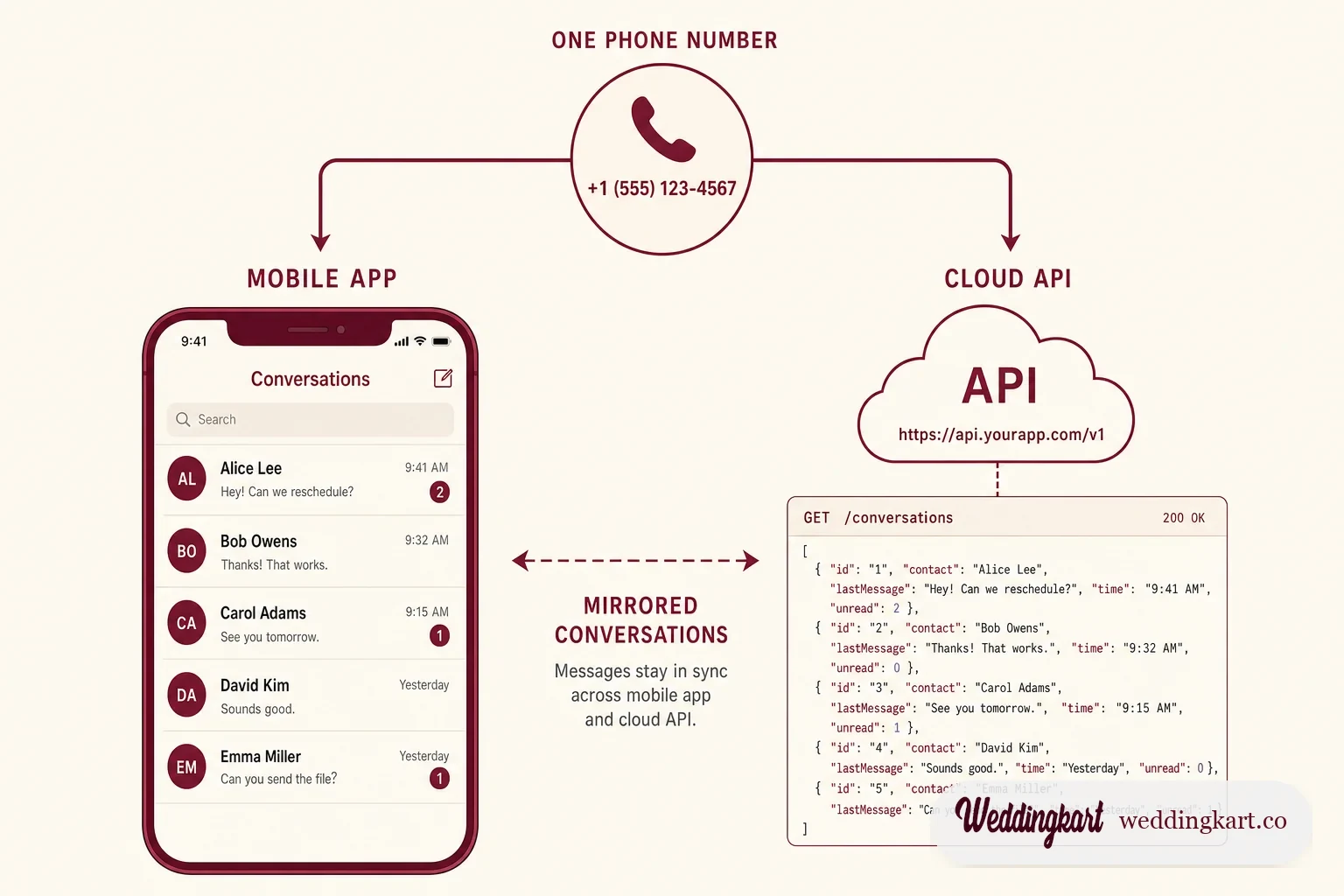
For years the most common reason a small business refused to connect its number to the WhatsApp API had nothing to do with technology. It was that the number was on their shopfront, their van, their wedding brochure - and connecting it meant deleting the WhatsApp Business app account on it. The owner would lose the inbox they actually used, along with every conversation in it.
That was a genuinely bad trade, and most people correctly refused it. Coexistence, which Meta shipped in May 2025, is the fix.
What it actually does
Coexistence lets a single number be live on the WhatsApp Business app and the Cloud API simultaneously. Your colleague replies by hand from their phone; your software sends templates and handles automation through the API; both see the same conversations.
Chat history is preserved rather than discarded, which is the part that makes it adoptable. Nobody has to explain to a customer why the business has forgotten a conversation from last week.
In practice this collapses a decision that used to be genuinely painful. The old question was “do we automate, or do we keep the human inbox?” That question no longer has to be answered.
The conditions
Coexistence is a real feature with real edges, and it is better to learn them now than during onboarding.
| Constraint | What it means for you |
|---|---|
| Business app only | Consumer WhatsApp is not supported. If the number currently runs on the personal green app, it has to move to the Business app first. |
| Open the app every 13 days | The account goes inactive otherwise. If nobody on your team will reliably open it, use standard Cloud API instead - this is a real operational commitment, not a formality. |
| One number per Business app account | You cannot fan several Coexistence numbers out of a single app account. |
| No disappearing messages | Once onboarded, disappearing messages stop being available for one-to-one chats on that number. |
| Normal messaging limits apply | Coexistence does not grant extra headroom. The number keeps whatever quality rating and daily cap it has earned. |
The 13-day rule deserves more attention than it usually gets. It is a small requirement that fails in a very annoying way: everything works for weeks, someone leaves or changes phones, nobody opens the app, and the number quietly goes inactive. If you are deploying Coexistence across many customers, that is a support ticket generator. Put a reminder somewhere a human will see it.
Two surfaces, two billing behaviours
A subtlety worth internalising: what a message costs depends on which surface sent it.
Messages your team types by hand in the WhatsApp Business app are free, exactly as they have always been. Messages sent through the API are billed at standard Cloud API per-message rates. The same conversation thread can therefore contain both free and billed messages.
This matters more from 1 October 2026, when in-window replies through the API stop being free. From that date, the cheapest way to answer a customer inside the 24-hour window is literally for a human to reply from the app. Whether that is a sensible way to run a business is a separate question, but the economics are worth knowing - see the pricing guide.
A wiring detail that will save you a bad afternoon
If you are integrating Coexistence yourself rather than through a provider, one hard-won note about webhook subscriptions.
Coexistence introduces additional webhook fields - things like history sync and app state - and it is tempting to enable everything by posting a fresh subscription for the business account. Do not. Subscribe field by field, toggling only the specific ones you need.
A wholesale re-subscribe can reset the fields already active on that account, and because webhooks fail silently, the symptom is not an error. It is inbound messages simply not arriving anymore, discovered whenever someone notices the replies stopped. We cover the general shape of this failure mode in how WhatsApp webhooks actually work.
When Coexistence is the wrong answer
It is not automatically the better option, and it is worth being clear about when to skip it.
Skip it if the number will be driven almost entirely by software. The 13-day requirement is pure operational overhead if nobody meaningfully uses the app, and standard Cloud API onboarding is simpler with fewer moving parts.
Skip it if you need several numbers under one identity, since the one-number-per-app-account limit will constrain you.
Reach for it when the number has a human relationship attached - a business whose customers already message that number, a team that answers by phone, an owner who wants to keep replying personally while automation handles the volume. That is exactly the case it was built for, and it is a common one.
Why this changes the onboarding conversation
The strongest argument for connecting your own number was always brand continuity: messages should come from the number your customers already know, not an unfamiliar one. The strongest argument against was that you had to give up the app to do it.
Coexistence removes the second argument without weakening the first, which makes bringing your own number the default choice for far more businesses than before. We wrote up that decision in full, including when a shared sending number is still the better option, in the guide to using your own number.
Tools referenced in this post
Try Weddingkart for your wedding
Guest lists, WhatsApp invites, RSVPs, countdowns and more - the AI layer for Indian weddings.
Related reading
Frequently Asked Questions
Can I use WhatsApp Business app and the API on the same number?
Yes, since Meta introduced Coexistence in May 2025. Before that, registering a number on the Cloud API required deleting the WhatsApp Business app account on it, which is why so many businesses put off connecting the number printed on their signage. With Coexistence the app keeps working, chat history carries over, and messages are visible in both places.
Do I lose my chat history when enabling Coexistence?
No - preserving it is much of the point. Existing conversations remain in the Business app and recent history syncs across, so your team does not lose context on customers mid-conversation. This is the main difference from the old migration path, where connecting a number meant starting from an empty inbox.
What are the limitations of WhatsApp Coexistence?
Four worth planning around. It works only with the WhatsApp Business app, not consumer WhatsApp. Each Business app account can have only one number under Coexistence. Someone must open the app at least once every 13 days or the account becomes inactive. And disappearing messages stop being available for one-to-one chats once the number is onboarded.
Does Coexistence cost extra?
No. Coexistence itself is free and there is no separate charge for enabling it. Messages your team sends by hand from the WhatsApp Business app are free, exactly as they were before. Messages sent through the API are billed at standard Cloud API per-message rates. So the same conversation can contain free and billed messages depending on which surface answered.
Does a Coexistence number have the same messaging limits?
Yes. A number on Coexistence follows the standard Cloud API messaging limits, which scale with quality rating and history in the usual way. Coexistence changes how you access the number, not how Meta rates it - a number with a poor quality rating carries that rating into Coexistence with it.
Was this article helpful?
Share
By Weddingkart TeamLast updated